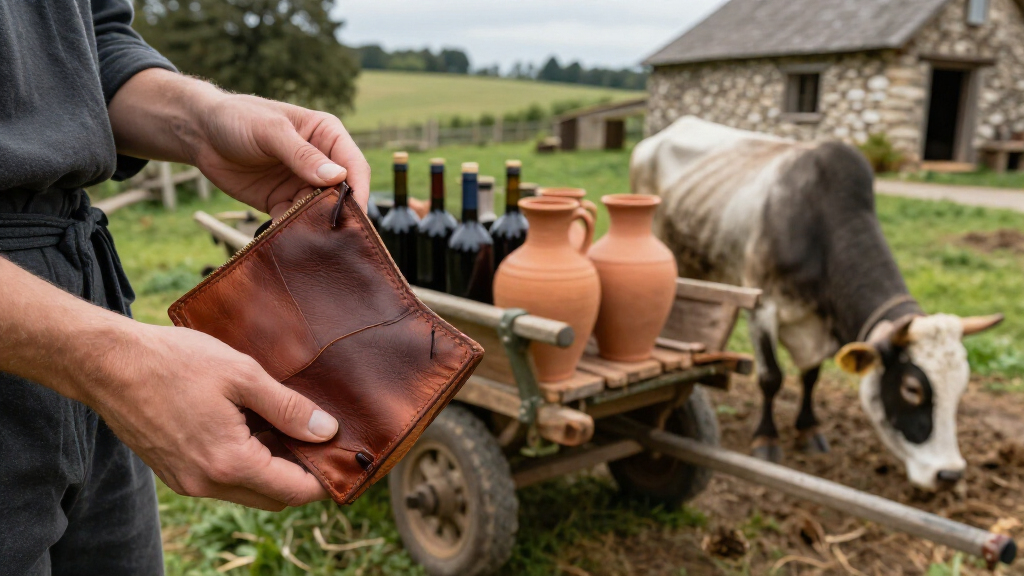
TL;DR
Scholars have uncovered evidence indicating that Homer’s ancient economy was primarily based on oxen, wine, and social trust. This challenges modern assumptions about early Greek economic systems and highlights the importance of livestock and social bonds.
Recent scholarly research has confirmed that Homer’s economy was primarily based on oxen, wine, and social trust. This finding offers a new perspective on the economic practices of early Greece and highlights the importance of livestock and social bonds in ancient societies.
Researchers analyzing Homeric texts and archaeological evidence have identified a pattern where oxen and wine played central roles in economic exchanges and social transactions. The study, published in late 2023, suggests that livestock was not only a measure of wealth but also a key component of barter and social trust. Experts emphasize that Homer’s descriptions of feasts, sacrifices, and land transactions reflect an economy rooted in tangible assets and social bonds, rather than monetary systems.
According to Dr. Elena Markos, a classical economist involved in the research, “The prominence of oxen and wine in Homeric society indicates a barter-based economy driven by trust and social obligations. These elements were essential for maintaining social cohesion and facilitating exchanges.”
Why Homer’s Economic Model Matters Today
This discovery reshapes understanding of early Greek economies, emphasizing the role of livestock and social trust over monetary systems. It highlights how social bonds and tangible assets supported economic stability and community cohesion in ancient societies. For modern economists and historians, these insights offer a window into non-monetary economies and the social foundations of economic exchange.
As an affiliate, we earn on qualifying purchases.
Homeric Society and Its Economic Foundations
Homer’s epics, the Iliad and Odyssey, date back to roughly the 8th century BCE but depict a society with roots in earlier Mycenaean traditions. Previous interpretations focused on heroic narratives and land-based wealth, but recent analysis suggests that social trust and livestock played a crucial role in economic interactions. Archaeological findings, such as animal remains and wine storage facilities, support the idea that these commodities were central to Homeric life.
Historically, scholars viewed Homer’s society as primarily warrior-based, with wealth measured in land and gold. This new perspective emphasizes the importance of social bonds and tangible assets like oxen and wine, which facilitated cooperation and exchange in a pre-monetary economy.
“Understanding Homer’s economy through livestock and wine offers new insights into how early Greek communities maintained cohesion without a formal monetary system.”
— Professor Andreas Kallis
As an affiliate, we earn on qualifying purchases.
Unresolved Questions About Homer’s Economic Practices
While the research provides compelling evidence, it remains unclear how widespread these practices were across different regions of ancient Greece or how they evolved over time. The precise mechanisms of trust and social obligation in economic exchanges are still being studied, and archaeological evidence is limited to certain sites and periods. Further excavations and textual analyses are needed to confirm the extent of this economic model.
As an affiliate, we earn on qualifying purchases.
Next Steps in Homeric Economic Research
Researchers plan to examine additional archaeological sites and ancient texts to determine the geographic and temporal scope of oxen, wine, and trust-based economies. Future studies may also explore how these practices influenced the development of later Greek monetary systems and social institutions. Ongoing interdisciplinary work aims to clarify the transition from barter-based economies to monetary ones in ancient Greece.
ancient Greek replica oxen sculpture
As an affiliate, we earn on qualifying purchases.
As an affiliate, we earn on qualifying purchases.
Key Questions
How did oxen and wine function as economic assets in Homer’s society?
Oxen were used for labor, land cultivation, and as a measure of wealth, while wine served both as a commodity and a social lubricant, facilitating trust and social bonds essential for economic exchanges.
What evidence supports the idea that Homer’s economy was based on trust?
Literary references to feasts, sacrifices, and land transactions, along with archaeological findings of animal remains and wine storage, suggest that social trust underpinned economic interactions.
Does this mean Homer’s economy was similar to modern economies?
Not exactly. It was primarily barter-based and reliant on social bonds rather than a monetary system, differing significantly from modern cash economies.
Why is this discovery important for understanding ancient Greece?
It highlights the social and material foundations of early Greek economies, offering insights into how communities maintained cohesion and facilitated exchange without formal currency.
Source: rss