📊 Full opportunity report: Managing Consent Requirements For Kid-Facing Vendors on IdeaNavigator AI — validation score, market gap, and execution plan.

Get smart everyday buys delivered free — and shop member deals
- Fast, free delivery on millions of items
- Access to Prime Big Deal Days deals on October 6–7
- Prime Video, Amazon Music and more included
TL;DR
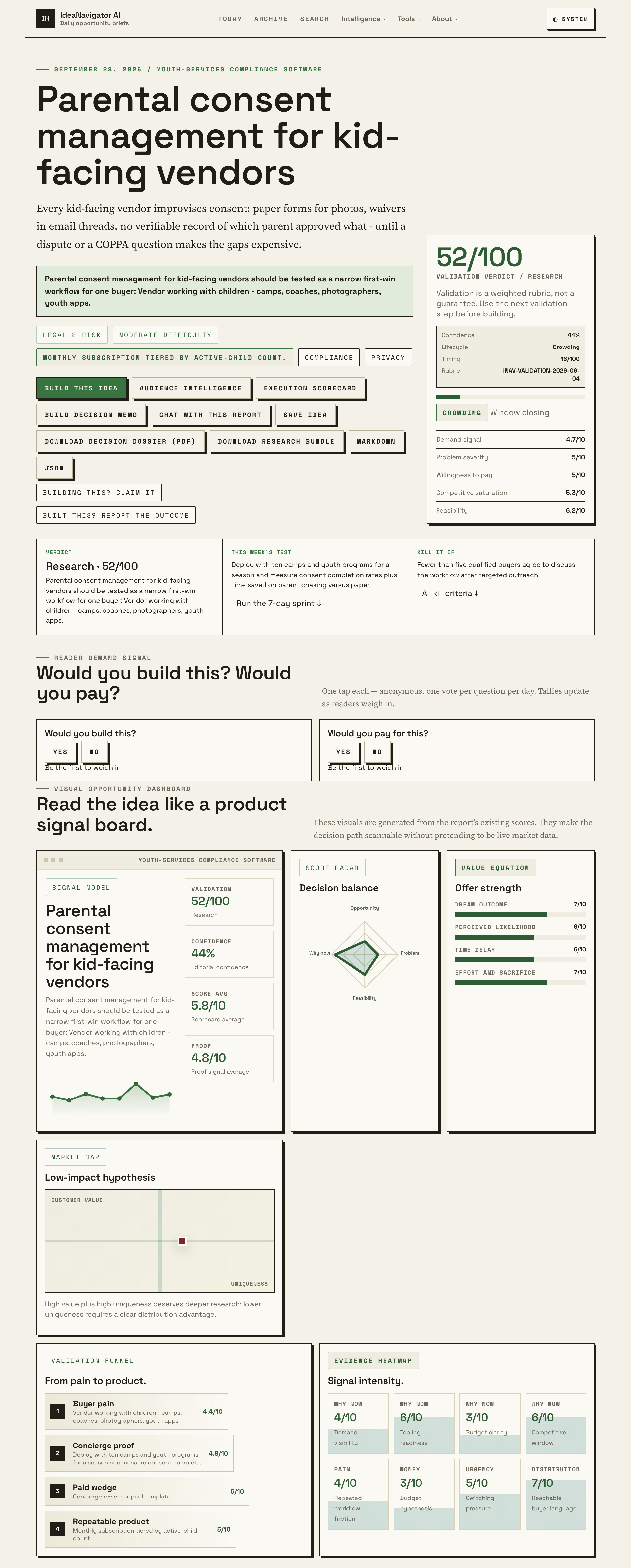
IdeaNavigator AI describes a proposed consent-management service for camps, coaches, photographers and youth apps. The concept would let parents complete vendor-branded forms on phones and give vendors per-child records, expiry tracking and audit exports. No product launch, pilot results or customer commitments are reported.
IdeaNavigator AI’s proposal outlines a phone-based parental-consent service for camps and other vendors working with children, and suggests testing it with ten camps and youth programs over a season. The idea brief says the service would help organizations record permission for uses such as photographs and data collection. It does not identify an operating product, pilot results or participating customers.
According to IdeaNavigator AI’s idea brief, vendors would be able to create branded consent flows for parents to complete on their phones. The suggested form types include permission for photo use and data collection, as well as medical and liability forms. The brief proposes identity checks calibrated to the risk of each consent request, but does not specify a verification method.
The brief also proposes per-child consent ledgers for vendors, with expiry tracking and an option to export an audit record. IdeaNavigator AI says the aim is to replace scattered paper forms and email exchanges with records showing which parent approved which request. The proposal does not explain how identity would be checked, how long records would be retained, or what safeguards would govern access and deletion.
IdeaNavigator AI suggests a monthly subscription tiered by active-child count and a seasonal test with ten camps and youth programs. The proposed measures are consent completion rates and time spent following up with parents compared with paper-based processes. The brief gives no pricing or measurement results and does not report that a trial has taken place.
A Recordkeeping Problem for Youth Vendors
IdeaNavigator AI’s brief frames the concept around an administrative problem: organizations that work with children may need to collect different permissions from parents, while some rely on paper forms or email threads. When records are spread across formats, the brief argues, vendors may have difficulty finding an approval or establishing what it covered. A searchable, child-specific record could make routine checks easier if the proposed service works as described; the brief does not provide independent evidence of the problem’s prevalence.
The proposal notes that permission for one use may not cover another. For example, a parent might approve a photograph for a program newsletter while declining broader online use. Its proposed forms and ledgers are intended to make approvals specific and traceable. Whether they could do so reliably would depend on product details, including how forms are written, changed and linked to a verified parent. The brief does not describe those details.
IdeaNavigator AI proposes measuring completion rates and staff follow-up time in a seasonal pilot, but reports no results. Those measures could help assess whether the service reduces administrative work enough to justify a subscription without making the process harder for parents. The brief provides no evidence yet on vendor demand, willingness to pay or measured time savings.
From Paper Forms to a Pilot
IdeaNavigator AI identifies camps, coaches, photographers and youth apps as potential users. The brief says these organizations may collect permissions for different activities, but does not document how many currently use informal processes or how often missing records lead to disputes. Its description of improvised consent and the costs of gaps is a problem statement, not a reported survey finding.
The brief cites changes in children’s privacy rules, including COPPA updates and state laws, as reasons vendors may pay closer attention to consent records. It also says parents increasingly challenge photo and data use. IdeaNavigator AI does not identify particular laws, enforcement actions, dates or examples of disputes, so the brief does not establish how those developments affect any specific vendor. Requirements can depend on the organization, information collected and activity involved.
IdeaNavigator AI describes a ten-program seasonal test as the proposed next step. The brief names no company behind an established service and reports no launch announcement, funding, customer list or adoption figures. It also does not say that any camps have agreed to participate.
Product and Legal Details Remain Open
IdeaNavigator AI’s brief reports no product launch or pilot outcome. It does not say whether development has begun, whether vendors or parents have tested the proposed flows, or whether ten programs are available to take part. It provides no evidence on completion rates, reduced follow-up time, customer demand or willingness to pay.
The proposed identity checks, record exports and expiry reminders also need more detail before their practical value can be judged. The brief does not say what information vendors would store, how parents could correct or withdraw consent, who could access records, or how long records would remain available. It identifies no security measures and does not explain how the service would handle a request to delete a child’s information.
The proposal cites privacy rules as part of its rationale but offers no legal analysis. It does not identify which vendors or activities the service would cover or how it would account for differing obligations. The brief does not establish that using a consent ledger would meet any particular legal requirement.
Pilot Measures Will Test Demand
IdeaNavigator AI proposes running the service with ten camps and youth programs for one season. Its suggested measures are consent completion rates and staff time spent following up with parents, compared with paper processes. The brief gives no dates, recruitment process, baseline method or success threshold, so it announces neither a schedule nor a standard for judging the trial.
The proposal leaves open whether vendors will sign up, which consent types a first version would include, and how parent identity checks and record handling would work. Results on staff time and completion could show whether the workflow addresses the problem described in the brief; feedback from parents and vendors could clarify whether it is workable. Until further details or trial results are reported, the platform remains a proposed product concept.
Source: IdeaNavigator AI’s proposal for a parental-consent platform.
Key Questions
Has a parental-consent platform launched?
No launch is reported. IdeaNavigator AI’s proposal provides no product release date or evidence that the service is operating.
Who is the proposed service for?
IdeaNavigator AI names camps, coaches, photographers and youth apps as potential users: vendors and programs that work with children and collect parental permissions.
What would the service do?
As described in IdeaNavigator AI’s proposal, it would offer phone-based consent forms, per-child records, expiry tracking and audit exports. The brief also suggests identity checks matched to the risk of each consent request.
What would the pilot measure?
IdeaNavigator AI proposes a seasonal test with ten camps and youth programs to compare consent completion rates and staff time spent following up with paper-based processes. The brief reports no trial results or participating programs.
Source: IdeaNavigator AI
Fall Picks
fall essentials
As an affiliate, we earn on qualifying purchases.