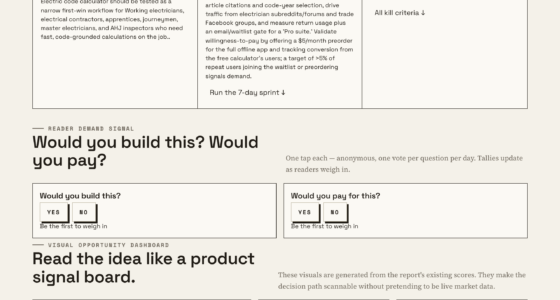
📊 Full opportunity report: How Residential Proptech Supports Backyard Home Projects on IdeaNavigator AI — validation score, market gap, and execution plan.

Get smart everyday buys delivered free — and shop member deals
- Fast, free delivery on millions of items
- Access to Prime Big Deal Days deals on October 6–7
- Prime Video, Amazon Music and more included
TL;DR
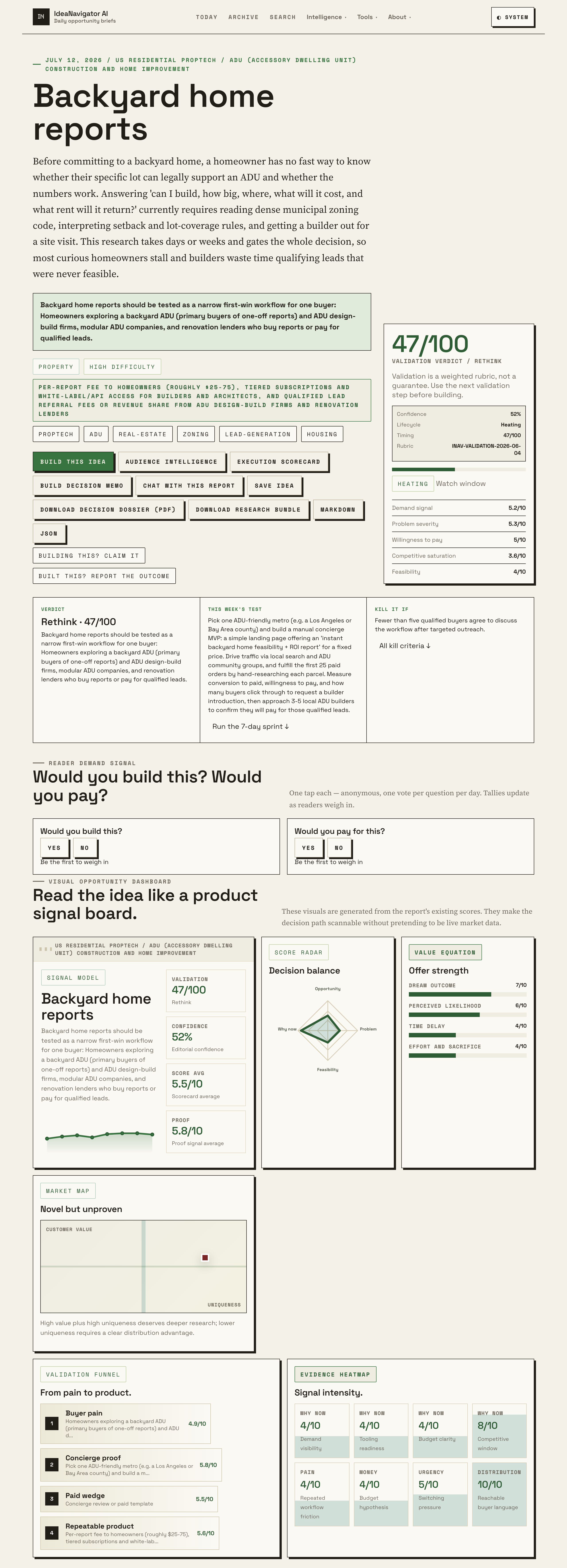
A new analysis from IdeaNavigator AI proposes instant, per-address backyard home feasibility reports as a targeted residential proptech opportunity. The analysis cites surging ADU permitting in California and maturing parcel data as reasons the model is now practical.
A new market analysis from IdeaNavigator AI lays out a plan for residential proptech companies to sell instant backyard home feasibility reports — per-address PDF documents that tell homeowners whether their lot can legally support an accessory dwelling unit (ADU), how big it can be, roughly what it will cost, and what rent it might return. The analysis argues that this narrow workflow is a practical first product for proptech entrants because it solves a specific, expensive problem: homeowners today spend days or weeks interpreting municipal zoning code before they can even decide whether a backyard home is worth pursuing.
The analysis identifies two customer groups. The first is homeowners exploring a backyard ADU, who would pay a one-off fee — roughly $25 to $75 per report according to the analysis — for a homeowner-ready assessment of their parcel. The second is businesses that serve those homeowners: ADU design-build firms, modular ADU companies, and renovation lenders, which could buy reports in bulk, subscribe to tiered access, or pay referral fees for qualified leads.
The proposed product works by ingesting county parcel data — lot boundaries, lot size, and existing building footprint — and testing the lot against state ADU law plus a curated set of local zoning rules. For one launch market, such as a handful of California counties, the report would cover allowed ADU types, maximum size, setback and lot-coverage constraints, a buildable-area estimate, a realistic construction cost band, and projected rental income based on local rent comparables. The analysis recommends starting with a single metro area and hand-curating the zoning rules rather than attempting nationwide coverage at launch.
The revenue model has three prongs: per-report fees from homeowners, subscriptions and white-label or API access for builders and architects, and lead-referral fees or revenue share from ADU firms and lenders. A ‘connect me with a vetted ADU builder’ button inside each report would capture the lead-generation revenue, converting report buyers into introductions for contracting firms.
Why Feasibility Bottlenecks Matter for Housing
The analysis frames the feasibility question — can I build, how big, where, at what cost, and for what return? — as the gate that stalls most backyard home projects before they begin. Under the current process, a homeowner must read dense municipal zoning code, interpret setback and lot-coverage rules, and schedule a builder site visit just to learn whether their lot qualifies. The analysis states that most curious homeowners stall at this stage, while builders waste time qualifying leads that were never buildable in the first place.
The stakes extend beyond individual projects. According to figures cited in the analysis, Los Angeles County alone permitted over 45,000 ADUs in 2023, and ADUs now account for roughly one in five new housing units produced in California. If even a fraction of stalled homeowners could get a fast, reliable answer on feasibility, the analysis implies, more backyard units could reach the permitting pipeline in a state facing a US housing shortage estimated in the millions of units. For proptech companies, the model offers a low-cost entry point with recurring revenue potential through subscriptions and lead fees rather than a single transaction.
State Law Changes Behind the ADU Boom
California legalized ADUs statewide starting in 2016 and has loosened the rules nearly every year since, according to the analysis. Other states and cities are following with their own ADU-friendly legislation. That regulatory shift is what created the market opportunity: rules changed fast enough that homeowners and even many builders struggle to keep current on what a specific lot allows.
Two technical developments make instant reports newly practical, the analysis argues: mature parcel and zoning datasets from county recorders, and LLM-based code parsing that can process zoning text that previously required a professional to read by hand. The combination allows a per-address answer that was not economically feasible to produce at scale a few years ago.
Unproven Assumptions in the Analysis
The analysis is a proposal, not a record of a launched product or measured results. No company named in the report has validated the model, and the $25–75 price point is an assumption about homeowner willingness to pay rather than a tested figure. Whether homeowners will trust an automated report over a professional assessment for a decision of this size is unaddressed.
Several operational risks are also left open. Zoning rules vary by jurisdiction and change frequently, and the analysis does not estimate the cost of maintaining curated rule sets as codes are amended. Liability for an incorrect feasibility conclusion — for example, a report that misses a lot-coverage restriction — is not discussed. The accuracy of LLM-based code parsing against ambiguous municipal text, and the quality of rental income projections in less liquid markets, remain unverified. The 45,000 ADU permits and one-in-five figures are cited within the analysis without primary sourcing, and the recommended validation steps — hand-fulfilling 25 paid orders in a single metro and confirming that 3–5 builders will pay for leads — have not been carried out.
The Recommended Validation Path
The analysis sets out a concrete validation sequence for any operator acting on the idea. First, pick one ADU-friendly metro — it suggests a Los Angeles or Bay Area county — and build a manual concierge MVP: a simple landing page offering an ‘instant backyard home feasibility + ROI report’ at a fixed price. Second, drive traffic through local search and ADU community groups, and fulfill the first 25 paid orders by hand-researching each parcel. Third, measure conversion to payment, willingness to pay, and how many buyers click through to request a builder introduction. Finally, approach three to five local ADU builders to confirm they will pay for those qualified leads before investing in automated rule sets or multi-market expansion. Those results would determine whether the proposed model survives contact with actual customers.
Source: IdeaNavigator AI
Key Questions
What is a backyard home feasibility report?
According to the IdeaNavigator AI analysis, it is a per-address document that tells a homeowner whether their lot can legally support an ADU, the maximum allowed size, setback and lot-coverage constraints, a buildable-area estimate, an estimated construction cost band, and projected rental income based on local rent comparables.
How much would a report cost?
The analysis proposes roughly $25 to $75 for a one-off homeowner report. This is a suggested price point, not a market-tested figure, and no company has yet validated it at scale.
Why is California the suggested launch market?
California legalized ADUs statewide in 2016 and has loosened rules nearly every year since, producing heavy permitting activity — the analysis cites over 45,000 ADUs permitted in Los Angeles County in 2023 — which creates concentrated demand for fast feasibility answers.
How would a company behind these reports make money beyond report fees?
The analysis identifies three revenue streams: per-report fees from homeowners, tiered subscriptions plus white-label and API access for builders and architects, and referral fees or revenue share when report buyers click a button to be connected with a vetted ADU builder or renovation lender.
Has this product been proven to work?
No. The analysis is a proposal with an untested validation plan — hand-fulfilling 25 paid reports in one metro and confirming that a handful of builders will pay for leads. Key questions including homeowner trust, report accuracy, and maintenance of zoning rule sets remain unresolved.
Source: IdeaNavigator AI
Fall Picks
fall essentials
As an affiliate, we earn on qualifying purchases.