
TL;DR

Get smart everyday buys delivered free with Prime
- Fast, free delivery on millions of items
- Prime Video, Amazon Music and more included
- Member-only deals all year
Building an AI workstation used to be cheaper, but in 2026, prebuilts often match or beat DIY prices thanks to component shortages. Your choice depends on whether you want control and customization or speed and support.
Imagine this: you need a powerful AI workstation, but the classic debate hits you — build it yourself or buy prebuilt? The answer used to be simple: DIY was cheaper, and prebuilts saved time. But today, the landscape has shifted dramatically. The AI boom, component shortages, and price spikes mean the old rule no longer applies. Now, you have to weigh control against convenience, cost against speed, and long-term flexibility against quick deployment.
In this article, you’ll learn how the market has evolved, what factors matter most for your workload, and how to decide whether building or buying makes more sense for you. Whether you’re a hobbyist, researcher, or enterprise, this decision shapes your entire AI journey.
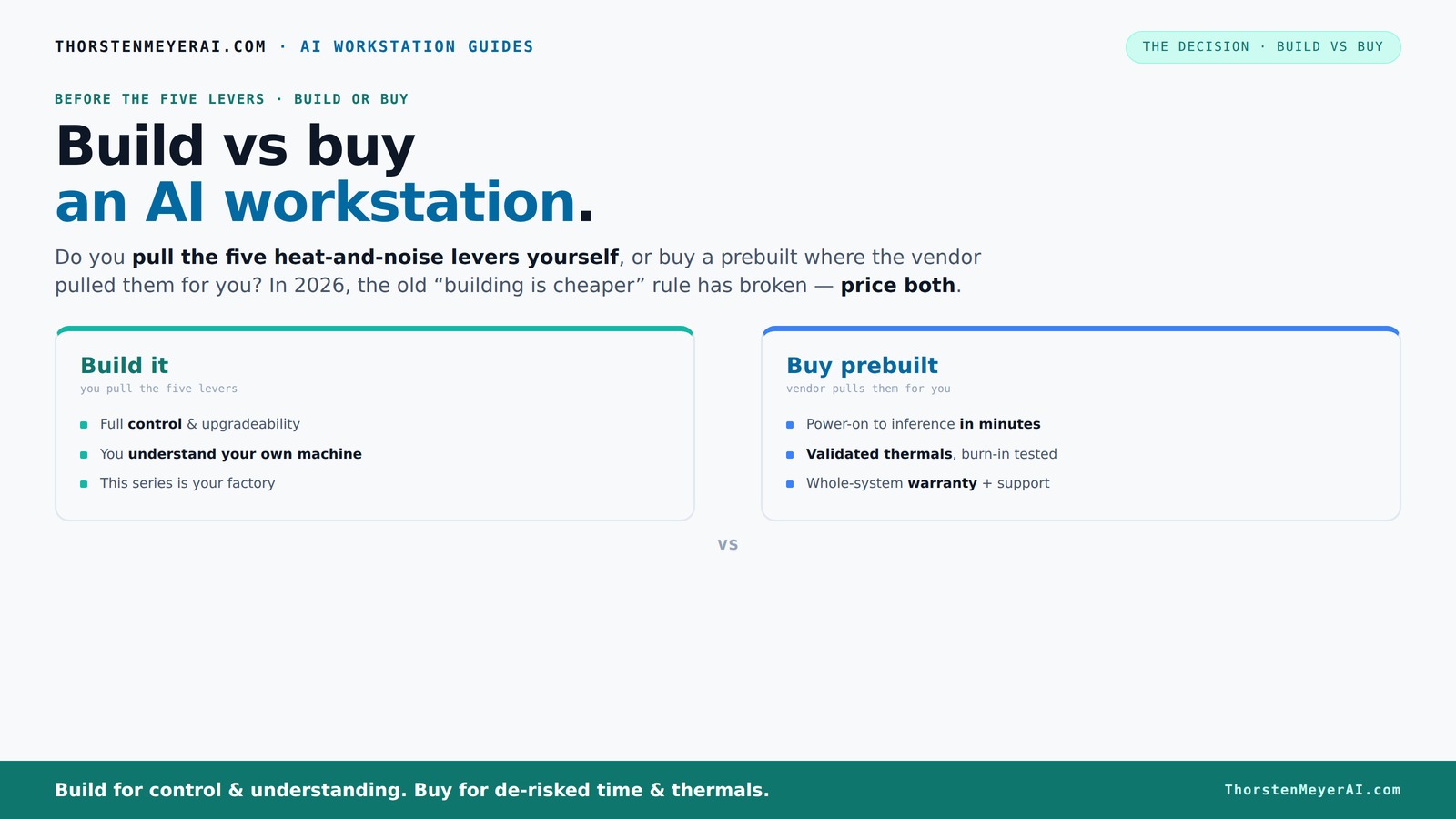
Build vs buy
an AI workstation.
The real question behind this whole series: do you pull the five heat-and-noise levers yourself, or buy a prebuilt where the vendor pulled them for you? And in 2026, the old “building is cheaper” rule has broken. Match your situation in Part 3.
Key Takeaways
- In 2026, prebuilt AI workstations often match or beat DIY costs due to component shortages and bulk buying.
- Buying prebuilt saves time, offers validated thermals, and reduces setup headaches — ideal for quick deployment.
- Building your own system grants maximum control over parts, cooling, noise, and upgradeability, perfect for tailored workloads.
- Evaluate your workload, expertise, and support needs before choosing — there's no one-size-fits-all.
- Future-proofing choices like extra PCIe slots and cooling support ensure your AI workstation remains relevant longer.
high performance AI workstation prebuilt
As an affiliate, we earn on qualifying purchases.
As an affiliate, we earn on qualifying purchases.
Why 2026 Changes Everything About Building vs Buying AI Workstations
Building your own AI workstation used to be the straightforward choice for saving money. But in 2026, component shortages and price hikes have flipped the script. GPU prices, DDR5 RAM, and SSDs have all surged — often pushing DIY costs above prebuilt systems.
For example, a DIY build that once cost around $1,000 now easily exceeds $1,250. Meanwhile, major vendors have bought parts in bulk before prices spiked, allowing them to offer systems at prices that are hard to beat — sometimes even cheaper than piecing it together yourself.
This shift means your decision isn’t just about saving a few bucks anymore. It’s about balancing cost, time, reliability, and control. The increased costs and supply chain uncertainties mean that building requires more planning and risk management. If you’re a hobbyist or researcher, this could mean reevaluating whether the time and effort are worth the potential savings, or if a prebuilt system offers a more predictable, hassle-free experience.
customizable AI workstation build kit
As an affiliate, we earn on qualifying purchases.
As an affiliate, we earn on qualifying purchases.
The Five Levers of a High-Power AI Workstation — Who Pulls Them?
Creating a quiet, cool, and reliable AI rig isn’t just about parts. It’s about tuning five key levers: undervolting the GPU, matching the right cooler, optimizing airflow, tuning fans, and placing the system correctly. The big question: do you pull these levers yourself or let the vendor do it? goldiramarkets.com offers insights into high-performance system components. It’s about tuning five key levers: undervolting the GPU, matching the right cooler, optimizing airflow, tuning fans, and placing the system correctly. The big question: do you pull these levers yourself or let the vendor do it?
Buy a prebuilt → the vendor pulls these levers, validating thermals and noise levels before shipping. For more on reliable prebuilt systems, visit theeventwithin.com. This means a system engineered for sustained load, with water-cooling options that run quieter and cooler. This approach reduces the guesswork and trial-and-error often involved in DIY tuning, which can be time-consuming and requires expertise. It also ensures that the system maintains optimal performance and longevity under heavy workloads, which is critical for professional or enterprise environments where stability is paramount.
Build it yourself → you control every detail. You pick a quiet GPU, undervolt it, select a case with sound-dampening features, and design airflow for maximum efficiency. This gives you a machine precisely tuned to your needs, plus the skills to fix it when things change. However, it requires a deep understanding of thermal dynamics, component compatibility, and noise management. Mistakes such as inadequate cooling or poor airflow can lead to thermal throttling, reduced lifespan, or noisy operation. The tradeoff is greater customization and potential performance gains, but at the cost of increased complexity and time investment.
As an affiliate, we earn on qualifying purchases.
When to Choose a Prebuilt AI Workstation — Speed, Support, and Certainty
If you need to start training or inference yesterday, prebuilts are a clear winner. They come ready with the OS, AI stacks (CUDA, PyTorch, TensorFlow), and validation already done. Just plug in and go — perfect for teams that value speed over tinkering.
Reputable vendors test their systems under load for 24–48 hours, confirming they won’t throttle or overheat. Learn more about enterprise-grade AI systems at startupsofa.com. This thorough validation process ensures the system performs reliably in real-world scenarios, reducing the risk of unexpected failures or downtime during critical tasks. Additionally, vendor support plans often include troubleshooting, firmware updates, and hardware replacements, which can be invaluable for enterprise users or those new to high-performance AI setups. This comprehensive support minimizes the technical overhead and allows users to focus on their projects rather than system maintenance.
High-end workloads, like multi-GPU setups or data-heavy inference, benefit from vendor validation. They’ve already solved cooling, power delivery, and compatibility issues, saving you headaches and time. In essence, prebuilts offer a predictable, reliable platform that accelerates deployment timelines and reduces the complexity of system configuration, making them ideal for urgent or mission-critical applications.
As an affiliate, we earn on qualifying purchases.
When to Build Your Own — Control, Customization, and Cost Savings
Building your own AI workstation is about having total control. If you're interested in the latest hardware options and customization tips, check out goldiramarkets.com. You choose every component — from a quiet GPU like the RTX 4090 with custom undervolting to a case with expert airflow. This is perfect if you want to optimize for specific workloads, VRAM size, or noise levels.
Moreover, DIY can be more cost-effective if you’re willing to invest time and effort into sourcing parts and assembling the system. By selecting high-quality, compatible components from trusted sources, you can avoid unnecessary markups and tailor the build precisely to your needs. This process also provides a valuable learning experience, deepening your understanding of hardware performance and cooling solutions. However, it’s important to recognize that the initial investment of time, research, and troubleshooting can be substantial, especially for complex multi-GPU setups or advanced cooling configurations. Mistakes or incompatible parts can lead to costly delays or hardware failures. Nevertheless, for those who value customization and control, the long-term benefits—such as upgradeability and a tailored system—often outweigh these challenges.
Comparison Table: Build vs Buy for AI Workstations in 2026 — for detailed insights, see the full guide at equitybuyers.net.
| Feature | Build Your Own | Buy Prebuilt |
|---|---|---|
| Cost | Potentially lower — but depends on skill and sourcing | Often comparable or better — due to bulk buying and validation |
| Time to Deploy | Longer — assembly, testing, troubleshooting | Minutes — ready to run |
| Control & Customization | Maximum — choose every part and tuning | Limited — vendor controls cooling, BIOS, and layout |
| Support & Warranty | Limited — depends on parts and DIY skills | Comprehensive — vendor support, warranty, and upgrades |
| Upgradability & Repair | Easier — accessible parts, modular design | Varies — some proprietary components |
| Thermal & Noise Tuning | Full control — tune to your environment | Factory validated — often quieter and cooler |
Key Considerations Before You Decide
Ask yourself: How urgent is my project? Do I have the skills or time to optimize a DIY build? Is long-term support or warranty more important? And most importantly, what’s my workload — inference, training, or data science? These questions guide your choice.
Understanding your workload helps clarify what tradeoffs matter most. For instance, if you're running large training jobs or require maximum stability, a prevalidated system reduces risks. Conversely, if you want to experiment with custom cooling or overclocking, building provides the flexibility to push hardware to its limits. Recognizing these priorities ensures your choice aligns with your project demands and technical comfort level.
Future-Proofing Your AI Workstation — What Matters Most
Whether building or buying, think about upgrade paths. Do you have spare PCIe slots? Is your PSU sized for future GPU upgrades? Does the case support good airflow? These choices impact how well your machine ages, especially as AI models grow larger and more demanding.
For example, opting for a case with multiple fan mounts and extra cooling options can save money and hassle later. Similarly, choosing a motherboard with multiple PCIe x16 slots allows stacking GPUs as your workload expands. These considerations are crucial because hardware obsolescence and increasing AI complexity mean that a system built today should accommodate future upgrades to stay relevant and performant over time.
Frequently Asked Questions
Is it cheaper to build or buy an AI workstation in 2026?
It depends. Due to shortages and bulk buying, prebuilts often match or beat DIY costs now. Always compare specific configurations, as prices fluctuate based on component availability and vendor deals.Which option offers better performance for local inference or training?
Performance depends on your parts choices and tuning. Building can give you a slight edge with customized cooling and component selection, but reputable prebuilts are validated for sustained loads and often include optimized cooling.How important is upgradeability in choosing between build and buy?
Building your own makes it easier to upgrade components over time. Prebuilts may include proprietary parts or limited slots, so check the upgrade paths before buying or building. This impacts long-term cost efficiency and flexibility, especially as AI workloads evolve rapidly.Are prebuilts reliable enough for professional AI workloads?
Yes, especially from trusted vendors who validate their systems under load and offer warranties. For mission-critical tasks, support and proven thermal management are key benefits, reducing downtime and ensuring consistent performance over time.Do I need to worry about proprietary parts in OEM prebuilts?
Sometimes. Proprietary connectors or layouts can complicate repairs and upgrades. Always check the warranty and support policies when choosing a prebuilt system, and consider how easy it will be to service or upgrade in the future to avoid vendor lock-in.Conclusion
Your decision between build and buy isn’t just about dollars anymore — it’s about what you value: control, speed, or support. In 2026, the market has shifted, making prebuilts a serious contender even for enthusiasts. Choose what aligns with your workflow, skills, and patience.
Remember: the best AI workstation is the one that gets you to your results faster, more reliably, and with confidence. So ask yourself — are you the driver, or the passenger in this build vs buy journey?
Halloween Picks
halloween
As an affiliate, we earn on qualifying purchases.