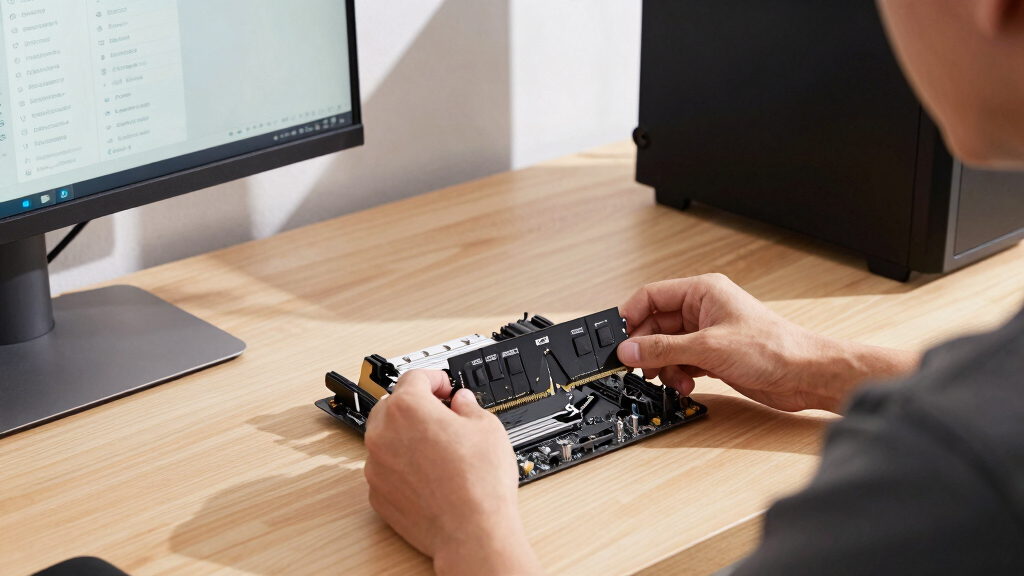

📊 Full opportunity report: DDR5 Now, DDR6 Soon: A Buyer’s Field Guide on ThorstenMeyerAI.com — validation score, market gap, and execution plan.

Get smart everyday buys delivered free with Prime
- Fast, free delivery on millions of items
- Prime Video, Amazon Music and more included
- Member-only deals all year
TL;DR
With DDR5 prices remaining high and DDR6 still in development, experts advise purchasing DDR5 now for current needs rather than waiting for DDR6, which won’t be mainstream until 2027. This guide explains why and what to consider.
Market experts confirm that DDR5 memory prices have remained high, and DDR6 is not expected to be widely available until 2027. Consumers and builders are advised to purchase DDR5 now for immediate needs, as waiting for DDR6 could lead to delays and higher costs.
According to recent analyses, DDR5 prices have stabilized at high levels, and forecasts suggest that meaningful price relief may not occur until 2028. DDR6, which promises significant bandwidth improvements, is still in development, with initial adoption expected around 2026–27 for enterprise and AI applications, and not until 2027 for mainstream desktops. The new standard will require entirely new platforms, including CPUs, chipsets, and modules, with launch prices estimated at 2–3 times higher per gigabyte than DDR5.
Experts emphasize that waiting for DDR6 is generally not advisable for most consumers in 2026, as the performance gains are not relevant for gaming or typical desktop use, and the costs and platform upgrades are substantial. Instead, users should focus on buying DDR5-6000 with CL30 timings, which is considered the sweet spot for performance and price, and size capacity based on actual workload needs—32GB for gaming and general use, 64GB for content creation. The market is also moving away from DDR4, which is approaching end-of-life, making DDR5 the logical choice for new builds.
While DDR6 offers a compelling architecture with wider channels and higher speeds, its adoption is staged and tied to new platforms. Early adopters willing to face early stability issues and limited capacities may consider DDR6 in 2027 for specialized workloads like AI and scientific computing, but for most, DDR5 remains the best option through at least 2028.
DDR5 now, DDR6 soon
A buyer’s field guide. The 20-year instinct — wait for prices to drop, or wait for the next generation — is broken this cycle. Buy the DDR5 you actually need now; don’t wait for DDR6. Here’s the reasoning.
Driven to end-of-life, production slashed. Same money, dead-end socket. Leave a working DDR4 box alone — but never start a new build on DDR4 to “save.”
A framework, not a gamble. Buy the DDR5 you need now, at the sweet spot, in the capacity you’ll actually use — don’t buy DDR4, don’t wait for DDR6. The two costliest mistakes in this market are the ones that feel prudent: waiting for a price drop that isn’t coming, and waiting for a next-gen part that launches dearer than what’s on the shelf. Next: The SSD Squeeze.
Why Buying DDR5 Now Is the Smarter Move
This guidance matters because delaying purchase in hopes of DDR6 could result in higher costs and missed platform upgrades. The current market conditions favor immediate investment in DDR5 for most users, avoiding the premium and uncertainties associated with early DDR6 adoption. For builders, this means focusing on platform compatibility and realistic capacity needs rather than speculative future performance gains.
As an affiliate, we earn on qualifying purchases.
Market Trends and Future Memory Standards
The memory market has been characterized by high prices and supply constraints since 2023, with DDR5 emerging as the current standard for new builds. DDR4 is nearing end-of-life, and DDR6 remains in standardization and development phases, with initial enterprise and AI deployments expected in 2026–27. The transition to DDR6 is expected to be gradual, with broad adoption not until around 2030, similar to DDR4’s slow rollout after its initial launch.
Historically, new memory standards take several years to become mainstream, and early versions often come with high costs and limited capacities. The current situation mirrors these patterns, emphasizing the importance of strategic purchasing based on actual needs rather than hype or speculation about future standards.
“The architecture of DDR6 promises significant improvements, but the platform transition and costs mean it’s not suitable for most in 2026.”
— Tech hardware expert
As an affiliate, we earn on qualifying purchases.
Uncertain Timeline and Adoption of DDR6
While DDR6 standards are finalized and compatible modules are beginning to appear, widespread adoption remains uncertain until late 2026 or early 2027. The actual performance benefits, stability, and pricing of early DDR6 modules are still to be seen, and early platforms may face compatibility and stability issues. The market is awaiting validation from major CPU and motherboard manufacturers before DDR6 becomes a mainstream option.
As an affiliate, we earn on qualifying purchases.
Next Steps for Consumers and Builders in 2026
Consumers should prioritize buying DDR5-6000 modules aligned with their workload needs, focusing on platform compatibility and capacity. Platform manufacturers will likely announce DDR6 support around late 2026 or early 2027, with initial modules and compatible systems appearing shortly thereafter. Monitoring JEDEC standards and motherboard QVL lists will be key indicators of readiness for DDR6 adoption. For most users, the best strategy is to wait until DDR6 is officially supported on stable, mature platforms.
As an affiliate, we earn on qualifying purchases.
Key Questions
Should I buy DDR4 now to save money?
No. DDR4 is nearing end-of-life, and new builds should focus on DDR5. DDR4 now costs roughly the same as DDR5 per gigabyte but offers no future upgrade path.
Is DDR6 worth waiting for in 2026?
For most users, no. DDR6 will be expensive, require new platforms, and won’t offer immediate benefits for gaming or general use. Only early adopters with specific workloads should consider waiting.
When will DDR6 be widely available?
Widespread adoption is expected around 2027–28, with initial enterprise and AI deployments in 2026–27. Mainstream desktops will likely see DDR6 support around 2027.
Can I upgrade my current system to DDR6 later?
No. DDR6 modules are not backward compatible with DDR5 or DDR4 platforms. A new CPU and motherboard will be required.
What performance gains does DDR6 offer over DDR5?
DDR6 promises higher speeds (up to 17,600 MT/s) and increased bandwidth, but these benefits are mainly relevant for high-bandwidth workloads like AI and scientific computing, not gaming or typical desktop tasks.
Source: ThorstenMeyerAI.com
Fall Picks
fall essentials
As an affiliate, we earn on qualifying purchases.