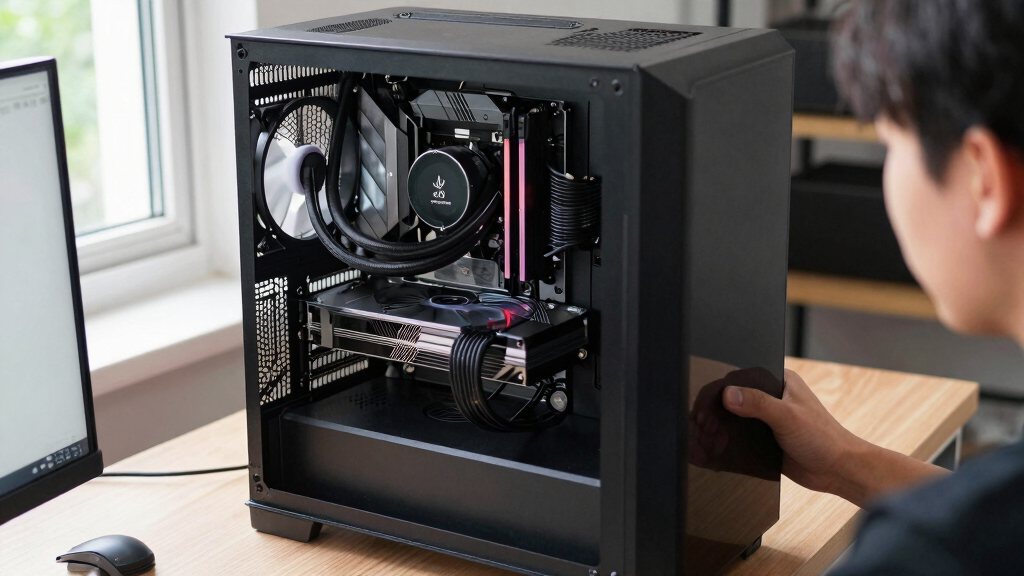

📊 Full opportunity report: Liquid vs Air Cooling for 24/7 Inference Rigs on ThorstenMeyerAI.com — validation score, market gap, and execution plan.

Get smart everyday buys delivered free with Prime
- Fast, free delivery on millions of items
- Prime Video, Amazon Music and more included
- Member-only deals all year
TL;DR
For most 24/7 AI inference systems, air cooling offers greater reliability, lower cost, and quieter operation. Liquid cooling may provide thermal headroom for high-demand CPUs but introduces potential failure points.
For continuous AI inference systems running 24/7, air cooling is generally the preferred choice over liquid cooling due to its simplicity, reliability, and lower total cost of ownership, according to industry experts.
Most high-performance workstations dedicated to AI inference can achieve adequate cooling with high-end air coolers, such as dual-tower models, which handle sustained loads efficiently without failure. Liquid cooling, particularly all-in-one (AIO) units, offers better thermal headroom for the hottest CPUs but introduces a single point of failure — the pump — and potential long-term issues like leaks and coolant degradation.
Air coolers are mechanically simpler, with only fans that are easy and inexpensive to replace. They are also quieter under load and require minimal maintenance, making them ideal for unattended operation. Conversely, AIOs, although modern units are reliable, have a lifespan limited by pump wear and coolant permeation, typically lasting 5–7 years before replacement is needed. Cost analysis shows air cooling is significantly more economical over the machine’s lifespan, often costing 2–3 times less in total ownership.
While liquid cooling can handle higher thermal loads, such as CPUs exceeding 360W TDP, this advantage is only relevant for specific high-demand scenarios. For most inference rigs, the thermal headroom provided by high-end air coolers is sufficient, and the added complexity of liquid cooling is unnecessary.
Liquid vs air
for a 24/7 inference rig.
For an always-on machine the question isn’t “which cools better” — it’s which one still works in three years without you thinking about it. That reframing makes air the default for most rigs. Answer three questions in Part 2 to find yours.
- Nothing to fail — fan swaps in minutes
- Lasts a decade+; lower total cost
- Quieter floor — no pump hum (~40–45 dBA)
- Trivial maintenance — wipe & repaste
- Tall — can block RAM, dumps heat in case
- Best headroom — ~360W TDP sustained
- Compact block — fits tight cases, clears RAM
- Exports heat out the radiator & room
- Pump fails at 5–7 yrs; replace whole unit
- Costs 2–3× more over its life; pump hum
- You run it 24/7 and want set-and-forget.
- Your CPU is mainstream-to-high-end (or power-capped).
- A big tower fits your case.
- You value lower cost and a quieter floor.
- Your CPU is too hot for air under sustained all-core load.
- A big tower won’t fit (compact / multi-GPU case).
- You need to export heat out of a warm room.
- RAM clearance is tight.
Reliability and Cost Advantages of Air Cooling
Choosing air cooling for 24/7 inference rigs prioritizes system reliability, reduces maintenance, and lowers long-term costs. This is critical for unattended systems where failure or downtime can impact productivity or data integrity.
high-end air CPU cooler for AI inference
As an affiliate, we earn on qualifying purchases.
As an affiliate, we earn on qualifying purchases.
Cooling Choices in AI Workstation Design
Traditionally, PC cooling guides focus on gaming or peak performance, often overlooking the needs of AI inference systems that run continuously. Recent evaluations indicate that for these workloads, air cooling's durability and simplicity outperform liquid solutions, which are better suited for high thermal headroom applications or compact builds where space constraints exist.
Manufacturers' warranty periods and long-term performance data support the notion that air coolers are more suited for long-term, unattended operation, whereas AIOs are often perceived as premium but with a finite lifespan due to pump wear and coolant degradation.
"For 24/7 inference rigs, reliability and simplicity tip the scales in favor of high-quality air cooling, which can last the lifetime of the system without intervention."
— Thorsten Meyer, AI hardware expert
all-in-one liquid CPU cooler for high thermal loads
As an affiliate, we earn on qualifying purchases.
As an affiliate, we earn on qualifying purchases.
Long-Term Reliability of Liquid Cooling Systems
While modern AIOs are generally reliable, their lifespan is limited by pump wear and coolant permeation, which may lead to leaks or reduced performance after 5–7 years. The actual failure rate in real-world, long-term use remains uncertain, as most data is based on manufacturer warranties and short-term testing.
As an affiliate, we earn on qualifying purchases.
Monitoring and Upgrading Cooling Solutions Over Time
Future developments may include more durable pump designs, longer-lasting coolants, and hybrid cooling solutions that combine the reliability of air with the thermal advantages of liquid. System administrators should monitor coolant integrity and pump performance periodically, especially in long-term deployments.
reliable CPU cooling system for unattended AI rigs
As an affiliate, we earn on qualifying purchases.
As an affiliate, we earn on qualifying purchases.
Key Questions
Is liquid cooling necessary for 24/7 AI inference rigs?
Generally no. High-quality air coolers are sufficient for most workloads and offer better long-term reliability for unattended systems.
How long do AIO coolers typically last?
Most AIOs are designed to last 5–7 years, with pump wear and coolant permeation being common failure points.
Are liquid coolers quieter than air coolers?
Not necessarily. Quality air coolers often operate more quietly under sustained load because they lack the constant pump hum associated with AIOs.
What are the main risks of using liquid cooling for continuous operation?
The primary risks include pump failure, coolant leaks, and degradation over time, which can lead to system downtime or damage.
Can I upgrade from air to liquid cooling later?
Yes, but it involves hardware modifications and space considerations. For most inference rigs, choosing the right cooling at the outset is preferable.
Source: ThorstenMeyerAI.com
Halloween Picks
halloween
As an affiliate, we earn on qualifying purchases.