
🔍 Read the full analysis: 15 Options For Automating Small Business Tasks With AI In 2027 on ThorstenMeyerAI.com

Get smart everyday buys delivered free with Prime
- Fast, free delivery on millions of items
- Prime Video, Amazon Music and more included
- Member-only deals all year
TL;DR
A roundup from ThorstenMeyerAI.com compares 15 books about automating small-business tasks with AI. The titles offer different learning paths, but the roundup assesses them as educational resources—not working software—and does not verify their specific instructions, integrations or results.
ThorstenMeyerAI.com has compared 15 books that aim to help small-business owners learn about AI automation, from broad business guides to titles focused on no-code workflows or ChatGPT, as detailed in the original roundup. The roundup ranks learning resources, not automation software, and says owners still need to select and configure the tools that run any workflow.
The roundup names AI Automation for Small Businesses: A Practical Guide to Automating Marketing, Sales, Customer Service, Operations, and Everyday Work as its best overall pick, citing the breadth of functions named in the title. It presents AI Automation Made Simple for Small Business as a beginner-oriented option associated with no-code workflows, and ChatGPT for Business: The 10X Playbook as a source of workflow ideas described as ready to adapt. For practical tool-selection considerations, see what to know before choosing AI automation software.
The source material does not provide a complete list of all 15 titles, publication dates, authors, prices, excerpts or detailed descriptions. It says the comparison draws on titles, stated audiences and promised formats, rather than a review of verified contents. The article’s characterizations should be read as indications from those descriptions, not confirmation of particular features or results. A practical guide to AI software for small-business automation offers additional context on the software side.
Other selection cues mentioned include books that signal a 30-day plan, a self-guided setup process, everyday-task coverage or an entrepreneur-focused approach to business growth. The source does not identify every title attached to those descriptions, so it is not possible to map all 15 books to those categories from the supplied information.
The 15 picks
- 1
 Smart AI for Small Business: 50 Simple Hacks to Grow Revenue, Cut Costs, and…View on Amazon →
- 2
 The Small Business Owner’s AI Handbook: How to Use Artificial Intelligence to…View on Amazon →
- 3
 AI Tools for Small Business: A Practical Guide to Automation, Saving Time, an…View on Amazon →
- 4
 AI-Powered Automation and Workflows for Small Business OwnersView on Amazon →
- 5
 ChatGPT for Business: The 10X Playbook — 100 AI Workflows to Save Time, Grow…View on Amazon →
- 6
 AI Automation for Small Businesses: Build Smarter Workflows, Save Time, Reduc…View on Amazon →
- 7
 Claude AI Made Practical: A Beginner’s Guide to Everyday Work, Small-Business…View on Amazon →
- 8
 AI Automation for Small Businesses: A Practical Guide to Save Time, Work Smar…View on Amazon →
- 9
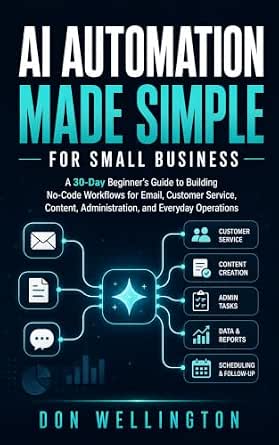 AI Automation Made Simple for Small Business: A 30-Day Beginner’s Guide to No…View on Amazon →
- 10
 AI Automation for Small Business: Simple AI Workflows for Everyday TasksView on Amazon →
- 11
 AI Automation for Small Business: A Practical Guide to Automating Marketing,…View on Amazon →
- 12
 AI for Small Business, Volume I: Getting Started — Set It Up Yourself, No Tec…View on Amazon →
- 13
 AI for Small Business: From Marketing and Sales to HR and OperationsView on Amazon →
- 14
 AI Automation for Small Businesses: Build Semi-Passive Income Systems Without…View on Amazon →
- 15
 AI for Entrepreneurs and Small Business Owners: How to Compete with Larger Bu…View on Amazon →
Choosing a Guide Before a Tool
The comparison addresses a common decision for small firms: where to start learning when routine marketing, service, sales or administrative work might be automated. A guide aimed at broad coverage may help owners survey several functions, while a no-code or beginner-framed title may feel more approachable to someone planning a first experiment. Those are differences in learning focus, not evidence that one book will produce better business outcomes.
The distinction between education and implementation matters because automation depends on a company’s existing apps, data and procedures. A book can describe a workflow without confirming that it works with a particular customer database, email service or payment system. Owners also need to account for the time spent checking generated outputs, especially when a process affects customers, financial details or sensitive information.
Products Worth Considering

LG 27-Inch 4K UHD Smart Monitor with webOS, IPS Display, USB-C 65W, and Adjustable Stand

Dell UltraSharp 27 Thunderbolt Hub Monitor (U2726DER), QHD

Dell XPS 13 13.4-Inch Touchscreen Laptop, Intel Core 5 320, 16GB RAM, 512GB SSD
As an affiliate, we earn on qualifying purchases.
How the 15-Book Comparison Works
The source says it compared the titles as business learning resources and favored apparent practical relevance, broad workflow coverage and clear entry points for nontechnical owners. It also treats structured plans and no-code framing as useful signals for readers who want a defined starting point. Specialized guides may fit a particular tool or learning preference, even if the roundup favors titles that appear broader.
That method has a clear limitation: the supplied information is based on what titles and descriptions promise. It does not establish how detailed the books’ instructions are, which software they cover, whether examples remain current, or whether readers can reproduce a workflow. The roundup is therefore best used to narrow a reading list, not as a substitute for checking sample pages and confirming tool compatibility.
“These are learning resources, not automation platforms.”
— ThorstenMeyerAI.com roundup
What the Source Does Not Verify
The available material does not give the full 15-title list or enough detail to verify the books’ contents, tool coverage, integration instructions, prices or publication status. It also provides no testing results or evidence that the books’ suggested workflows save time, reduce costs or improve sales. Titles that suggest a specific format do not, on their own, confirm the depth or quality of the instructions.
It is also unclear which AI services and small-business software combinations each guide addresses, or how frequently its examples are updated. Those details matter for a 2027-focused choice, since platforms and product features can change. The roundup offers no independent assessment of privacy safeguards, accuracy or ongoing maintenance for any workflow.
Checks to Make Before Buying
Owners considering one of the books can start by identifying a repetitive task that consumes staff time, writing down its current steps and defining what a successful result would look like. They can then compare that need with the book’s description and, where available, sample pages. Look for practical examples, clear setup guidance and coverage of the software the business already uses.
Before automating customer-facing or sensitive work, set rules for human review and approval, and check integration details with the relevant software provider. The next step for readers is to verify the complete title list and current editions directly with booksellers or publishers; the source material does not specify those details or report later updates to the roundup.
Key Questions
Are the 15 options AI automation software?
No. The source describes them as books and learning resources, not platforms that perform automations. Businesses still need to choose and configure the software used to run a workflow.
Which book does the roundup recommend overall?
It names AI Automation for Small Businesses: A Practical Guide to Automating Marketing, Sales, Customer Service, Operations, and Everyday Work as its best overall pick, based on the broad functional scope indicated by its title.
Which options are framed for beginners?
The source presents AI Automation Made Simple for Small Business as focused on no-code workflows. It also describes structured plans and self-guided setup framing as possible signs of an accessible starting point, while cautioning that titles alone cannot confirm how detailed a book is.
Does the roundup confirm that the books work with specific apps?
No. The supplied material does not verify software integrations or tool compatibility. Readers should check a book’s description or sample pages and confirm integration details with the software provider.
What should a small business do before automating a task?
Document the existing process, identify the result needed and decide which outputs require human review. This helps owners choose a relevant learning resource and set safeguards before using automation in customer-facing or sensitive work.
Source: ThorstenMeyerAI.com