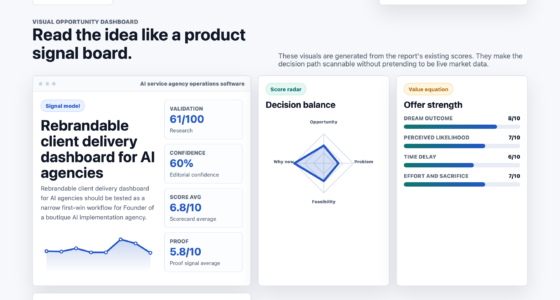

📊 Full opportunity report: AI workflow reliability monitor for small teams on IdeaNavigator AI — validation score, market gap, and execution plan.

Get smart everyday buys delivered free with Prime
- Fast, free delivery on millions of items
- Prime Video, Amazon Music and more included
- Member-only deals all year
TL;DR
A new AI workflow reliability monitor aimed at small teams is in testing. It tracks failures, latency, and fallback actions to enhance AI operation dependability. The tool could become essential as AI tools become core to daily workflows.
A new AI workflow reliability monitor designed for small teams is in testing, aiming to address increasing dependence on AI tools by tracking failures, latency issues, and fallback actions to improve operational dependability.
The proposed tool is a local status and output checker that records failed prompts, latency spikes, degraded answers, and fallback actions across a team’s AI workflows. It is targeted at small team operators who rely heavily on AI for client or internal processes and face productivity losses when AI responses fail or silently break.
The initiative is driven by the recognition that AI tools are becoming integral to daily operations, making their reliability critical. The initial testing involves asking five AI-heavy operators to share recent workflow failures and manually creating reliability logs with suggested fallback procedures.
Why It Matters
This development is significant because it addresses a growing need among small teams for dependable AI operations. As AI becomes embedded in routine workflows, failures can cause delays and reduce trust in automation. A dedicated reliability monitor could help teams quickly identify issues and implement fallbacks, minimizing downtime and maintaining productivity.
As an affiliate, we earn on qualifying purchases.
Background
Reliability concerns with AI tools have increased as organizations integrate them more deeply into daily tasks. Currently, many teams lack dedicated monitoring solutions, relying instead on manual checks or ad hoc troubleshooting. The concept of a small-team-focused reliability monitor emerges amid broader trends toward operational AI management and the need for scalable, easy-to-use tools.
“AI workflow reliability is becoming a critical concern for small teams relying on automation for their core operations.”
— an anonymous researcher
AI failure detection tools for small teams
As an affiliate, we earn on qualifying purchases.
As an affiliate, we earn on qualifying purchases.
What Remains Unclear
It is not yet clear how effective the prototype will be in real-world applications or how widely it will be adopted. Details about its specific features, scalability, and integration with existing tools remain under development.
As an affiliate, we earn on qualifying purchases.
What’s Next
The next steps include expanding testing to more teams, refining the monitoring features based on user feedback, and exploring commercialization options through subscription models. Further validation will determine its broader market potential.
AI fallback and error handling tools
As an affiliate, we earn on qualifying purchases.
As an affiliate, we earn on qualifying purchases.
Key Questions
What exactly does the AI workflow reliability monitor do?
The monitor tracks failed prompts, latency spikes, degraded answers, and fallback actions within a team’s AI workflows, providing a status overview to identify and address issues promptly.
Who is this tool intended for?
It is designed for small team operators who heavily depend on AI tools for client work or internal processes and need dependable operation monitoring.
Is this tool available now?
It is currently in the testing phase, with further development and validation ongoing before potential wider release.
How does this improve current AI workflows?
It provides real-time insights into workflow failures and latency issues, allowing teams to implement fallbacks quickly and reduce downtime caused by AI response failures.
Source: IdeaNavigator AI
Evergreen bestsellers Picks
bestsellers
As an affiliate, we earn on qualifying purchases.