
📊 Full opportunity report: Connecting Entrepreneurs To Vacant Storefronts Across Small Towns on IdeaNavigator AI — validation score, market gap, and execution plan.

Get smart everyday buys delivered free with Prime
- Fast, free delivery on millions of items
- Prime Video, Amazon Music and more included
- Member-only deals all year
TL;DR
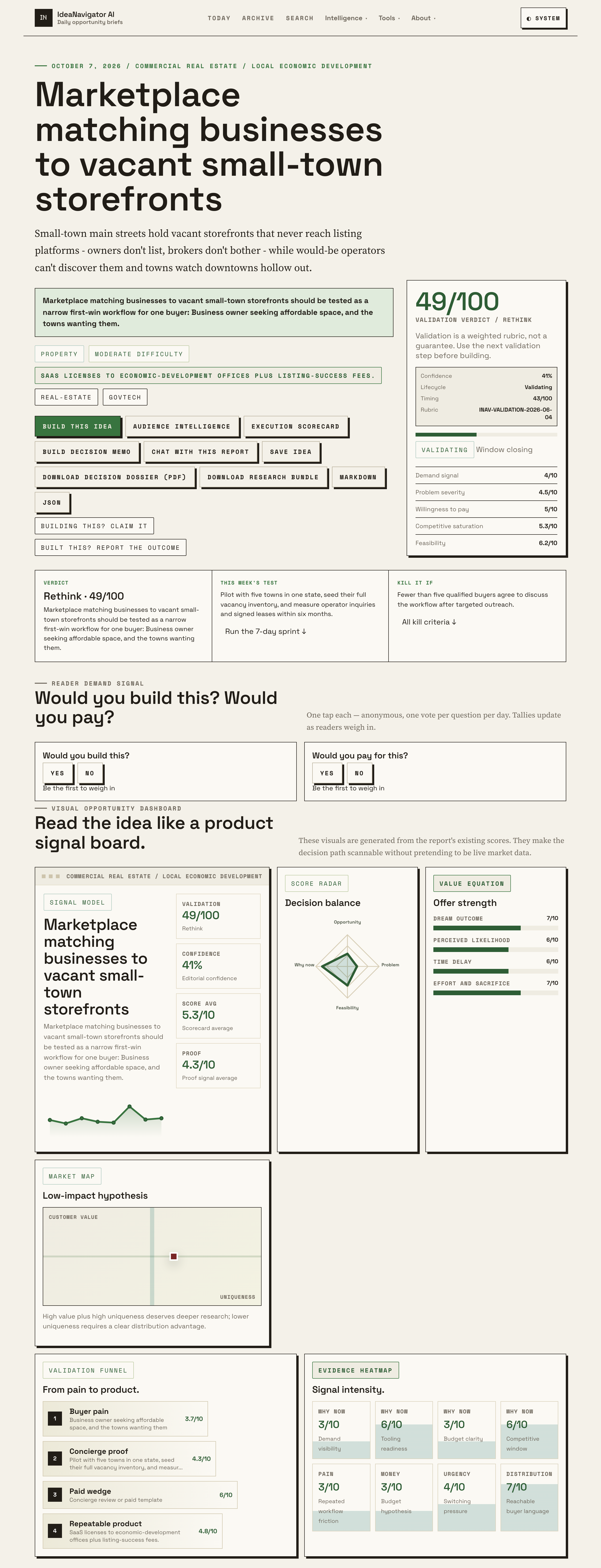
IdeaNavigator AI outlines a proposed marketplace to connect business owners seeking affordable space with vacant storefronts in small towns. The concept calls for a five-town pilot, but no launch, participating towns, funding awards or results are confirmed.
IdeaNavigator AI has proposed a marketplace to connect entrepreneurs seeking affordable commercial space with vacant storefronts in small towns, suggesting a five-town pilot to test whether the listings generate inquiries and signed leases. The plan is a proposed business concept, not an announced operating service: no participating towns, launch date or confirmed grant funding are identified.
The proposed platform would let towns and property owners post storefront listings with photos, size, rent and available incentive programs. Prospective operators would be able to browse by town profile and foot-traffic data, then send inquiries through a system that routes potential matches to a local economic-development office. The proposal says available grants could be attached to those referrals.
IdeaNavigator AI frames the problem as a gap in visibility: some owners do not list empty properties on commercial platforms, and brokers may not market them, leaving prospective tenants unable to find spaces. The proposal does not provide a count of affected properties or evidence measuring how widespread that problem is.
To test the idea, the plan recommends selecting five towns in one state, assembling each town’s full inventory of vacant storefronts and tracking operator inquiries and signed leases over six months. It suggests revenue from software licenses sold to economic-development offices, alongside fees tied to successful listings. No pricing, operating costs or projected revenue are provided.
A Test for Main Street Leasing
If developed and adopted, the marketplace could give small-town officials and property owners a shared way to present vacancies to potential businesses. Its value would depend on whether the listings are complete and current, whether entrepreneurs use them, and whether inquiries turn into leases and operating businesses. The proposed six-month measures would capture inquiries and signed leases, but would not alone establish whether a service caused new business activity.
For entrepreneurs, a single searchable inventory could reduce the effort of finding spaces that are not publicly advertised. For towns, routing prospects through local development offices could make it easier to connect applicants with relevant incentives. Those are intended benefits in the proposal, not demonstrated outcomes; the plan reports no completed matches or leases.
The concept also raises practical questions for communities with limited staff. Someone must gather property details, confirm rents and availability, maintain listings and respond to prospects. If the information goes stale or local offices lack capacity to follow up, a marketplace may not solve the discovery problem it is designed to address.
Products Worth Considering

Apple iPad Air (2025) 13‑inch Wi‑Fi 256 GB – Space Gray (M3 chip)

Apple MacBook Pro (14.2-inch, 2025) – M5 chip, 16GB Unified Memory, 1TB SSD, Space Black

Apple MacBook Pro 2023 with M2 Pro Chip, 14‑inch, 16 GB RAM, 512 GB SSD – Space Gray
As an affiliate, we earn on qualifying purchases.
How the Pilot Would Work
The proposal focuses on a defined group of users: business owners looking for affordable space and towns seeking tenants for vacant storefronts. It positions the product within commercial real estate and local economic development, rather than as a general property-search service.
IdeaNavigator AI cites renewed interest in small-town commercial space linked to remote-work migration and says economic-development offices have grant money for this kind of matching effort. It does not name specific grant programs, provide funding amounts or identify research supporting the claim about increased interest. Those points should be treated as the proposal’s rationale, not as verified market measurements.
The suggested pilot would begin with a concentrated inventory across five towns in one state, rather than a broad national launch. That approach could make it easier to test listing quality and referral processes, but the proposal does not specify how towns or property owners would be recruited, what platform would be built, or how success would be compared with activity before the test.
Pilot Funding and Participation
No operational details are confirmed. The proposal names no participating towns, platform operator, launch schedule, signed agreements or awarded grants. It also does not establish how many storefronts are vacant, how many owners would list, or whether the claimed grant resources are available to any specific town.
The proposal does not provide evidence that remote-work migration has increased demand for small-town commercial space, nor does it specify foot-traffic data providers, privacy practices, listing-verification standards or the terms of success-based fees. It remains unclear how the service would define a successful listing or lease, and whether the suggested six-month period would allow enough time to measure outcomes.
Evidence Needed Before Expansion
The next step described is a proposed five-town pilot, beginning with a complete inventory of local storefront vacancies. Towns and property owners would need to supply accurate listing details, while economic-development offices would need to confirm which incentives apply and establish a process for handling referrals.
After six months, the plan calls for reviewing operator inquiries and signed leases. Those figures could show whether the marketplace is attracting attention and producing transactions, though a stronger evaluation would also track listing accuracy, response times, costs and whether businesses remain open. No pilot has been announced, so there is no confirmed timetable or next public milestone.
Source: IdeaNavigator AI
Key Questions
Is the storefront marketplace already operating?
No operating service or launch was announced in the proposal. It describes a marketplace concept and recommends a pilot.
Who would use the proposed marketplace?
The intended users are entrepreneurs seeking affordable commercial space, property owners with vacant storefronts, and local economic-development offices that would help connect prospects with listings and incentives.
What would the pilot measure?
The suggested test would cover five towns in one state and track operator inquiries and signed leases over six months. The proposal does not report any pilot results.
How might the service make money?
The proposal suggests software licenses for economic-development offices and fees tied to successful listings. It gives no prices, revenue estimates or fee terms.
Are specific grants or towns confirmed?
No. The proposal refers generally to grant money but identifies no program, award or participating town.
Source: IdeaNavigator AI