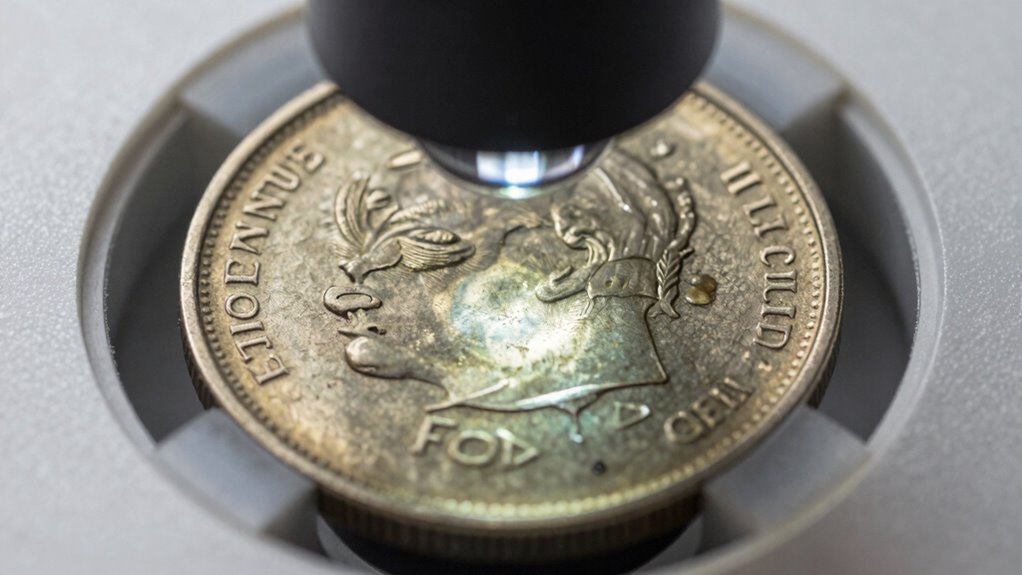

Digital microscopes help you see tiny details on coins that you can’t spot with your eyes or basic tools. They reveal small markings, die cracks, and minting errors, making it easier to authenticate and identify rare pieces. Plus, they assist in monitoring condition, tracking deterioration, and organizing your collection. By using a digital microscope, you gain a clearer understanding of your coins’ craftsmanship and history. Keep exploring to discover how this tool can elevate your collection further.

Get smart everyday buys delivered free with Prime
- Fast, free delivery on millions of items
- Prime Video, Amazon Music and more included
- Member-only deals all year
Key Takeaways
- Enable detailed examination of tiny minting features and authenticity markers, reducing counterfeit risks.
- Assist in detecting early signs of corrosion, wear, or damage not visible to the naked eye.
- Help identify rare minting errors and anomalies, increasing collection value.
- Provide high-resolution images for documentation, valuation, and provenance tracking.
- Enhance understanding of coin craftsmanship and history through close-up visual insights.
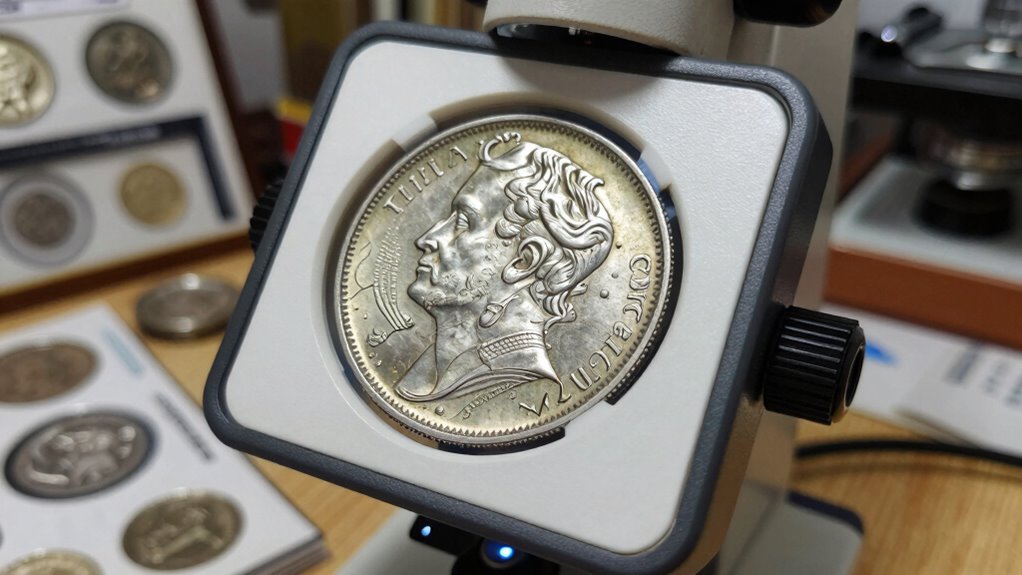
If you’re serious about coin collecting, a digital microscope can substantially enhance your ability to examine and authenticate your coins. These devices allow you to see details that are impossible to detect with the naked eye or a standard magnifying glass. When you scrutinize coins closely, you gain a deeper appreciation of their historical significance. Tiny markings, die cracks, and minting details reveal stories about the era, minting process, and even the artisans involved. This insight helps you understand each coin’s background, making your collection more meaningful and valuable. Digital microscopes also aid in identifying counterfeits, which is critical for preserving the integrity of your collection. By comparing authentic features with known genuine coins, you can avoid costly mistakes and guarantee your collection’s authenticity.
Beyond authentication, digital microscopes are essential tools for applying preservation techniques. Many coins, especially older or rare pieces, require careful handling and maintenance to prevent deterioration. Using a digital microscope, you can spot early signs of corrosion, dirt, or wear that might not be visible otherwise. This early detection allows you to take targeted preservation steps, such as cleaning or storing the coin in ideal conditions. Proper preservation techniques maintain a coin’s condition, which directly impacts its value. With high-resolution images, you can document your coins’ state over time, assisting you in tracking any changes or deterioration. This documentation is particularly helpful if you decide to sell or trade coins later, as it provides clear evidence of your care and the coin’s condition. Additionally, understanding the precision of minting and the technological advancements in coin production can deepen your appreciation for the craftsmanship involved. Recognizing these manufacturing techniques can also help you identify rare or error coins, adding to your collection’s uniqueness. Gaining knowledge about minting technology can further enhance your understanding of the complexities behind coin design and production, making your collecting experience more engaging. Moreover, studying minting errors can lead you to discover highly collectible coins that might otherwise be overlooked.
digital microscope for coin collecting
As an affiliate, we earn on qualifying purchases.
As an affiliate, we earn on qualifying purchases.
Frequently Asked Questions
Can Digital Microscopes Identify Counterfeit Coins Accurately?
Yes, digital microscopes can accurately identify counterfeit coins. They enhance your counterfeit detection by providing high-resolution images, allowing you to spot subtle differences in minting details, surface textures, and markings. With their zoom capabilities, you can closely examine features critical for authentication, increasing your authentication accuracy. This makes digital microscopes valuable tools, giving you confidence in verifying the authenticity of your coins quickly and precisely.
What Is the Best Magnification Level for Coin Examination?
The best magnification level for coin examination is around 20x to 40x, as it provides ideal magnification accuracy and clear, detailed images. At this range, you can easily identify subtle imperfections, surface details, and minting marks without losing image clarity. Higher magnifications may introduce noise, making it harder to analyze accurately, while lower levels might miss fine details essential for authenticating and grading your coins.
Are Digital Microscopes Portable for Field Coin Collecting?
Yes, digital microscopes are quite portable for field coin collecting. You can easily carry one in your bag, ready to reveal hidden details wherever you go. Look for models with long battery life to avoid interruptions and image stabilization features to keep your view steady, making your exploration smooth and enjoyable. With these tools, you’ll feel like a detective uncovering secrets on every coin journey.
How Do Digital Microscopes Compare to Traditional Magnifying Glasses?
Digital microscopes offer much greater magnification and detail than traditional magnifying glasses, allowing you to examine coins with precision. This enhances historical preservation by helping you identify wear, damage, or markings. Plus, their educational benefits are significant—you can easily share high-quality images and insights with others. Overall, digital microscopes make coin collecting more engaging and informative, providing a deeper understanding of each piece’s history and condition.
What Features Should I Look for in a Digital Microscope for Coins?
You should look for a digital microscope with adjustable lighting options to clearly see fine details and reduce glare on your coins. Make certain it has ample image storage, so you can save and organize your discoveries easily. A high-resolution camera makes a big difference, capturing sharp, detailed images. These features help you appreciate your collection’s intricacies and prevent frustration, making coin collecting even more enjoyable and rewarding.
As an affiliate, we earn on qualifying purchases.
Conclusion
So, next time you’re marveling at your coin collection through a digital microscope, remember—it’s not just about spotting flaws or grading accuracy. Sure, technology makes it easier to scrutinize every detail, but don’t forget, sometimes the true beauty lies in the imperfections we’d otherwise overlook. Ironically, while digital microscopes enhance precision, they also remind us that the charm of coins often comes from their flaws—proof that even in perfection, a little imperfection makes it special.
USB digital microscope for coins
As an affiliate, we earn on qualifying purchases.
As an affiliate, we earn on qualifying purchases.
magnification microscope for numismatics
As an affiliate, we earn on qualifying purchases.
As an affiliate, we earn on qualifying purchases.
Halloween Picks
halloween
As an affiliate, we earn on qualifying purchases.