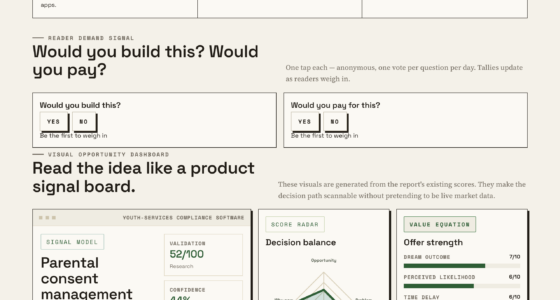

📊 Full opportunity report: The clause. How a contractual definition of AGI met the capital built on top of it. on ThorstenMeyerAI.com — validation score, market gap, and execution plan.

Get smart everyday buys delivered free with Prime
- Fast, free delivery on millions of items
- Prime Video, Amazon Music and more included
- Member-only deals all year
TL;DR
The original contract clause defining AGI was a doomsday trigger that threatened Microsoft’s access to OpenAI’s technology. It was gradually defused through negotiations, transforming into a verification process, illustrating how capital pressures override governance ideals in AI development.
OpenAI and Microsoft have revised their 2019 contract clause that defined the achievement of artificial general intelligence (AGI), transforming it from a potential termination trigger into a procedural verification step. This change reflects how capital pressures have overridden initial governance protections, with implications for AI governance and corporate strategy.
The original clause, written in 2019, tied Microsoft’s access to OpenAI’s technology directly to the achievement of AGI, a term that was never explicitly defined but was described as systems surpassing humans in most valuable work. The clause was intended to protect OpenAI’s mission to benefit humanity by preventing a single corporation from monopolizing AGI. However, the clause lacked a clear, measurable definition of AGI, making it a de facto time bomb that depended solely on OpenAI’s interpretation. Over six years, this clause became a significant obstacle for OpenAI’s strategic goals, including restructuring into a public benefit corporation and raising capital. During a $500 billion recapitalization, the clause was systematically renegotiated into a verification process. The trigger that once threatened to end Microsoft’s access was replaced with a panel-based verification, and the clause’s role as a termination event was replaced with a procedural milestone. By April 2026, the clause no longer posed a threat to the partnership, and the mission language remained but without enforceable teeth. This shift exemplifies how contractual definitions of AI milestones are vulnerable to the pressures of capital and corporate interests.The clause.
How a contractual
definition of AGI met
the capital built
on top of it.
clause stood in the way of
post-AGI models · the clause reversed
payments decoupled from AGI
OpenAI models live on AWS Bedrock
fireable without
catastrophic cost
to the firer
A provision written to wall AGI off from a single corporation became the price of that corporation’s continued partnership — renegotiated from a unilateral, deal-ending trigger into a jointly-verified, consequence-free checkpoint. The form of the mission survived; its force was traded for the capital the restructuring required.Thorsten Meyer · The Clause · AI Governance 03
Implications of Contractual Flexibility in AI Governance
This case demonstrates that governance mechanisms embedded in contracts are subject to the influence of capital and strategic interests. The transformation of the AGI clause from a doomsday trigger to a procedural verification highlights how financial imperatives can reshape foundational governance principles in AI development. It underscores the importance of explicit, measurable definitions in safeguarding ethical commitments and raises questions about the durability of governance frameworks under commercial pressures.AI governance contract review tools
As an affiliate, we earn on qualifying purchases.
As an affiliate, we earn on qualifying purchases.
The Evolution of AI Governance and Contractual Risks
Initially, the 2019 Microsoft–OpenAI contract included a clause that linked the achievement of AGI to the termination of Microsoft’s access, aiming to protect OpenAI’s mission. However, the lack of a precise definition of AGI and the absence of a regulatory body made this clause more of a symbolic safeguard than a practical one. As OpenAI sought to restructure and raise capital, the clause became an obstacle, prompting negotiations that ultimately led to its dilution. The amendments in October 2025 and April 2026 reflect a broader trend where governance mechanisms are adjusted to accommodate commercial realities, often at the expense of original ethical safeguards.“The clause was, in essence, a time bomb without a timer—detonation depended solely on OpenAI’s own interpretation of when AGI had arrived.”
— Thorsten Meyer
As an affiliate, we earn on qualifying purchases.
Remaining Ambiguities in AGI Verification Procedures
It is not yet clear what specific standards or procedures the verification panel now uses to determine whether AGI has been achieved. The exact criteria and whether this process is more objective or subjective remain undisclosed, leaving some uncertainty about the robustness of the current verification process.
As an affiliate, we earn on qualifying purchases.
Future Developments in AI Contractual Governance
OpenAI and Microsoft are expected to continue refining their contractual framework, potentially establishing more explicit, measurable criteria for AGI. Monitoring how these agreements evolve will be critical for understanding the balance of power between governance and capital in AI development. Further disclosures or regulatory oversight could influence future contractual standards.
As an affiliate, we earn on qualifying purchases.
Key Questions
What was the original purpose of the AGI clause in the Microsoft–OpenAI contract?
The clause was designed to prevent Microsoft from maintaining access to OpenAI’s technology once AGI was achieved, protecting OpenAI’s mission to benefit humanity by avoiding monopolization.
How was the AGI clause changed over time?
It was gradually renegotiated from a doomsday trigger into a verification step, with the termination event replaced by a procedural milestone, through amendments in October 2025 and April 2026.
Why was the original clause considered problematic?
Because it lacked a clear, measurable definition of AGI, making it dependent on subjective interpretation and potentially unstable as a governance mechanism.
What does this case tell us about AI governance in practice?
It shows that contractual governance mechanisms are vulnerable to the influence of capital and strategic interests, often leading to the dilution of initial safeguards.
Will the new verification process be more reliable than the original clause?
It remains unclear what standards the verification panel uses, and whether this process is more objective than the original subjective trigger.
Source: ThorstenMeyerAI.com
Halloween Picks
halloween
As an affiliate, we earn on qualifying purchases.