
📊 Full opportunity report: How Immersive VR Training Enhances Manufacturing Workforce Competency on IdeaNavigator AI — validation score, market gap, and execution plan.

Get smart everyday buys delivered free — and shop member deals
- Fast, free delivery on millions of items
- Access to Prime Big Deal Days deals on October 6–7
- Prime Video, Amazon Music and more included
TL;DR
Manufacturing companies are piloting VR training modules to accelerate onboarding and improve safety. Early tests indicate faster skill acquisition and better hazard recognition, addressing labor and safety challenges.
Manufacturers are increasingly adopting immersive virtual reality (VR) training modules to tackle persistent labor shortages and safety risks. Early pilot programs at mid-sized plants suggest that VR can significantly accelerate onboarding and enhance hazard recognition, offering a promising solution for industry-wide workforce development.
The shift toward VR training is driven by a severe labor shortage in the U.S. manufacturing sector, with approximately 409,000 unfilled positions as of August 2025, and a projected need for 3.8 million new workers by 2033. Traditional training methods, such as classroom instruction and on-the-floor demonstrations, are slow, inconsistent, and pose safety risks when used on live machinery. VR offers a scalable, standardized alternative that can be deployed rapidly and at lower costs due to the declining price of standalone headsets like Meta Quest and Pico.
Manufacturers are testing a focused VR module library targeting high-risk procedures, such as lockout/tagout (LOTO) and forklift safety. These modules are delivered via standalone headsets connected through cloud platforms that track completion, scores, hazard recognition accuracy, and time-to-competency. The initial approach involves a pilot with one plant, shipping 5-10 headsets with core scenarios and a management dashboard to monitor progress. Success metrics include faster onboarding times, improved hazard recognition scores, and positive supervisor feedback.
Industry experts note that early results from these pilots could demonstrate that VR reduces onboarding time by up to 30%, while hazard recognition accuracy improves by a similar margin. The potential for cost savings and safety improvements makes VR an attractive option for large manufacturers facing urgent workforce and safety challenges.
Impact of VR Training on Manufacturing Safety and Efficiency
The adoption of VR training in manufacturing could transform workforce development by enabling faster onboarding and reducing safety incidents. As the industry faces a significant skills gap and high turnover, VR offers a standardized, engaging, and scalable solution that can improve retention and safety compliance. Early pilot results suggest that VR can lead to measurable improvements in hazard recognition and procedural proficiency, which are critical for reducing accidents and operational downtime.
Furthermore, as hardware costs decline and cloud-based platforms mature, VR training is becoming more accessible to mid-sized and large manufacturers. This shift could lead to widespread adoption, ultimately improving safety records and lowering costs associated with accidents and training inefficiencies.
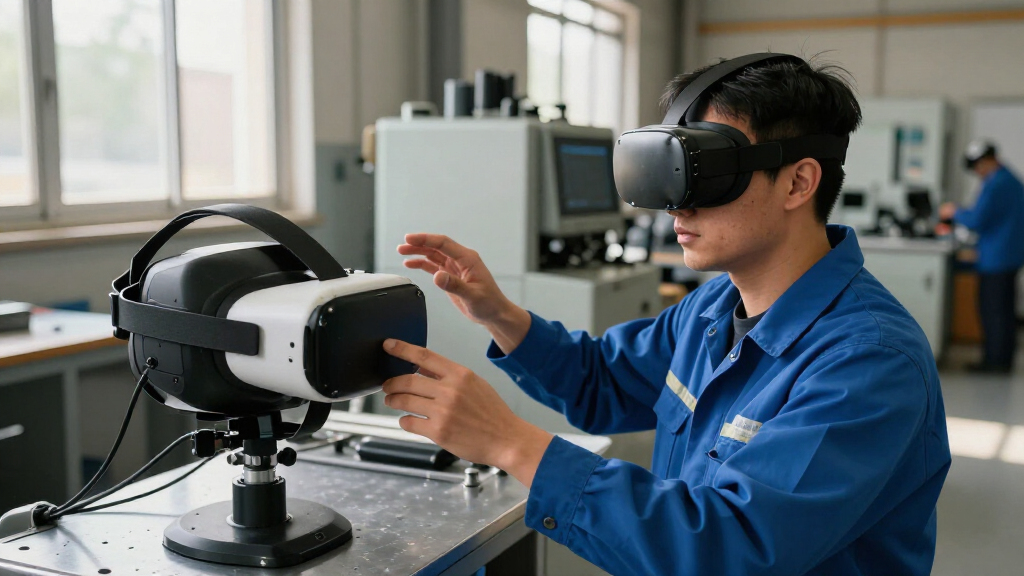
VR headset for industrial training
As an affiliate, we earn on qualifying purchases.
As an affiliate, we earn on qualifying purchases.
Manufacturing Workforce Challenges and VR Adoption Timeline
The manufacturing sector has been experiencing a persistent labor shortage, with millions of unfilled positions and a need for rapid onboarding of new workers. Traditional training methods are often slow, inconsistent, and pose safety risks, especially when training on live equipment. The rise of affordable standalone VR headsets and cloud streaming technology has created a new opportunity for immersive, standardized training modules.
Initial efforts are focused on high-risk procedures, where training deficiencies can lead to costly safety incidents. Pilot programs are being conducted at mid-sized plants, with early indicators pointing toward faster skill acquisition and better hazard detection. The industry is watching these pilots closely, as successful results could accelerate broader adoption across the sector.
While the technology shows promise, it remains to be seen how scalable and cost-effective VR training will be in long-term deployment, and how it compares to existing methods in diverse manufacturing environments.
standalone VR headset for manufacturing
As an affiliate, we earn on qualifying purchases.
As an affiliate, we earn on qualifying purchases.
Uncertainties Around Long-Term Effectiveness and Scalability
It is not yet clear how well VR training will perform across different manufacturing environments or how scalable the solutions will be beyond pilot programs. Long-term retention, cost-effectiveness at scale, and integration with existing training systems remain to be validated through ongoing studies and wider deployment.
As an affiliate, we earn on qualifying purchases.
Next Steps for VR Manufacturing Training Pilots
Manufacturers will continue 60-90 day pilot programs, measuring outcomes such as onboarding speed, hazard recognition accuracy, and supervisor assessments. Positive results could lead to expanded deployment across multiple plants and procedures. Industry stakeholders are also exploring customization options and integration with existing safety and training systems to enhance scalability and effectiveness.
As an affiliate, we earn on qualifying purchases.
Key Questions
How quickly can VR training improve onboarding times?
Early pilot data suggests VR can reduce onboarding times by up to 30%, but results may vary depending on the procedure and implementation quality.
What safety benefits does VR training offer?
VR training allows workers to practice high-risk procedures in a safe, controlled environment, which can lead to fewer safety incidents and better hazard recognition.
Are VR headsets affordable for manufacturing companies?
Yes, the declining cost of standalone headsets like Meta Quest and Pico makes VR training increasingly accessible without large capital investments.
What procedures are best suited for VR training?
High-risk, procedural tasks such as lockout/tagout, forklift operation, and machine safety are currently the focus for VR modules due to their safety-critical nature.
When will VR training become widely adopted in manufacturing?
Widespread adoption depends on pilot success, but industry experts expect broader use within the next few years as evidence of effectiveness grows.
Source: IdeaNavigator AI
Halloween Picks
halloween
As an affiliate, we earn on qualifying purchases.