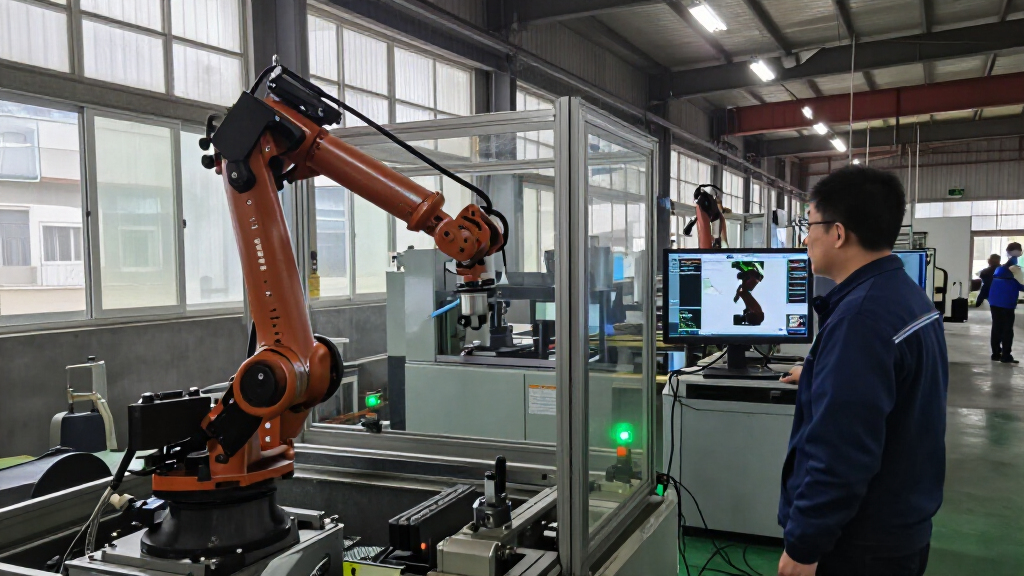

🔍 Read the full analysis: What Happens When AI Joins Factory Robotics? on ThorstenMeyerAI.com

Get smart everyday buys delivered free with Prime
- Fast, free delivery on millions of items
- Prime Video, Amazon Music and more included
- Member-only deals all year
TL;DR
The source material traces industrial robots from Unimate’s 1961 factory deployment to more than 5 million robots operating worldwide in 2025. It reports that research found job losses associated with robot adoption in the United States, while German evidence showed factory losses offset by service-sector gains. The supplied material does not establish a new AI deployment or measure AI’s separate effect on factory jobs.
A November 24 report on factory automation says more than 5 million industrial robots were operating worldwide in 2025, but it does not document a new deployment of AI-powered factory robots or establish AI’s distinct effect on jobs. Instead, it reviews the history of industrial robots and research suggesting that employment effects vary by country and by which workers are counted.
The report draws on figures attributed to the International Federation of Robotics (IFR): factories installed more than 600,000 robots in 2025, and the worldwide operating stock reached 5 million, up 9% from 2024 and more than double its level seven years earlier. China accounted for 354,000 new installations, or 59% of the total. The United States installed almost 38,500, while Japan installed 36,219, South Korea 30,000 and Germany fewer than 25,000.
The report’s central historical example is Unimate, which began work at a General Motors plant in Trenton, New Jersey, in 1961. It unloaded a die-casting press, handling hot metal parts in a job described as dangerous and physically demanding. The account traces subsequent uses into welding and car-body production, where robots took on work that was difficult to staff or hazardous for people.
On employment, the article cites a study by economists Daron Acemoglu and Pascual Restrepo. Their estimate, as summarized in the source, is that each additional industrial robot from 1990 to 2007 replaced about 3.3 workers across the U.S. economy, for an estimated total of about 400,000 jobs. It contrasts that result with Germany, where factory job losses associated with robots were reportedly offset by gains in services. Those figures describe particular periods and research findings; they do not show what AI will do to jobs in the future.
Infographic 01 · Five million robots
Where the robots work
Sixty-five years after the first Unimate, five million industrial robots work in the world's factories. South Korea has by far the most per worker.
Robots per 10,000 employees in manufacturing · 2024
Where the new robots went · 2025
- China: 354,000 installed, 59% of the world total.
- United States: almost 38,500 (+12%), again the second-largest market.
- Japan 36,219 (−19%) · South Korea 30,000 · Germany fewer than 25,000 (−8%), Europe’s largest market.
Robot density = operational industrial robots per 10,000 employees in manufacturing. China (166 in 2024) is not compared here: the IFR switched to updated Chinese labour data in 2026, which changed the denominator.
Sources: IFR, robot density press release, 8 Apr 2026 (data 2024); IFR, World Robotics 2026 press release, 24 Sep 2026.
Powered by Thorsten Meyer AI
Robot Growth and Uneven Job Effects
The figures show that factory automation is already widespread, but a rising robot count alone does not say whether employment will fall overall. Job effects can differ across industries and countries, and national totals may conceal losses for particular workers or places. The reported U.S. estimate points to displacement, while the German example suggests service-sector growth can offset factory losses in an aggregate count.
The distinction matters for readers trying to understand the phrase “AI joins factory robotics.” The source describes industrial robots and their history, but supplies no evidence separating AI’s effects from automation more generally. It does not report whether AI changes the number of jobs displaced, creates new roles, or alters how people work alongside robots. Those questions cannot be answered from robot installation totals alone.
Robot density offers another comparison, though it is not a direct measure of job losses. For 2024, the IFR figures cited in the report put South Korea at 1,220 robots per 10,000 manufacturing employees, Germany at 449 and the United States at 307. Density indicates how common robots are relative to manufacturing employment; it does not, by itself, show whether a country has fewer jobs because of them.
Products Worth Considering

Canon Color imageCLASS MF753Cdw II Wireless All-in-One Color Laser Printer

FLEXISPOT E6 MAX Dual-Motor Electric Standing Desk, 55 x 28 in, Walnut Top, Black Frame

FLEXISPOT WoodiX 55 x 28-Inch Solid Wood Executive Standing Desk, Walnut
As an affiliate, we earn on qualifying purchases.
From Unimate to Global Installations
The source dates the first step toward Unimate to an invention by George C. Devol. He filed a U.S. patent for a programmed article-transfer machine on December 10, 1954; the patent was granted on June 13, 1961. Devol and entrepreneur Joseph Engelberger formed Unimation, and the first robot went to a General Motors plant in Trenton to unload a die-casting press. The Henry Ford museum holds the machine, according to the article.
Industrial robots then moved into other factory tasks. At GM’s Lordstown plant in 1969, Unimate robots were used for spot welding. The report, citing the IFR, says more than 90% of body welding was automated there, compared with 20% to 40% at traditional plants. In Japan, Kawasaki licensed Unimation technology and completed its first Kawasaki-Unimate 2000 in 1969. The company’s history, as cited in the source, connects demand to a shortage of workers for hard, dirty and dangerous jobs.
Recent growth is concentrated in several manufacturing economies. The IFR’s 2024 density figures, published in April 2026, placed South Korea first among the listed countries, followed by Singapore, Germany and Japan; the world average was 132 robots per 10,000 manufacturing employees. The report’s 2025 installation figures show China’s large share of new purchases, but do not explain how many installations use AI or what capabilities they have.
AI’s Separate Factory Impact
The supplied source does not identify a specific AI-enabled robot launch, factory trial or company announcement. It gives no count of robots using AI, no definition of what qualifies as AI in this setting and no estimate of AI’s separate effects on productivity, safety or employment. The headline question is therefore broader than the evidence presented.
The employment estimates also have limits. The cited U.S. study covers 1990 to 2007, and the article’s summary does not provide the study’s full methods or uncertainty range. The German comparison is presented as an aggregate pattern, without enough detail here to assess differences among industries, regions or worker groups. The source does not establish that the findings apply to current installations or future AI systems.
Evidence Needed on AI Deployment
A clearer account of AI’s role in factory robotics would require data identifying which systems use AI and what tasks they perform, alongside comparable measures of employment, wages, output and safety before and after adoption. The supplied report gives no upcoming study, company rollout or policy deadline that would answer those questions.
For now, the reported IFR totals can track the spread of industrial robots, while the cited studies offer historical evidence about employment effects under particular conditions. Whether AI changes those outcomes remains unestablished in the source material; readers should distinguish that open question from the confirmed growth in robot installations.
Key Questions
Does the report describe a new AI factory robot?
No. The source reviews the history and growth of industrial robots but does not identify a new AI-powered robot launch or factory deployment.
How many industrial robots were operating worldwide in 2025?
The source attributes a total of 5 million robots in operation to the International Federation of Robotics. It says this was 9% more than in 2024 and more than double the count seven years earlier.
Do industrial robots always reduce total employment?
The evidence summarized in the article varies by country and measure. It cites estimated U.S. job displacement from 1990 to 2007, while its account of Germany says service-sector gains roughly offset factory job losses. Neither finding establishes a universal result.
What does robot density measure?
Robot density is the number of industrial robots per 10,000 manufacturing employees. It compares robot use relative to manufacturing employment, but does not by itself prove that robots caused job losses.
Source: ThorstenMeyerAI.com