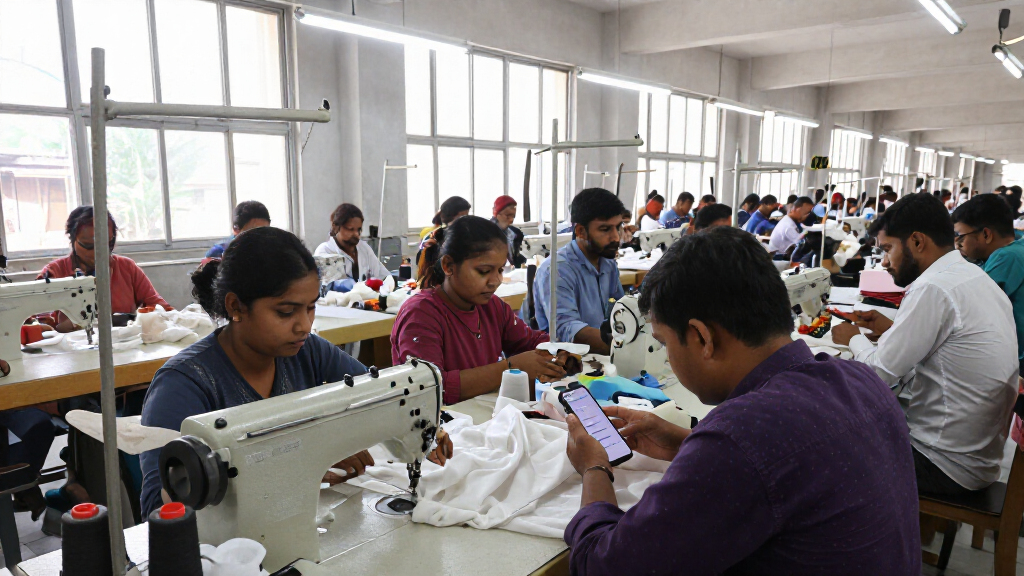
🔍 Read the full analysis: The AI Question Behind Bangladesh’s Garment Worker Protests on ThorstenMeyerAI.com

Get smart everyday buys delivered free with Prime
- Fast, free delivery on millions of items
- Prime Video, Amazon Music and more included
- Member-only deals all year
TL;DR
Garment workers in Bangladesh protested across industrial areas near Dhaka on November 17 and 18 after a scheduled wage-board meeting was postponed. Workers formally proposed a 32,000-taka minimum, while factory owners had not submitted a figure; automation is a longer-term pressure on jobs, but the source does not establish it as a cause of these protests.
Garment workers in Bangladesh blocked roads and clashed with police on November 17 and 18 as a dispute over minimum pay intensified after the industry’s wage board postponed a meeting scheduled to hear employers’ proposal. Workers’ representatives have proposed a 32,000-taka monthly minimum, while factory owners had not put a formal figure on the table as of November 19. The unrest affects an industry employing about four million people and supplying international clothing brands.
The wage board’s third meeting was called off on November 16 after Anwar Hossain, the workers’ permanent representative, fell ill and was hospitalized, according to a joint statement by the Bangladesh Garment Manufacturers and Exporters Association (BGMEA) and the Bangladesh Knitwear Manufacturers and Exporters Association (BKMEA). The associations said employers were ready to submit their proposal and asked for the meeting to be rescheduled without delay. The board is due to meet again on November 23.
The current minimum wage is 12,500 taka a month, in force since December 1, 2023. Workers protesting on the streets have demanded 30,000 taka, while their representative on the board formally proposed 32,000 taka. Those figures amount to sharply different expectations from the existing floor. The Financial Express reported that factory owners had discussed a figure of about 15,000 taka before the postponed meeting, but employers had not formally submitted an offer as of the latest reporting.
Protests spread across Gazipur, Savar, Ashulia and Mirpur. AFP reported that police used tear gas and stun grenades as demonstrators threw bricks, set vehicles on fire and blocked roads. On November 18, about 20,000 workers from one factory blocked the Dhaka-Aricha Highway in Savar, according to AP, which cited local media; police used tear gas, stun grenades and batons. AP said the number of people injured was not immediately clear.
Estimates of disruption differ by source. A BGMEA vice-president told The Daily Star that production had stopped at nearly 450 factories. The paper’s correspondents, citing industrial police and protesters, counted at least 250 closed factories in Savar, Ashulia and Hemayetpur and another 60 in Gazipur. AFP, citing sources, put the number at about 500 out of the country’s 4,500 garment factories. These are reported counts from different sources, not a single verified tally.
Wages at the Center of Factory Disruption
The dispute brings together workers’ purchasing power, factory operating costs and the price pressure garment suppliers say they face from international buyers. A higher minimum wage would affect workers directly, but the amount and timetable for any increase remain subject to the wage board. The industry’s decision also matters to manufacturers whose operations and export orders can be disrupted when workers stop production or roads are blocked.
Factory owners have argued that a steep wage rise could weaken Bangladesh’s cost advantage over competitors such as India and Vietnam. They have also pointed to low prices paid by buyers and rising energy costs. Those are employers’ arguments, not independently established measures of how a wage increase would affect competitiveness. Reports reviewed in the source material said no international buyer had commented on this round of protests.
The article’s AI question concerns automation’s possible effect on garment work, not evidence that AI caused the current demonstrations. A 2024 study of factories around Dhaka found automated production lines needed 30.58 percent fewer workers, mostly helpers. That finding points to a potential employment pressure as factories adopt machinery. The available material does not show how many jobs have been lost to automation across the sector or whether it has shaped workers’ current wage demands.
Products Worth Considering

FLEXISPOT 48 x 24-Inch Solid Rubberwood Electric Standing Desk, Black Frame

Canon SELPHY QX20 Wireless Compact Photo Printer Bundle (Dark Gray)

Logitech MX Mechanical Wireless Illuminated Keyboard, Tactile Quiet, Graphite
As an affiliate, we earn on qualifying purchases.
The Wage Board’s November Schedule
The wage board is the immediate forum for the dispute. It was formed earlier in November, and its third meeting was scheduled for November 16, when employers were expected to respond to the workers’ proposal. The postponement followed the workers’ representative’s illness, according to the owners’ associations. The board’s next meeting is set for November 23, leaving a short period for a decision before the implementation date stated by its chairman.
The board chairman has said the new wage will take effect on December 1, 2026, whatever amount is decided, and workers are expected to receive it with their January 2027 pay. The source material reports the schedule as the chairman’s statement; the final wage figure has not been announced. Meanwhile, BGMEA sources cited by The Financial Express said 98 factories were closed under the Labour Act’s “no work, no pay” provision on November 16, and another 24 had suspended operations.
Automation adds a separate, longer-term dimension. An International Labour Organization working paper calculated from labour force survey data that women’s share of apparel jobs fell from 46.2 percent in 2016–17 to 35.2 percent in 2024. The figures describe a change in workforce share; they do not, by themselves, establish that automation caused it. The 2024 factory study and the workforce data raise questions about which workers bear the costs of changing production, but do not explain the immediate cause of the protests.
“We want to return to our machines.”
— A 28-year-old garment worker, speaking to AFP
The Offer and Protest Toll Remain Unknown
The wage board has not announced its decision, and factory owners had not formally submitted a figure in the reporting available through 07:00 UTC on November 19. The reported 15,000-taka figure was an amount owners had discussed, according to The Financial Express, not an official offer. It is also not clear whether the November 23 meeting will produce an agreement or how the board would resolve a continuing gap between proposals.
The scale and human cost of the unrest also remain incomplete. Factory-closure estimates vary across reports, and AP said it was not immediately clear how many people were injured in the November 18 clashes. The reviewed coverage reported no deaths, but that is limited to the reporting available at the stated cutoff. A Savar police officer said 117 people had been arrested since October 31 and alleged that members of various groups, including banned organizations, had infiltrated the movement; the cited report did not provide evidence for that allegation.
Finally, the available reporting does not establish that artificial intelligence or automation triggered the protests. The research cited describes labor needs on automated lines and changes in women’s share of apparel employment, but offers no direct account linking either trend to the current demonstrations or to individual job losses.
Board Reconvenes on November 23
The next scheduled milestone is the wage board meeting on November 23. Workers and employers are waiting to see what amount is formally proposed and whether the board can settle on a new minimum. The chairman’s stated timetable calls for the new rate to take effect on December 1 and appear in workers’ January 2027 pay, but that schedule does not resolve the amount or the response to the delay.
Further reporting will need to track whether factories resume production, whether road blockades and police deployments continue, and whether the reported arrest and closure totals change. The board’s decision may clarify the immediate wage dispute; separate evidence would be needed to measure how automation is affecting employment and how that pressure relates to workers’ concerns.
Key Questions
What are Bangladesh garment workers demanding?
Workers have demanded a 30,000-taka monthly minimum in protests. Their representative on the wage board formally proposed 32,000 taka. The current minimum is 12,500 taka a month.
Why was the November 16 wage-board meeting postponed?
The BGMEA and BKMEA said the meeting was postponed after workers’ representative Anwar Hossain fell ill and was hospitalized. They said employers had been prepared to present a proposal.
When is the wage board due to meet again?
The next meeting is scheduled for November 23, 2026. The board has not yet announced a new wage figure.
Did AI cause the garment worker protests?
The available reporting does not establish that AI or automation caused the protests. A 2024 study found automated lines in factories around Dhaka needed 30.58 percent fewer workers, mostly helpers, but that finding does not link automation to the current wage dispute.
How many factories have been affected?
Reported counts vary. A BGMEA vice-president told The Daily Star that production had stopped at nearly 450 factories, while AFP cited a figure of about 500. The reports rely on different sources, so a single verified total is not available.
Source: ThorstenMeyerAI.com