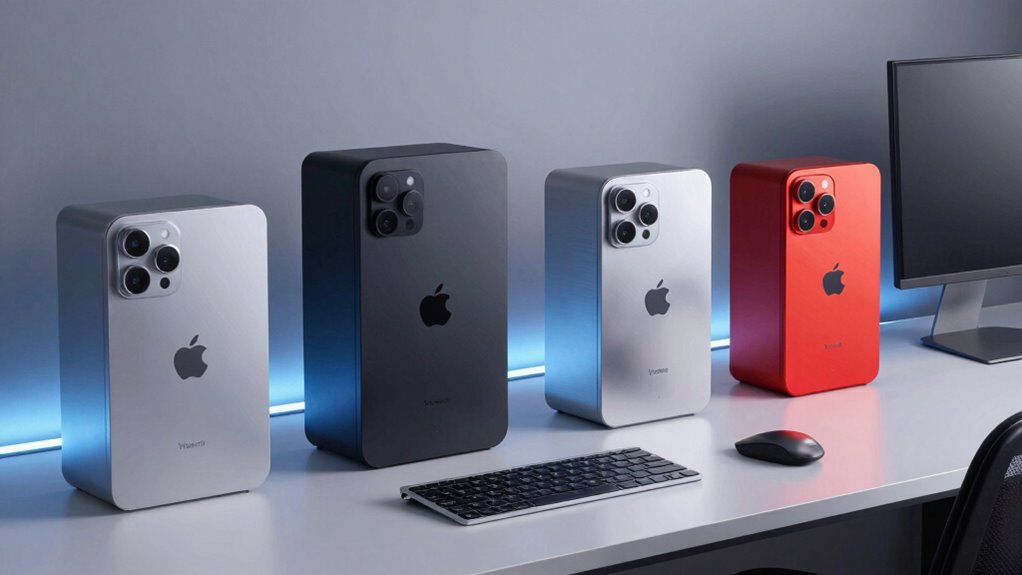

If I had to pick the four best Mac Studio configurations for 2026, I’d focus on high performance and future-proofing: a model with the latest M4 or M4 Pro chip, plenty of RAM—at least 24GB—and large SSDs to handle big projects. I’d also consider models with extra GPU cores and expandability options for long-term use. Keep an eye on potential upgrades and external accessories, and if you keep exploring, you’ll discover even more ways to optimize your setup.
Key Takeaways
- Prioritize high-performance configurations with the latest M4 Pro or M4 Max chips for demanding workflows in 2026.
- Opt for at least 32GB of RAM and 1TB+ SSD to future-proof multitasking and large project handling.
- Ensure ample and versatile connectivity options, including multiple Thunderbolt, HDMI, and USB-C ports for expanding peripherals.
- Choose upgradeable models or external expandability like PCIe cards to adapt to upcoming hardware and software advancements.
- Balance budget with long-term value by selecting configurations that support upcoming software requirements and scalable storage.
| Apple 2024 Mac mini with M4 chip and 16GB RAM |  | High-Performance Powerhouse | Size: 5×5 inches | Connectivity Ports: Thunderbolt, HDMI, Gigabit Ethernet, USB-C, headphone jack | Processor: M4 with 10-core CPU | VIEW LATEST PRICE | See Our Full Breakdown |
| Apple Mac mini M4 Desktop with 16GB 256GB SSD | | Compact Efficiency | Size: 5×5 inches | Connectivity Ports: Thunderbolt, HDMI, Gigabit Ethernet, USB-C, headphone jack | Processor: M4 with 10-core CPU | VIEW LATEST PRICE | See Our Full Breakdown |
| Apple 2024 Mac mini with M4 Pro 24GB 512GB SSD | | Creative Powerhouse | Size: 5×5 inches | Connectivity Ports: Thunderbolt, HDMI, Gigabit Ethernet, USB-C, headphone jack | Processor: M4 Pro with 12-core CPU | VIEW LATEST PRICE | See Our Full Breakdown |
| Apple 2024 Mac mini with M4 Chip and 24GB RAM | | Versatile Workhorse | Size: 5×5 inches | Connectivity Ports: Thunderbolt, HDMI, Gigabit Ethernet, USB-C, headphone jack | Processor: M4 with 10-core CPU | VIEW LATEST PRICE | See Our Full Breakdown |
More Details on Our Top Picks
-
Apple 2024 Mac mini Desktop Computer with M4 chip with 10‑core CPU and 10‑core GPU: Built for Apple Intelligence, 16GB Unified Memory, 256GB SSD Storage, Gigabit Ethernet. Works with iPhone/iPad
SIZE DOWN. POWER UP — The far mightier, way tinier Mac mini desktop computer is five by five...
As an affiliate, we earn on qualifying purchases.
Apple 2024 Mac mini with M4 chip and 16GB RAM
If you’re looking for a compact yet powerful desktop, the Apple 2024 Mac mini with M4 chip and 16GB RAM is an excellent choice. Its small five-by-five-inch design fits easily next to your monitor, making it ideal for tight spaces. Despite its size, it delivers impressive performance thanks to the M4 chip’s 10-core CPU and GPU, paired with 16GB of unified memory and a 512GB SSD. Multiple ports—including Thunderbolt, HDMI, and USB-C—offer excellent connectivity. Plus, its seamless integration with Apple’s ecosystem and enhanced privacy features make it a versatile, reliable machine for work and creative projects.
- Size:5×5 inches
- Connectivity Ports:Thunderbolt, HDMI, Gigabit Ethernet, USB-C, headphone jack
- Processor:M4 with 10-core CPU
- RAM:16GB
- Storage:512GB SSD
- Ecosystem & Compatibility:Supports Apple, Microsoft 365, Adobe CC, iPhone/iPad mirroring
- Additional Feature:Supports macOS productivity apps
- Additional Feature:Works with iPhone/iPad features
- Additional Feature:Carbon neutral manufacturing
-
Apple 2024 Mac mini Desktop Computer with M4 Pro chip with 12‑core CPU and 16‑core GPU: Built for Apple Intelligence, 24GB Unified Memory, 512GB SSD Storage, Gigabit Ethernet. Works with iPhone/iPad
SIZE DOWN. POWER UP — The far mightier, way tinier Mac mini desktop computer is five by five...
As an affiliate, we earn on qualifying purchases.
Apple Mac mini M4 Desktop with 16GB 256GB SSD
The Apple Mac mini M4 Desktop with 16GB of RAM and a 256GB SSD is an excellent choice for professionals and small businesses seeking a compact yet powerful workstation. Its five-by-five-inch design fits easily next to monitors, saving space without sacrificing performance. Powered by the M4 chip with a 10-core CPU and GPU, it delivers fast, smooth performance for multitasking and creative tasks. With versatile connectivity options like Thunderbolt, HDMI, and USB-C, it supports a wide range of peripherals. Seamlessly integrated into the Apple ecosystem, it offers quick app performance and enhanced privacy, making it an efficient, environmentally conscious desktop for modern workflows.
- Size:5×5 inches
- Connectivity Ports:Thunderbolt, HDMI, Gigabit Ethernet, USB-C, headphone jack
- Processor:M4 with 10-core CPU
- RAM:16GB
- Storage:256GB SSD
- Ecosystem & Compatibility:Supports Apple, Microsoft 365, Adobe CC, iPhone mirroring
- Additional Feature:Optimized for Apple Silicon
- Additional Feature:Seamless ecosystem integration
- Additional Feature:Supports device mirroring and Messages
-
Apple 2024 Mac mini Desktop Computer with M4 chip with 10‑core CPU and 10‑core GPU: Built for Apple Intelligence, 24GB Unified Memory, 512GB SSD Storage, Gigabit Ethernet. Works with iPhone/iPad
SIZE DOWN. POWER UP — The far mightier, way tinier Mac mini desktop computer is five by five...
As an affiliate, we earn on qualifying purchases.
Apple 2024 Mac mini with M4 Pro 24GB 512GB SSD
For professionals seeking a compact yet powerful desktop, the Apple 2024 Mac mini with M4 Pro, 24GB of memory, and a 512GB SSD stands out as an ideal choice. Its small five-by-five-inch design easily fits next to a monitor or in tight spaces, yet it packs a punch with a 12-core M4 Pro chip and a 16-core GPU. The 24GB of unified memory ensures smooth multitasking, while the fast SSD handles large files effortlessly. With multiple ports—including Thunderbolt, HDMI, and Ethernet—and seamless integration with Apple devices, it’s perfect for demanding workflows and creative projects in a space-efficient package.
- Size:5×5 inches
- Connectivity Ports:Thunderbolt, HDMI, Gigabit Ethernet, USB-C, headphone jack
- Processor:M4 Pro with 12-core CPU
- RAM:24GB
- Storage:512GB SSD
- Ecosystem & Compatibility:Supports Apple, Microsoft 365, Adobe CC, iPhone/iPad mirroring
- Additional Feature:Handles complex projects
- Additional Feature:Designed for space efficiency
- Additional Feature:Supports FaceTime and sharing
Apple 2024 Mac mini with M4 Chip and 24GB RAM
Power users seeking a compact yet high-performance desktop will find the Apple 2024 Mac mini with M4 chip and 24GB RAM to be an ideal choice. Its small five-by-five-inch design fits perfectly beside monitors or in tight spaces, yet it packs a punch with a 10-core CPU and GPU, plus 24GB of unified memory. The 512GB SSD ensures speedy storage and responsiveness. It offers versatile connectivity with Thunderbolt, HDMI, USB-C, Ethernet, and a headphone jack. Built on macOS, it handles demanding apps like Adobe Creative Cloud effortlessly and integrates seamlessly with other Apple devices, all while maintaining Apple’s high standards for privacy and environmental responsibility.
- Size:5×5 inches
- Connectivity Ports:Thunderbolt, HDMI, Gigabit Ethernet, USB-C, headphone jack
- Processor:M4 with 10-core CPU
- RAM:24GB
- Storage:512GB SSD
- Ecosystem & Compatibility:Supports Apple, Microsoft 365, Adobe CC, iPhone/iPad mirroring
- Additional Feature:Built for demanding tasks
- Additional Feature:Privacy protections included
- Additional Feature:Eco-friendly, carbon neutral
Factors to Consider When Choosing Mac Studio Configurations
When choosing a Mac Studio configuration, I focus on my performance needs first to guarantee it handles my tasks efficiently. I also consider my budget, storage space, and connectivity options to match my workflow. Finally, I think about my intended usage to select the best setup that balances power and practicality.
Performance Needs Assessment
Choosing the right Mac Studio configuration starts with understanding the demanding nature of your tasks. I assess whether I’ll be doing intensive video editing, 3D rendering, or software development, which helps determine the needed performance level. RAM is vital for smooth multitasking and large projects; I typically look for 16GB or more for demanding workflows. If my work involves graphically intensive applications, I consider high-performance GPU options like the M4 Pro’s 16-core GPU. I also evaluate whether faster storage solutions—such as larger SSD capacities or faster data transfer speeds—benefit my workflow. By matching these performance needs with available Mac Studio configurations, I guarantee a balanced setup that provides enough power now and future-proofing for upcoming tasks. This assessment helps me choose a configuration that’s both efficient and scalable.
Budget Considerations
Evaluating your budget is a key step after understanding your performance needs because it helps narrow down your Mac Studio options and prevents overspending. Higher-end configurations with more RAM and larger storage come at increased costs, so it’s essential to weigh your performance requirements against your financial limits. If you plan to use resource-intensive applications regularly, investing in more powerful hardware could offer better long-term value. Balance the cost of upgrades like additional RAM or bigger SSDs with your current and future use cases. If budget constraints are tight, consider financing or installment plans, which can make higher-spec models more accessible without a hefty upfront expense. Being realistic about your budget guarantees you get the best value without sacrificing essential performance.
Storage Requirements
How much storage do you really need for your Mac Studio? Think about your current files and future projects. If you work with large media files, datasets, or run many applications, opting for 512GB or more makes sense. Larger SSDs provide faster access to data, boosting productivity. Keep in mind, you can supplement internal storage with external drives if needed, which helps manage costs. However, higher storage capacities do increase the overall price of your Mac Studio. Assess your workflow carefully—if quick data transfer and ample space are priorities, investing in more internal storage is worthwhile. Balancing your needs with your budget is key here; choose a capacity that comfortably supports your projects now and in the near future.
Connectivity Options
When selecting a Mac Studio, it’s vital to take into account its connectivity options to guarantee your workflow runs smoothly. Make sure the setup includes essential ports like Thunderbolt, HDMI, and Gigabit Ethernet for versatile connectivity. Front-facing USB-C ports are particularly convenient for quick access to peripherals without reaching behind the device. Check if the ports support your preferred external devices, such as high-speed storage, external displays, or audio equipment. Consider the number of ports to allow for future expansion, reducing the need for adapters or hubs later on. Also, confirm the connectivity options are compatible with your existing workspace setup and peripheral devices. A well-rounded configuration will keep your workflow efficient and adaptable as your needs evolve.
Intended Usage Type
Choosing the right Mac Studio configuration depends heavily on your intended usage. If you’re into demanding tasks like video editing or 3D rendering, you’ll need higher-end specs with more GPU cores and greater memory capacity to handle large files smoothly. For everyday office work, web browsing, or light productivity, a base or mid-tier setup with sufficient RAM and storage will do the job without overkill. Creative professionals working with complex software benefit from increased processing power and memory, while software developers or multi-taskers should prioritize faster storage and more RAM for efficiency. It’s also wise to contemplate future scalability, such as adding extra storage or upgrading components if your needs grow, ensuring your setup remains capable over time.
Future Upgrade Plans
Selecting the right Mac Studio configuration now means thinking ahead about future upgrades and expandability. I consider whether the RAM can be upgraded later, as some models might have soldered memory that’s not replaceable. I also evaluate if I can increase storage capacity, especially if the initial SSD isn’t user-accessible. Upgrading the GPU or CPU isn’t possible in many models, so I look for configurations with future-proof components. Compatibility with upcoming software updates and hardware accessories is vital, so I choose specs that meet future requirements. Additionally, I plan for external expandability through extra drives, PCIe cards, or peripheral connections, considering the available ports. Thinking ahead helps guarantee my Mac Studio remains capable and adaptable for years to come.
Compatibility With Devices
Making certain your Mac Studio has the right ports and connectivity options is vital for seamless integration with your existing devices. You’ll want to verify that it includes ports like Thunderbolt, HDMI, or USB-C, which match your peripherals and external displays. Compatibility with your ecosystem is also essential—features like iPhone mirroring, Messages, and FaceTime should work smoothly. Check if the hardware specifications meet the demands of your peripherals to avoid bottlenecks. Additionally, make sure your preferred software applications are optimized for your chosen configuration. Finally, consider the power and data transfer needs of your devices to select a setup that guarantees efficient, reliable connections. This careful approach guarantees your Mac Studio integrates effortlessly with your workflow.
Frequently Asked Questions
How Will Future Mac Studio Upgrades Impact Configuration Choices in 2026?
Future Mac Studio upgrades will definitely influence my configuration choices in 2026. I expect faster processors, more RAM, and improved graphics to become standard, pushing me to upgrade for better performance. I’ll also consider energy efficiency and new features like enhanced connectivity. Staying informed about these upgrades helps me decide whether to invest now or wait for the latest tech, ensuring I get the best value and performance for my needs.
Are There Compatibility Concerns With Newer Software on Upcoming Mac Studio Models?
Yes, there could be compatibility concerns with newer software on upcoming Mac Studio models. Apple’s constant updates might mean some older applications or plugins become obsolete or require updates. I recommend staying current with software releases and checking compatibility before upgrading. To avoid issues, I always verify my essential programs are optimized for the latest macOS versions and keep backups in case I need to revert.
What Third-Party Accessories Are Recommended for the Best Mac Studio Performance?
For ideal Mac Studio performance, I recommend high-quality external SSDs like Samsung T7 for fast storage, a reliable USB-C hub to expand connectivity, and a calibrated monitor for accurate visuals. I also use a professional-grade keyboard and mouse for comfort during long work sessions. These accessories boost productivity, guarantee seamless data transfer, and enhance your overall experience, making your setup more efficient and enjoyable.
How Do Emerging Storage Technologies Influence Mac Studio Storage Options?
Think of emerging storage tech as a bustling highway system expanding rapidly. It influences Mac Studio storage options by offering faster, more flexible pathways for data. I can choose Thunderbolt 4 or even newer protocols to boost my workflow, reducing bottlenecks. These innovations mean I’ll have more room to grow, handle larger files, and enjoy smoother performance. Staying updated guarantees my setup remains a powerful, future-proof hub for creativity and productivity.
Will Apple Introduce New Ports or Connectivity Features in 2026 Mac Studio Models?
I believe Apple will likely introduce new ports or connectivity features in the 2026 Mac Studio models to keep up with evolving user needs. They might incorporate faster Thunderbolt or USB-C options, or even new wireless standards. As someone excited about tech innovation, I think these updates will enhance performance, improve compatibility, and make the Mac Studio even more versatile for professionals and creatives alike.
Conclusion
Choosing the right Mac Studio setup is like balancing creativity and power; sometimes, I need the raw strength of an M4 Pro, while other times, a sleek M4 mini does the trick. It’s about knowing what’s essential—speed, storage, or budget—and finding that sweet spot. Whether you’re pushing boundaries or just getting started, your perfect configuration awaits. After all, the best Mac is the one that fits your goals and keeps you inspired.