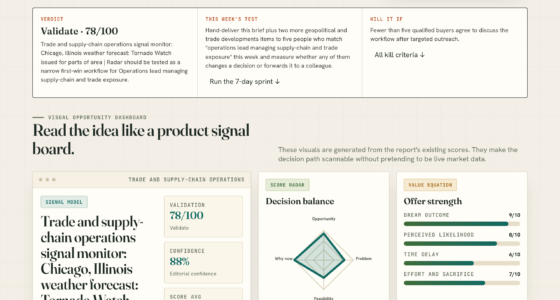

📊 Full opportunity report: Sovereignty Is a Pipe, Not a Passport on ThorstenMeyerAI.com — validation score, market gap, and execution plan.
TL;DR
European AI firm Mistral claims sovereignty based on infrastructure and legal jurisdiction, but the reliance on American cloud platforms complicates this. The core issue is whether sovereignty is about data location or legal control.
Mistral, a European AI company valued at $14 billion, claims its sovereignty stems from hosting models on European infrastructure and legal jurisdiction, not merely company nationality. This assertion challenges common assumptions about data sovereignty and cloud security, making it a significant development for European digital independence.
While Mistral promotes its sovereignty by distributing models through European data centers and offering on-premise, self-hosted options, it also relies on American cloud providers like Microsoft Azure, Google Cloud, and Amazon Web Services to deliver its models. This reliance introduces potential legal exposure under U.S. laws such as the CLOUD Act, which allows U.S. authorities to compel data access regardless of physical location, as confirmed by legal experts.
Legal frameworks like the 2018 CLOUD Act and the 2020 Schrems II ruling emphasize that jurisdiction, not physical location, determines data access rights. Even if data resides in European data centers, hosting on U.S.-based cloud infrastructure can expose that data to U.S. legal reach, complicating claims of sovereignty based solely on infrastructure. European regulators remain cautious, especially after controversies like France’s Health Data Hub, which involved data physically stored in Europe but hosted by U.S.-based providers.
However, Mistral’s true sovereignty advantage exists when models are run entirely within European-controlled environments—self-hosted, on-premise, or on European cloud infrastructure—where U.S. laws do not apply. European certifications and funding structures further reinforce this position. Yet, the dependency on hardware suppliers like Nvidia, which is U.S.-based, and subcontractors in the supply chain, means sovereignty is limited at the hardware level.
Sovereignty is a pipe, not a passport
Mistral sells European data sovereignty — then distributes its models through Azure, Bedrock & Google Cloud, the American infrastructure it tells customers to flee. A French passport on the lab doesn’t travel down an American wire.
Mistral-direct
hyperscaler
The CLOUD Act lets US authorities compel a US-headquartered provider to hand over data wherever it physically sits. Picking the “EU region” in AWS or Azure doesn’t resolve it — jurisdiction follows the company’s HQ, not the server’s location. Schrems II established the same from the EU side.
Mistral isn’t selling a lie — it’s selling a conditional truth, and the condition is the part the marketing skips. Sovereignty holds on Mistral’s own iron; it leaks the moment convenience routes the model through the American cloud. The deeper lesson cuts at Brussels: sovereignty is an end-to-end property of the whole stack — model, cloud, chips, supply chain — that Europe owns at no layer except the model itself. As Mensch put it: you “cannot regulate your way to computing supremacy.”
Implications of Legal Jurisdiction on Data Sovereignty Claims
This development underscores that data sovereignty is less about the physical location of servers and more about the legal jurisdiction governing the data. For European companies, claiming sovereignty requires control over both infrastructure and legal compliance. The reliance on U.S.-based cloud platforms complicates sovereignty claims, as U.S. laws like the CLOUD Act can override physical safeguards, impacting European trust in cloud sovereignty initiatives.
European regulators and enterprises are increasingly aware that infrastructure alone does not guarantee sovereignty. The industry’s shift towards European-controlled hosting and hardware aims to address these concerns, but dependencies on U.S. legal frameworks and supply chains remain significant hurdles. The debate influences procurement decisions, regulatory policies, and the future of European AI independence.
European data center server hardware
As an affiliate, we earn on qualifying purchases.
As an affiliate, we earn on qualifying purchases.
European Data Sovereignty and Cloud Jurisdiction Challenges
The concept of sovereignty in data has been a contentious issue since the 2018 enactment of the U.S. CLOUD Act, which permits U.S. authorities to access data held by American companies regardless of location. The 2020 Schrems II ruling further complicated matters by invalidating the EU-US Privacy Shield, emphasizing that jurisdiction, not data location, determines legal access. European regulators, including France and Germany, have expressed ongoing concerns about data stored within European borders but hosted by U.S.-based providers, exemplified by the controversy surrounding France’s Health Data Hub.
European companies and governments are increasingly investing in local infrastructure, certifications like SecNumCloud and BSI C5, and self-hosted solutions to mitigate legal risks. However, the hardware supply chain remains predominantly U.S.-centric, with Nvidia controlling a large share of AI chips, and subcontractors often answer to U.S. export laws. This layered dependency complicates efforts to achieve true sovereignty.
Meanwhile, industry players like Mistral are attempting to position themselves as sovereign alternatives by emphasizing infrastructure and legal jurisdiction, but the reliance on American cloud platforms and hardware continues to challenge these claims.
“Jurisdiction, not physical location, determines the legal reach of data under laws like the CLOUD Act. Hosting data in Europe does not automatically shield it from U.S. legal access if the provider is U.S.-based.”
— Legal Expert
self-hosted AI model deployment tools
As an affiliate, we earn on qualifying purchases.
As an affiliate, we earn on qualifying purchases.
Legal and Technical Limits of European Data Sovereignty
It remains unclear how European regulators will enforce sovereignty in practice, especially as cloud providers develop EU-specific data residency options that still operate within U.S. legal frameworks. The effectiveness of European certifications and hardware supply chain independence in fully mitigating U.S. legal exposure is also uncertain. Additionally, the extent to which fully self-hosted, hardware-independent models can be scaled remains to be seen, particularly given hardware supply dependencies and international export laws.
European cloud infrastructure providers
As an affiliate, we earn on qualifying purchases.
As an affiliate, we earn on qualifying purchases.
Future Regulatory and Industry Responses to Data Jurisdiction Challenges
European regulators are likely to continue scrutinizing cloud and hardware supply chains, potentially introducing stricter standards for sovereignty claims. Industry players like Mistral may expand self-hosted offerings and European infrastructure investments to strengthen sovereignty assertions. Meanwhile, legal debates over jurisdiction and the development of U.S. cloud services with European controls will shape procurement and compliance strategies in the coming years. Monitoring regulatory decisions and industry shifts will be critical for understanding the evolving landscape of data sovereignty.
privacy-focused data sovereignty hardware
As an affiliate, we earn on qualifying purchases.
As an affiliate, we earn on qualifying purchases.
Key Questions
Does hosting data in Europe guarantee sovereignty?
Not necessarily. Hosting data within European borders does not automatically prevent U.S. legal access if the hosting provider is U.S.-based or answers to U.S. laws like the CLOUD Act.
Can European companies fully escape U.S. legal jurisdiction?
Only if they operate entirely within European-controlled infrastructure, including hardware, and avoid U.S.-based cloud services. Dependencies on U.S. hardware and subcontractors complicate this.
Will European regulations tighten controls over cloud providers?
European regulators are likely to enhance standards and certifications to better enforce sovereignty claims, but legal and technical dependencies remain challenges.
Is self-hosting a viable solution for sovereignty?
Self-hosting and on-premise models offer stronger sovereignty assurances, but scalability, hardware dependencies, and costs are significant considerations.
How does hardware supply chain affect sovereignty?
Most AI hardware, especially GPUs from Nvidia, is U.S.-based, and export laws influence hardware availability and compliance, limiting sovereignty at the hardware level.
Source: ThorstenMeyerAI.com