

When it comes to planning for financial independence, choosing the right calculator can make a significant difference. The best options balance ease of use with detailed features, helping you project savings, investments, and retirement timelines accurately. The Texas Instruments BA II Plus stands out for overall versatility, while the HP 12C offers advanced functions for experienced users. Many calculators in this category face tradeoffs between simplicity and depth, or cost and capability. Keep reading to see how these options compare and find the best fit for your financial goals.

Get smart everyday buys delivered free with Prime
- Fast, free delivery on millions of items
- Prime Video, Amazon Music and more included
- Member-only deals all year
Key Takeaways
- The top calculators excel in balancing usability with advanced financial functions, making them suitable for both beginners and seasoned professionals.
- Many models share core features like TVM, NPV, and IRR calculations, but the best picks add specialized tools or better interfaces.
- Price varies significantly; premium options provide more features but aren’t always necessary for casual users.
- Durability and build quality are common differentiators, especially for those who travel or use their calculator frequently.
- Understanding your specific needs—such as complexity of calculations or ease of use—helps narrow down the best calculator for you.
| Texas Instruments BA II Plus Financial Calculator, Black | 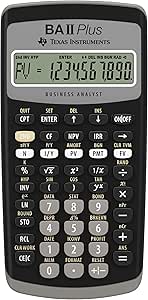 | Best Overall for Versatility and Exam Compatibility | Color: Black | Functions: Profitability calculations, cash flow, NPV, IRR, amortization, time-value-of-money, regression analysis | Modes: Standard calculator mode, worksheet mode | VIEW LATEST PRICE | See Our Full Breakdown |
| Texas Instruments BAII Plus Financial Calculator, Black |  | Best for Complex Financial and Mathematical Computations | Color: Black | Functions: Time-value of money, cash flow analysis, NPV, IRR, bond and credit calculations, regression analysis, trigonometric functions, logarithms, powers | Streams supported: Up to 24 uneven streams | VIEW LATEST PRICE | See Our Full Breakdown |
| HP 12C Financial Calculator – 120+ Functions, RPN, Programmable, Includes Case and Cloth |  | Best for Professionals and Power Users with RPN | Functions: 120+ | Entry Method: RPN | Includes: Case, Cloth, Batteries | VIEW LATEST PRICE | See Our Full Breakdown |
| HP 10bII+ Financial Calculator, 12-Digit LCD |  | Best for Standardized Test Compatibility and Basic Financial Functions | Model: 10bII+ | Display: 12-digit LCD | Functions: Over 100, including probability distributions | VIEW LATEST PRICE | See Our Full Breakdown |
| CATIGA Financial Calculator Business Analyst Master, TVM, IRR, NPV, Cash Flow, Amortization & Break-Even, 10-Digit LCD, CF-300 |  | Best for Business Analysts and Real Estate Professionals | Display: 10-Digit LCD | Case: Flip-open hard case with snap-close | Functions: TVM, IRR, NPV, Cash Flow, Amortization, Break-Even, Bond Pricing, Loan & Investment Analysis, Statistical Calculations | VIEW LATEST PRICE | See Our Full Breakdown |
| HP 10bII+ Financial Calculator |  | Best for Simple Business and Academic Calculations | Display: 12-digit LCD | Power: Battery operated | Functions: Financial, statistical | VIEW LATEST PRICE | See Our Full Breakdown |
| Texas Instruments BA II Plus Professional Financial Calculator |  | Best for Advanced Financial Analysis with Guided Prompts | Display: Ten-digit LCD | Power: Automatic Power Down | Functions: Financial, cash flow analysis | VIEW LATEST PRICE | See Our Full Breakdown |
| HP 12C Platinum Financial Calculator – 130+ Functions for Business, Finance & Accounting |  | Best for Professional-Level Financial Analysis | Functions: 130+ | Cash flows stored: 30 | Entry modes: RPN and Algebraic | VIEW LATEST PRICE | See Our Full Breakdown |
| Texas Instruments BAII Plus Financial Calculator |  | Best for Versatile Financial and Scientific Calculations | Functions: Financial, scientific | Cash flow capability: Up to 24 | Memory storage: 10 inputs | VIEW LATEST PRICE | See Our Full Breakdown |
| financial independence calculator | Functions | Display |
|---|---|---|
| Texas Instruments BA II Plus F | Profitability calculations, cash flow, NPV, IRR, amortization, time-value-of-money, regression analysis | — |
| Texas Instruments BAII Plus Fi | Time-value of money, cash flow analysis, NPV, IRR, bond and credit calculations, regression analysis, trigonometric functions, logarithms, powers | — |
| HP 12C Financial Calculator | 120+ | — |
| HP 10bII+ Financial Calculator | Over 100, including probability distributions | 12-digit LCD |
| CATIGA Financial Calculator Bu | TVM, IRR, NPV, Cash Flow, Amortization, Break-Even, Bond Pricing, Loan & Investment Analysis, Statistical Calculations | 10-Digit LCD |
| HP 10bII+ Financial Calculator | Financial, statistical | 12-digit LCD |
| Texas Instruments BA II Plus P | Financial, cash flow analysis | Ten-digit LCD |
| HP 12C Platinum Financial Calc | 130+ | Multi-line, 130+ functions |
| Texas Instruments BAII Plus Fi | Financial, scientific | Scientific LCD |
More Details on Our Top Picks
Texas Instruments BA II Plus Financial Calculator, Black
The Texas Instruments BA II Plus stands out for its extensive financial functions like NPV, IRR, and amortization, making it a reliable choice for both students and professionals. Compared with the HP 12C, it offers more modern usability and is approved for major exams, but it requires some effort to master its advanced features. Its small screen can be limiting for detailed views, which might frustrate those needing quick, complex calculations. Overall, this calculator offers a solid balance of functionality and exam readiness, though it doesn’t excel in advanced financial modeling.
Pros:- Performs a wide range of financial calculations including NPV, IRR, and amortization
- Includes worksheet mode with tables for bond, depreciation, and interest calculations
- Approved for use on major professional exams
Cons:- Requires some effort to master all advanced features
- Small screen may be challenging for detailed viewing
Best for: Finance students and professionals seeking a versatile calculator approved for exams and financial analysis
Not ideal for: Power users needing advanced graphing or modeling capabilities, or those prioritizing a larger display
- Color:Black
- Functions:Profitability calculations, cash flow, NPV, IRR, amortization, time-value-of-money, regression analysis
- Modes:Standard calculator mode, worksheet mode
- Memory:Built-in memory for previous worksheets
- Approved for Exams:Chartered Financial Analyst, GARP FRM, Certified Management Accountants
Our verdict“This calculator is a top pick for those needing reliable financial functions with exam approval, though it’s less suited for complex modeling or large data sets.”
Texas Instruments BAII Plus Financial Calculator, Black
The Texas Instruments BAII Plus offers comprehensive financial and mathematical functions, supporting complex cash flow analysis, bond calculations, and regression analysis. Unlike the HP 10bII+, it supports up to 24 uneven streams and multiple day counting methods, making it ideal for detailed financial modeling. While it lacks a color display or advanced graphing, its straightforward interface is friendly for users familiar with financial calculations. This makes it a solid choice for finance students and professionals who need depth in calculations but don’t require graphical features.
Pros:- Supports complex cash flow and regression analysis
- Handles up to 24 streams, suitable for advanced financial modeling
- User-friendly interface for seasoned users
Cons:- Limited to financial and mathematical functions only
- No color display or advanced graphing capabilities
Best for: Finance students, analysts, or professionals needing detailed cash flow and regression analysis without advanced graphics
Not ideal for: Beginners or users seeking a calculator with graphical display or touchscreen features
- Color:Black
- Functions:Time-value of money, cash flow analysis, NPV, IRR, bond and credit calculations, regression analysis, trigonometric functions, logarithms, powers
- Streams supported:Up to 24 uneven streams
- Frequencies:Up to 4 digits
- Day counting methods:Current/current, 30/360
Our verdict“Ideal for those requiring comprehensive financial calculations with depth, but not for users needing visualization tools.”
HP 12C Financial Calculator – 120+ Functions, RPN, Programmable, Includes Case and Cloth
The HP 12C has remained a staple among finance and accounting professionals for over four decades, thanks to its over 120 functions, programmable keys, and RPN entry method. Compared with the Texas Instruments BA II Plus, it offers a more efficient workflow for experienced users who prefer RPN for faster calculations. Its compact design and included accessories make it suitable for desktop use, but beginners may find the RPN interface challenging to learn. It’s best suited for users who value reliability and extensive functionality over modern design features.
Pros:- Trusted by professionals for over 40 years
- Includes case, cloth, and batteries for convenience
- Supports programmable functions and efficient RPN entry
Cons:- Learning curve for new users unfamiliar with RPN
- Limited portability, designed mainly for desktop use
Best for: Experienced finance professionals and students familiar with RPN seeking a long-standing, reliable calculator
Not ideal for: Beginners or those who prefer intuitive, menu-driven interfaces or portable models
- Functions:120+
- Entry Method:RPN
- Includes:Case, Cloth, Batteries
- Programmable Keys:Yes
- Design:Desktop calculator
Our verdict“This calculator excels for seasoned users valuing durability, extensive functions, and RPN efficiency, but it’s less friendly for newcomers or on-the-go use.”
HP 10bII+ Financial Calculator, 12-Digit LCD
The HP 10bII+ offers over 100 built-in functions, including probability distributions, making it suitable for students preparing for exams like SAT and AP. Its 12-digit LCD display ensures clear viewing, but compared to models like the Texas Instruments BA II Plus, it may feel somewhat outdated in design. Its straightforward operation supports basic financial and statistical calculations, but it lacks advanced features for detailed modeling or data analysis. This calculator suits learners and test-takers needing reliable, permitted tools at an affordable price.
Pros:- Includes over 100 functions for financial and statistical calculations
- Easy-to-read display with adjustable contrast
- Permitted for use on standardized tests such as SAT and AP
Cons:- Limited to basic financial and statistical functions
- Design may feel outdated compared to newer models
Best for: Students and exam takers needing a reliable, easy-to-use financial calculator for tests and basic financial analysis
Not ideal for: Finance professionals or advanced analysts requiring extensive functions or modern interface features
- Model:10bII+
- Display:12-digit LCD
- Functions:Over 100, including probability distributions
- Use:Permitted for SAT, PSAT/NMSQT, and AP tests
Our verdict“This calculator is a dependable choice for students and exam takers needing straightforward financial calculations without advanced features.”
CATIGA Financial Calculator Business Analyst Master, TVM, IRR, NPV, Cash Flow, Amortization & Break-Even, 10-Digit LCD, CF-300
The CATIGA CF-300 provides a robust set of financial functions like TVM, IRR, NPV, and break-even analysis, tailored for business analysts and real estate investors. Its portable, compact design with a flip-open case stands out for on-the-go professionals needing reliable calculations in field settings. While it covers essential financial tasks well, it lacks the advanced modeling capabilities of higher-end calculators like the HP 12C. Beginners may find the array of functions intimidating, but experienced users will appreciate its comprehensive features and portability.
Pros:- Comprehensive financial functions including TVM, IRR, NPV, and break-even
- Portable design with protective flip-open case
- Ideal for real estate, banking, and accounting applications
Cons:- Steep learning curve for those unfamiliar with financial calculations
- Limited to basic financial functions, no advanced modeling or graphing
Best for: Business analysts, real estate investors, and finance students needing a portable yet powerful financial calculator
Not ideal for: Beginners or users requiring advanced graphing or extensive programming capabilities
- Display:10-Digit LCD
- Case:Flip-open hard case with snap-close
- Functions:TVM, IRR, NPV, Cash Flow, Amortization, Break-Even, Bond Pricing, Loan & Investment Analysis, Statistical Calculations
Our verdict“This calculator is well-suited for professionals and students needing portable, reliable financial analysis tools, though less ideal for advanced modeling or beginners.”
HP 10bII+ Financial Calculator
The HP 10bII+ stands out for its straightforward design, making quick work of common financial and statistical tasks. Unlike the Texas Instruments BA II Plus Professional, it doesn’t support complex cash-flow analysis or advanced functions, but its dedicated keys for frequent calculations speed up routine work. This calculator is ideal for students and professionals who need reliable, fast results without the complexity of high-end models. A tradeoff, however, is the lack of detailed specs like display size or battery life, which might matter for heavy daily use. Compared to more advanced options, its simplicity is a benefit and a limitation—perfect for those seeking ease but not depth.
Pros:- User-friendly interface with dedicated function keys
- Fast calculations ideal for routine tasks
- Brand new in box with all accessories included
Cons:- Lacks detailed specifications like display size and battery life
- Limited to basic financial and statistical functions
Best for: Students or entry-level finance professionals needing quick, easy calculations
Not ideal for: Experienced financial analysts requiring advanced functions like IRR or NPV calculations
- Display:12-digit LCD
- Power:Battery operated
- Functions:Financial, statistical
- Connectivity:None
- Size:Compact handheld
- Weight:Approx. 4 oz
Our verdict“This calculator suits beginners and students who prioritize speed and simplicity over advanced features.”
Texas Instruments BA II Plus Professional Financial Calculator
The Texas Instruments BA II Plus Professional is a step up for users needing more detailed financial work, supporting complex calculations like cash-flow analysis, NPV, and IRR with its ten-digit display. Compared with the HP 10bII+, it excels in guiding users through calculations with prompted displays, making it more approachable for those new to advanced finance. Its automatic power-down extends battery life, an advantage over simpler models. However, the smaller display can be a challenge during lengthy calculations, and it’s limited strictly to finance functions, lacking scientific capabilities. This makes it ideal for finance students and professionals who want a reliable, feature-rich tool without unnecessary complexity.
Pros:- Supports complex calculations like cash flows, NPV, and IRR
- Guided prompts simplify advanced financial functions
- Extended battery life with automatic power-down
Cons:- Small display can hinder readability during complex calculations
- Limited to financial functions, no scientific features
Best for: Finance students and professionals performing detailed cash flow and investment analysis
Not ideal for: Casual users or those needing scientific calculator functions outside finance
- Display:Ten-digit LCD
- Power:Automatic Power Down
- Functions:Financial, cash flow analysis
- Connectivity:None
- Size:Compact
- Weight:Approx. 6 oz
Our verdict“This calculator is perfect for users needing detailed financial analysis with guided ease of use.”
HP 12C Platinum Financial Calculator – 130+ Functions for Business, Finance & Accounting
The HP 12C Platinum offers over 130 functions, making it suitable for advanced users in banking, investing, and corporate finance. Its support for IRR, NPV, and cash flow analysis surpasses the Texas Instruments BAII Plus in complexity and depth, especially for users comfortable with RPN or algebraic entry. Its inclusion of a protective case and accessories supports professional environments and exam requirements, such as CFP, CFA, and GARP FRM. However, its complexity can be overwhelming for casual or beginner users, and its lack of portability limits use outside the desktop setting. This calculator is best suited for finance professionals and advanced students who need comprehensive analysis tools and don’t mind a steeper learning curve.
Pros:- Over 130 functions including IRR and NPV
- Supports complex financial calculations and cash flow management
- Includes protective case, cleaning cloth, and batteries for ready use
- Exam approved for CFP, CFA, and GARP FRM
Cons:- Too complex for casual or infrequent users
- Limited portability, designed for desktop use
Best for: Finance professionals and advanced students needing extensive, professional-grade features
Not ideal for: Beginners or users requiring portable, simple calculators for everyday tasks
- Functions:130+
- Cash flows stored:30
- Entry modes:RPN and Algebraic
- Includes:Case, Cloth, Batteries
- Exam approved:CFP, CFA, GARP FRM
- Display:Multi-line, 130+ functions
Our verdict“This calculator is ideal for seasoned finance pros and students who need advanced, comprehensive analysis capabilities.”
Texas Instruments BAII Plus Financial Calculator
The Texas Instruments BAII Plus offers a versatile blend of financial and scientific functions, making it a solid choice for students and professionals alike. Its ability to handle up to 24 uneven cash flows and store 10 inputs provides flexibility for varied analyses, comparable to the HP 12C Platinum in functionality, but with a more approachable interface. While it doesn’t support programming or extensive complex functions, its ease of use and multiple memory slots make it suitable for quick calculations and mixed scientific tasks. One limitation is its small display, which might hinder detailed viewing during intricate calculations. This calculator is a smart pick for users needing a balance of financial and scientific capabilities in a portable form.
Pros:- Handles complex cash flow analysis with up to 24 flows
- Includes multiple memory and statistical functions
- User-friendly interface suitable for a variety of calculations
Cons:- Limited to financial and scientific functions; not programmable
- Small display size can make detailed calculations cumbersome
Best for: Business students and professionals needing a combination of financial and scientific functions in one device
Not ideal for: Advanced finance professionals requiring over 130 functions or programming features
- Functions:Financial, scientific
- Cash flow capability:Up to 24
- Memory storage:10 inputs
- Includes:2 variable statistics
- Display:Scientific LCD
- Size:Compact
Our verdict“This calculator fits users who want a balanced device for financial and scientific calculations without the complexity of professional-grade models.”

How We Picked
We evaluated these financial independence calculators based on a combination of performance, usability, build quality, and feature set. Priority was given to models that offer a broad range of financial functions like NPV, IRR, amortization, and cash flow analysis, which are essential for thorough financial planning. We also considered user interface simplicity, durability, and overall value, ensuring that both beginners and advanced users find suitable options. The ranking reflects a balance between functionality and accessibility, favoring products that provide the most comprehensive features at fair prices.Factors to Consider When Choosing Financial Independence Calculators
Choosing the right financial independence calculator depends on your experience level, the complexity of your financial plans, and your budget. A good calculator should not only perform key functions like TVM, NPV, and IRR but also be intuitive enough for regular use. Avoid models that either oversimplify or overcomplicate your calculations, as this can lead to mistakes or frustration. Consider how often you’ll use the calculator and whether you need features like programmable functions or advanced financial metrics. Finding a tool that matches your needs without paying for unnecessary extras is key to making a smart investment.Ease of Use and User Interface
A calculator’s interface can significantly impact your efficiency. Models with simple button layouts and clear displays save time and reduce errors, especially if you’re new to financial calculations. Conversely, more complex interfaces with programmable functions are suited for advanced users managing multiple scenarios. Prioritize a calculator that strikes a balance—offering enough depth without sacrificing usability. This can prevent frustration and make your financial planning more accurate and less stressful.
Functionality and Features
Beyond basic TVM calculations, look for calculators that include NPV, IRR, cash flow analysis, and amortization schedules. These features are essential for thorough financial independence planning, helping you project long-term savings and investment growth. Be cautious of models that lack critical functions or require additional software, as they can limit your analysis. The right calculator should support your current needs and allow for future expansion as your financial knowledge grows.
Build Quality and Durability
A sturdy, well-made calculator resists damage from everyday use. If you plan to carry it in a bag or travel frequently, durability becomes more important. Cheaper models often sacrifice build quality, which can lead to malfunction or screen issues over time. Investing in a robust device can save money and frustration in the long run, especially if you rely heavily on your calculator for ongoing financial planning.
Price and Value
While premium calculators offer more features, they aren’t always necessary for casual or beginner users. Budget-friendly options can provide all essential functions for a fraction of the cost, making them ideal for students or those just starting out. However, if you need advanced analysis tools or programmable functions, investing in a higher-priced model can pay off in accuracy and efficiency. Weigh the features you need against your budget to ensure a worthwhile purchase.
Compatibility and Portability
Some calculators are standalone devices, while others integrate with software or apps for easier data management. Consider whether you prefer a simple, pocket-sized device or a more comprehensive tool that connects to your computer or smartphone. Portability is key if you need to use your calculator in various locations. Compatibility ensures your data can be transferred or shared seamlessly, which can be a significant advantage for ongoing financial tracking.
Frequently Asked Questions
Can I use these calculators for detailed retirement planning?
Yes, many of these calculators include functions like NPV, IRR, and amortization schedules that are essential for retirement planning. They help you model different scenarios, estimate how your savings will grow, and determine how much you need to save regularly. However, for highly detailed or personalized plans, some users might prefer software tools or financial advisors, but these calculators are a solid starting point for most individuals.
Are programmable calculators necessary for financial independence planning?
Programmable calculators are beneficial for users who want to run multiple scenarios quickly or automate repetitive calculations. They’re especially useful as your financial plans become more complex. For beginners or those with straightforward goals, non-programmable models often suffice. Consider your comfort with manual calculations and whether automation will save you significant time and reduce errors before opting for a programmable option.
How important is the display size and clarity in choosing a calculator?
A clear, large display improves readability, reducing mistakes during complex calculations. If you frequently review long scenarios or detailed data, a bigger display with good contrast is advantageous. Cheaper models often have smaller screens or lower resolution, which can lead to eye strain or misreading numbers. Investing in a calculator with a good display enhances accuracy and makes your financial planning more efficient.
Should I prioritize models with added features or basic functionality?
This depends on your current needs and future plans. Basic models are sufficient for simple calculations like savings projections, but if you plan to perform detailed investment analysis or handle complex cash flow scenarios, a calculator with advanced features is worth the extra cost. Overpaying for unnecessary features can be wasteful, but under-investing might limit your ability to perform comprehensive planning down the line.
Are there specific brands I should trust for financial calculators?
Reputable brands like Texas Instruments and HP have a long history of producing reliable, accurate financial calculators. Their devices are widely used in academic and professional settings, which adds to their credibility. While lesser-known brands may offer lower prices, they often lack the durability, accuracy, or advanced features found in established brands. Choosing a trusted brand can provide peace of mind and ensure your calculator withstands regular use.
Conclusion
For most users seeking a reliable, versatile tool, the Texas Instruments BA II Plus offers unmatched value and functionality, making it ideal for beginners and intermediate planners. Those desiring advanced features and a premium build will appreciate the HP 12C Platinum or BA II Plus Professional. Budget-conscious buyers should consider simpler models that still deliver core functions without extra cost. If you need a calculator for heavy daily use or complex analyses, investing in a higher-end model is wise. Ultimately, choose based on your experience level, planning complexity, and how often you intend to use the device.
Fall Picks
fall essentials
As an affiliate, we earn on qualifying purchases.