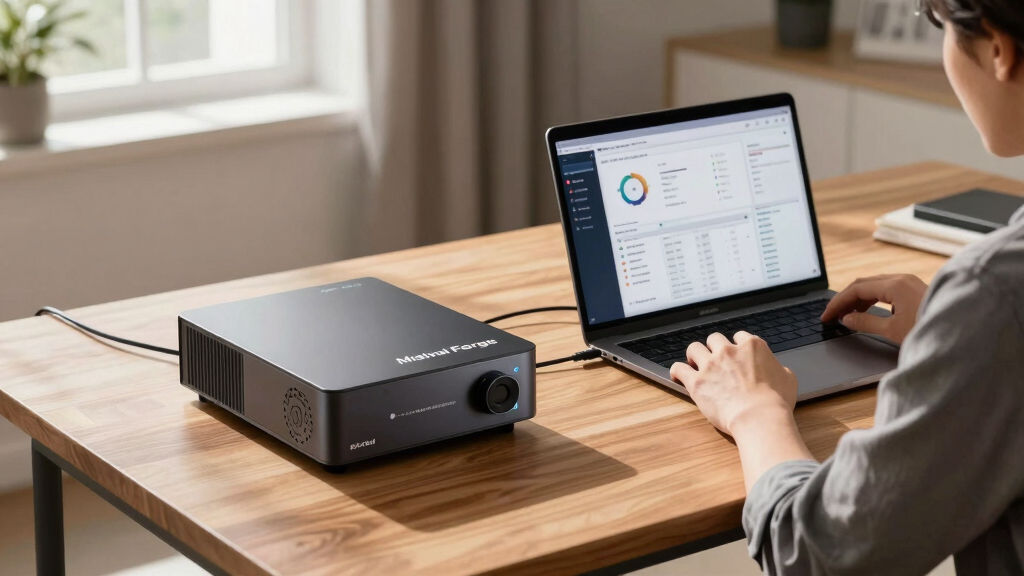

📊 Full opportunity report: How To Transition From API Rentals To Full AI Model Ownership With Mistral Forge on ThorstenMeyerAI.com — validation score, market gap, and execution plan.
Open a free Amazon Business account
Business pricing, bulk buying and tax-exempt orders.
Create a free accountAs an affiliate, we earn on qualifying purchases.
TL;DR
Mistral Forge offers a pathway for organizations to develop and operate proprietary AI models, moving beyond API rentals. This article explains the process, benefits, and challenges involved in this transition.
Mistral Forge was officially announced at Nvidia’s GTC in March 2026 as a platform enabling organizations to develop, train, and deploy their own AI models rather than relying solely on third-party APIs. This move signals a strategic push towards AI sovereignty, especially for organizations with sensitive or specialized data, and represents a significant shift in how enterprise AI capabilities are built and owned.
Forge is an end-to-end lifecycle platform that supports data preparation, large-scale training, alignment, evaluation, lifecycle management, and deployment of custom AI models. Unlike simple fine-tuning or retrieval-based methods, Forge aims to create models whose reasoning abilities are tailored to an organization’s proprietary knowledge, code, and operational rules.
Key features include support for synthetic data generation, multimodal training, and advanced post-training techniques like RLHF and distillation. It also offers private deployment options—on-premises, private cloud, or Mistral’s own infrastructure—with embedded engineers to assist organizations during implementation. The platform is built around Mistral’s open-weight checkpoints, ensuring transparency and customization.
Organizations like ASML, Ericsson, and the European Space Agency are early adopters, primarily because their data is highly sensitive or specialized, making API solutions insufficient. Mistral emphasizes that Forge is most suitable for entities requiring deep model reasoning aligned with their specific operational context, rather than general-purpose applications better served by retrieval or fine-tuning.
Mistral Forge: owning the model, not just renting the API
Europe’s most valuable AI company is betting the next sovereignty fight isn’t which API you call — it’s whether you own the model at all. Forge builds a model adapted to your data, terminology & rules, run inside your own walls. A leap for the right buyer; overkill for most.
Your proprietary knowledge changes how the model reasons — engineering/code, industrial constraints, government language & law, security telemetry, agentic tool-use by your rules. High-consequence, data-mature, sovereignty-bound.
You want a knowledge assistant, doc search or support bot — RAG or light fine-tuning wins on cost, speed & updatability. Analysts warn most enterprises lack the clean, governed data Forge assumes.
Train on your data, in your jurisdiction, on infrastructure you control, with a non-US vendor — air-gapped if needed, keeping the models, infra & knowledge. In a year when model access proved to be a geopolitical variable, owning the model stops being philosophy and becomes a hedge. (US labs offer custom models too; Forge’s moat is the combination — full pre-training + EU residency + on-prem, one platform.)
Forge packages what used to require an in-house AI research team — deep adaptation, sovereign deployment, full lifecycle, with embedded engineers. For big, regulated, data-rich orgs with high-consequence use cases, that’s a real leap, and the European framing is a feature. For everyone else it’s a heavier commitment than the problem needs — climb the ladder (RAG → fine-tune → Forge) and demand proof, not marketing. The deeper signal: enterprise sovereignty is shifting from “which API?” to “do I own the model?”
Why Moving to Full Model Ownership Matters for Enterprises
This transition allows organizations to gain greater control over their AI systems, improve data privacy, and tailor models to their unique needs. For sectors like aerospace, defense, and government, owning the model means reducing dependency on external providers and enhancing sovereignty over sensitive data and operations. However, it also requires substantial technical capacity, data maturity, and investment, making it a strategic choice for only certain types of organizations.
As an affiliate, we earn on qualifying purchases.
The Shift Toward AI Sovereignty and Proprietary Models
For the past two years, enterprise AI has largely revolved around API access to large general-purpose models, which are adapted through prompt engineering, retrieval pipelines, and governance wrappers. Mistral’s Forge introduces a different approach—building custom models trained specifically on an organization’s data, code, and operational rules. This aligns with broader trends toward AI sovereignty, especially in Europe, where data privacy and control are prioritized. Early adopters of Forge are typically organizations with mature data infrastructures and high security requirements, such as aerospace and government agencies.
The platform’s announcement at Nvidia’s GTC signals a growing industry recognition that model ownership is the next frontier in enterprise AI, moving beyond API reliance to full control and customization.
“Forge is a managed model-development program that supports organizations in creating domain-specific, reasoning-capable AI models, not just fine-tuning existing ones.”
— Thorsten Meyer, Mistral
enterprise AI model deployment hardware
As an affiliate, we earn on qualifying purchases.
As an affiliate, we earn on qualifying purchases.
What Aspects of Forge’s Adoption Are Still Unclear
It is not yet clear how broadly Forge will be adopted outside of highly specialized organizations with advanced data infrastructures. The platform’s complexity, cost, and technical requirements may limit its appeal to a smaller segment of enterprises. Additionally, the long-term effectiveness of in-house model ownership versus API reliance remains to be seen, especially regarding updateability, knowledge management, and operational agility.
As an affiliate, we earn on qualifying purchases.
Next Steps for Organizations Considering Full Model Ownership
Organizations interested in Forge should evaluate their data maturity, internal AI expertise, and security needs. The next steps include engaging with Mistral’s deployment teams to assess feasibility, pilot testing on specific use cases, and gradually scaling up model development. Industry watchers will also monitor how Forge’s early adopters perform and whether the platform’s capabilities expand to broader markets over time.
As an affiliate, we earn on qualifying purchases.
Key Questions
Who is the ideal candidate for Mistral Forge?
The ideal candidate is a highly data-mature organization with sensitive or specialized data, such as aerospace, government, or industrial firms, that require deep model reasoning aligned with their unique operations.
What are the main advantages of owning a model versus using APIs?
Ownership provides greater control over data privacy, customization, and operational sovereignty. It enables organizations to tailor models to their specific needs and reduce dependency on external providers.
What are the main challenges in adopting Forge?
Challenges include high technical complexity, significant data infrastructure requirements, and the need for ongoing model management and updates. It is best suited for organizations with existing AI expertise and mature data systems.
When should an organization consider skipping Forge in favor of simpler solutions?
If an organization’s needs are primarily for document retrieval, lightweight fine-tuning, or support bots, then RAG or fine-tuning are more cost-effective and faster options. Forge is overkill unless deep model reasoning is essential.
Source: ThorstenMeyerAI.com
Fall Picks
fall essentials
As an affiliate, we earn on qualifying purchases.