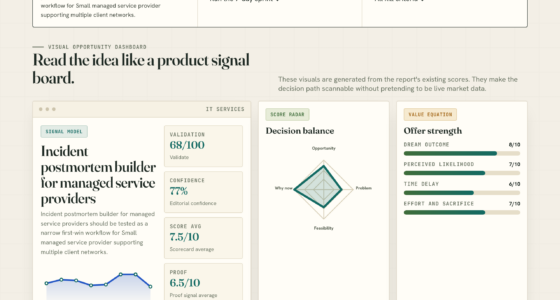

📊 Full opportunity report: The Local-First Agentic Operator on ThorstenMeyerAI.com — validation score, market gap, and execution plan.

Get smart everyday buys delivered free with Prime
- Fast, free delivery on millions of items
- Prime Video, Amazon Music and more included
- Member-only deals all year
TL;DR
An emerging approach enables a solo operator, leveraging agentic AI, to create and oversee diverse software products across domains. This challenges traditional organizational models and emphasizes local control, vendor flexibility, and subtraction-based design.
A single operator, empowered by agentic AI, has built and launched a portfolio of 18 diverse software products, demonstrating that complex, multi-domain systems can now be managed by one person rather than an organization. This development challenges conventional notions of software creation, which historically required large teams and companies. The rails. Why European agentic commerce is co-defined by two converging regimes. The portfolio exemplifies a new stance: that the unit of software development is now the individual, amplified by AI tools, rather than a collective organization. Disk Is the Contract: Inside Threlmark’s Local-First Architecture
The portfolio includes products spanning content engines, decision tools, open-source platforms, regulated systems, market bots, and intelligence platforms. All are based on four core principles: local-first, provider-agnostic, built through agentic AI by a non-developer, and edited by subtraction. These principles enable a single operator to own data and compute infrastructure, swap models and providers freely, and craft software without traditional developer skills.
According to the source, this approach was demonstrated over 18 days, with each product embodying these principles. The operator used agentic AI to describe, build, and refine software, maintaining direct control and making deliberate edits by subtraction. The pyramid cracks. What agentic AI does to the consulting leverage model. The portfolio’s diversity shows the potential for individual operators to handle complex, domain-specific systems without organizational overhead.
The Local-First Agentic Operator
Eighteen products that looked like a sprawl were never eighteen things. They were one thing, built eighteen times. This is the thesis underneath all of them — named.
- Not “solo beats funded team.” Depth still wins most single contests. The narrower, truer claim: the floor moved — one person can now do what recently took many.
- Breadth is strength and risk. Eighteen products is resilience and a focus problem; several are seeds, not trees.
- The AI part is assisted, not autonomous. Strip away human judgment and subtraction and you get faster mediocrity, not a portfolio.
- A pattern, not a prescription. This fit one operator, one skill set, one moment. The honest version of any manifesto includes “this worked for me.”
A synthesis and a statement of one operator’s working philosophy — independent commentary, produced with AI assistance under human editorial oversight. The views are the author’s own and may change. This is not business, financial, legal, or technical advice, and the four-facet framing is a personal operating pattern, not a prescription or a claim of results. Individual products carry their own terms, disclaimers, and limitations in their respective articles; several are early- or positioning-stage. Product, model, and company names are trademarks of their respective owners; mention does not imply endorsement.
Implications of Solo-Driven Software Portfolios
This shift signifies a fundamental change in how software is built and managed. It suggests that the traditional organizational model—requiring large teams and structured companies—may give way to individual operators empowered by AI tools. This democratizes software development, making it accessible to non-developers, and increases resilience through local control and vendor flexibility. The approach could impact industries from content creation to defense and intelligence, reducing reliance on external vendors and proprietary models.
agentic AI software development tools
As an affiliate, we earn on qualifying purchases.
As an affiliate, we earn on qualifying purchases.
Background of the Single-Operator Software Movement
Historically, building complex software systems required large teams, extensive coordination, and organizational infrastructure. Recent advances in agentic AI have begun to shift this paradigm, enabling individuals to generate and manage sophisticated systems. Over the past few years, there has been a growing emphasis on local-first architectures, vendor independence, and minimalistic design—principles that underpin this new approach. The recent series of product launches illustrates that these principles are now practically achievable at scale by a single person, challenging long-held assumptions about software development’s complexity and resource needs.
“The core claim is that one operator, working with agentic AI, can now build and run what used to require a company, shifting the unit of software creation from organizations to individuals.”
— Thorsten Meyer, source author
local-first AI infrastructure hardware
As an affiliate, we earn on qualifying purchases.
As an affiliate, we earn on qualifying purchases.
Unresolved Questions About Solo-Operator Viability
It remains unclear how scalable and sustainable this approach is for highly complex or safety-critical systems. Long-term maintenance, security, and compliance challenges, especially in regulated industries, are still being evaluated. Additionally, the extent to which this model can replace traditional organizational structures across various domains is not yet confirmed and may vary depending on context and complexity.
self-hosted decision-making platforms
As an affiliate, we earn on qualifying purchases.
As an affiliate, we earn on qualifying purchases.
Next Steps for Adoption and Validation
Further testing and real-world deployment will be needed to assess the robustness and reliability of single-operator portfolios. Industry observers are watching for more demonstrations, especially in regulated sectors, to gauge how broadly this approach can be adopted. Development of supporting tools and community standards could accelerate its integration into mainstream software practices.
vendor-agnostic AI model providers
As an affiliate, we earn on qualifying purchases.
As an affiliate, we earn on qualifying purchases.
Key Questions
Can a single person truly replace a team in software development?
While the portfolio demonstrates that one person can build complex systems using agentic AI, large-scale or highly regulated projects may still require organizational resources. The approach is a significant step toward individual-driven development but may not fully replace traditional teams in all contexts.
What are the risks of relying on agentic AI for critical systems?
Potential risks include security vulnerabilities, model drift, and compliance issues. Since the approach involves human oversight and subtraction-based editing, these risks can be mitigated but not eliminated. Ongoing validation and security measures are essential.
How does local-first architecture benefit organizations?
Local-first architecture reduces dependency on external vendors, enhances data privacy, and improves resilience by maintaining control over compute and data infrastructure. It also enables faster iteration and customization tailored to specific needs.
Is this approach applicable outside of experimental settings?
Early demonstrations suggest potential for broader application, especially in domains where control, privacy, and customization are critical. However, widespread adoption will depend on further validation, tooling, and industry-specific requirements.
What role does subtraction play in this new software development model?
Subtraction involves removing unnecessary complexity, noise, and features to focus on what truly matters. This minimalist approach enhances clarity, reduces costs, and improves maintainability, forming a core part of the design philosophy.
Source: ThorstenMeyerAI.com
Halloween Picks
halloween
As an affiliate, we earn on qualifying purchases.