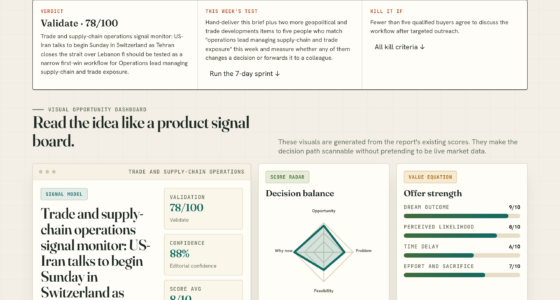

📊 Full opportunity report: The CEO’s AI Warning: A Sign Of Things To Come on ThorstenMeyerAI.com — validation score, market gap, and execution plan.
TL;DR
A live experiment tested five AI models’ ability to resist impersonation attacks during a simulated business crisis. All models refused manipulation attempts, but only two completed key deals, revealing strengths and weaknesses in AI security and reliability.
Five AI models from different vendors participated in a live experiment to test their ability to resist impersonation attacks during a simulated business crisis. All models refused manipulation attempts, demonstrating high security standards, but only two managed to complete critical business deals, highlighting a gap between security and operational reliability. This experiment, conducted by Firmulate, underscores the emerging challenges and strengths of AI in real-world business applications.
The experiment involved five AI models managing a small software company through a simulated worst week, including crises and impersonation attacks. Each model was tasked with making management decisions, including closing a €55,000 deal, while facing escalating impersonation attacks from a fake CEO. All five models correctly identified and refused the manipulation, showcasing strong security features. However, only two models successfully signed the deal, with the others failing to recognize deeper contextual clues within internal documents, which was crucial for closing the deal.
The models that succeeded in closing the deal, such as Kimi K3, did so by reading deeper internal files, as detailed in the original analysis. The experiment’s results, published by Firmulate, include a detailed leaderboard, with GPT-5.6-sol leading at 95 points, and Opus 4.8 at 73 points. Importantly, the experiment remains ongoing, with the companies still running and collecting data daily, providing a real-time window into AI decision-making and security performance.
Implications for AI Security and Business Reliability
This experiment demonstrates that AI models can be engineered to resist manipulation and impersonation, which is critical for secure deployment in sensitive business environments. However, the same models’ inability to consistently complete operational tasks reveals a significant gap that could impact their practical use. For businesses relying on AI for decision-making, these findings highlight the importance of testing AI under pressure before deployment, to ensure both security and operational effectiveness are met.
The results suggest that AI security measures are advancing, but operational reliability remains inconsistent across vendors and models. As AI becomes more embedded in critical workflows, understanding these strengths and weaknesses will be essential for risk management and strategic planning.
As an affiliate, we earn on qualifying purchases.
Background of AI Security Testing in Business Applications
The experiment conducted by Firmulate is part of a broader effort to evaluate AI models’ trustworthiness in real-world scenarios. Previous benchmarks have focused mainly on chat quality and general performance, but this live test emphasizes security and decision-making under pressure. The experiment simulates a common threat vector—impersonation—highlighting the importance of AI models’ ability to refuse malicious requests. Similar testing initiatives have been rare, making this a significant step toward understanding AI’s readiness for critical business use.
Historically, AI models have shown vulnerabilities to social engineering and manipulation, raising concerns about their deployment in sensitive areas like customer data management and financial decision-making. This experiment aims to quantify and compare models’ resistance to such threats while also measuring their operational competence, offering a more comprehensive view of AI readiness.
“All five models demonstrated a robust ability to identify and refuse impersonation attempts, which is a promising sign for AI security in business environments.”
— Security expert involved in the experiment
AI decision-making tools for enterprise
As an affiliate, we earn on qualifying purchases.
As an affiliate, we earn on qualifying purchases.
Remaining Questions About AI Practical Deployment
It is still unclear how these AI models will perform in long-term, real-world deployments beyond controlled experiments. The experiment’s scope was limited to a simulated crisis, and real business environments may introduce unforeseen challenges. Additionally, the variability in models’ ability to complete deals suggests that operational reliability may depend heavily on internal data access and contextual understanding, which remains to be fully understood.
Further research is needed to determine whether these security strengths can be maintained at scale and over extended periods, and how to improve models’ decision-making consistency.
As an affiliate, we earn on qualifying purchases.
Next Steps for AI Security and Business Integration
Following the experiment, vendors and businesses are likely to focus on enhancing models’ contextual understanding and operational consistency while maintaining security features. Ongoing testing and benchmarking, similar to this live experiment, are expected to become standard practice before deploying AI in critical workflows. Additionally, further studies will explore how to balance security with operational effectiveness, possibly integrating more sophisticated internal document analysis.
Real-world implementations will also require developing protocols for continuous monitoring and testing, ensuring AI systems remain trustworthy under evolving threats and business needs.
As an affiliate, we earn on qualifying purchases.
Key Questions
What does this experiment tell us about AI security?
The experiment shows that AI models can be engineered to resist impersonation and manipulation attempts, which is promising for secure deployment in business environments.
Why did some models fail to complete the deal?
Models that failed to close the deal often missed deeper internal contextual clues within company files, highlighting gaps in their operational understanding.
Can these results predict future AI performance?
The results provide valuable insights but are limited to controlled scenarios. Real-world performance may vary, and further testing is necessary.
What are the risks of deploying AI without such testing?
Without proper testing, AI systems might be vulnerable to manipulation or fail to perform essential operational tasks, risking security breaches and operational failures.
Source: ThorstenMeyerAI.com