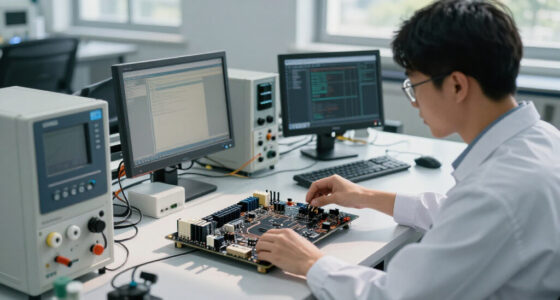

📊 Full opportunity report: Why China’s Practical Training Methods Are Crucial For AI Success on ThorstenMeyerAI.com — validation score, market gap, and execution plan.
TL;DR
China is making significant progress in domestic chip manufacturing by emphasizing practical, hands-on training and iterative learning. While prototypes and initial tools exist, scaling reliable, high-yield production remains a complex challenge. This approach is vital for China’s AI hardware ambitions.
China has begun mass-producing domestic immersion DUV lithography machines and is prototyping EUV tools, marking significant steps in its chip manufacturing ambitions. These advances are crucial for China’s goal to develop self-sufficient AI hardware, but challenges remain in scaling reliable, high-yield production, according to industry analysts.
Recent reports confirm that China is now manufacturing domestic immersion DUV lithography machines capable of producing chips at 7-nanometer and potentially 5-nanometer nodes, primarily for applications such as AI accelerators. These systems are tied to companies like Huawei and evaluated at firms such as SMIC, which has demonstrated 7-nanometer production using older tools.
However, experts note that the transition from prototype to reliable, high-yield manufacturing is complex. SMIC reportedly achieves yields around 20 percent, far below the 90 percent typical of leading EUV fabs. Achieving consistent yields requires extensive, iterative learning through running wafers, fixing failures, and accumulating tacit knowledge over years.
China’s dependence on imported, ultra-pure materials, especially photoresist from Japan, and the lag in domestic equipment—estimated at about four generations behind advanced Dutch tools—further complicate scaling. The installed base of over 200 DUV tools relies heavily on Western servicing and maintenance, which China cannot yet fully replicate domestically.
Every few weeks a headline says China cracked the last hard problem in chipmaking — and triggers alarm in one camp, triumph in the other. Both overreact, because both mistake a learning-by-doing problem for a copying problem. It isn’t one.
▲ Forward-looking · figures are point-in-time estimates“A machine exists” and “a machine makes advanced chips at scale, profitably, for years” are separated by a chasm — made of things that only accumulate with time.
In a race, a burst of speed closes the gap. In a phase transition, you can’t move faster to cross over — you have to accumulate enough, slowly, until the system changes state.
When you see “China achieves X,” ask which of two very different claims is actually being made.
Even amid the loud headlines, the quiet data points all say the same thing.
No prototype, no shipped tool, no yield headline teleports past it.
Why Practical Training and Learning Are Critical for China’s Chip Goals
This focus on learning-by-doing is essential because advanced chip manufacturing is a phase transition—it requires accumulating enough tacit knowledge and operational experience over time, not just acquiring equipment or blueprints. China's progress illustrates that technological breakthroughs depend on persistent, iterative practice and problem-solving, which are difficult to replicate through imports or quick fixes.
Understanding this process clarifies why China’s advances, while notable, are still far from achieving reliable, high-volume production at cutting-edge nodes. It underscores the importance of long-term capacity building and domestic expertise development for future leadership in AI hardware.
AI chip manufacturing training kits
As an affiliate, we earn on qualifying purchases.
As an affiliate, we earn on qualifying purchases.
China’s Chip Manufacturing Progress and Challenges
Over the past decade, China has invested heavily in semiconductor self-sufficiency amid US export controls and technological restrictions. Recent developments include the production of domestic DUV lithography machines and prototypes of EUV tools. Despite these advances, experts acknowledge that China remains at least four generations behind leading firms like ASML, with significant hurdles in achieving high yields and reliable, scalable manufacturing.
Industry analysts emphasize that success depends on long-term learning through repeated practice, not just acquiring equipment. This approach aligns with China's broader strategy of building indigenous expertise and domestic supply chains.
"Advanced chip manufacturing is a phase transition, requiring years of iterative practice to accumulate the tacit knowledge necessary for reliable production."
— Thorsten Meyer
ultra-pure photoresist for semiconductor
As an affiliate, we earn on qualifying purchases.
As an affiliate, we earn on qualifying purchases.
Uncertain Timeline for Achieving Commercial-Scale, High-Yield Production
It is not yet clear when China will reliably produce sub-10 nanometer chips at high yields suitable for commercial AI hardware. Experts estimate this may not happen before around 2030, but technical hurdles could delay progress further.As an affiliate, we earn on qualifying purchases.
Next Steps in China’s Semiconductor Learning Journey
China will likely continue to focus on iterative process improvements, expanding domestic supply chains, and developing more advanced equipment. Monitoring the progression of yield improvements and material independence will be key indicators of progress toward scalable, reliable manufacturing.
Further breakthroughs in materials purity and equipment domestication are expected to be crucial milestones in the coming years.
As an affiliate, we earn on qualifying purchases.
Key Questions
Why is learning-by-doing important for chip manufacturing?
It allows engineers and manufacturers to develop the tacit knowledge needed to reliably produce high-quality chips at scale, which cannot be gained through equipment alone.
How does China’s dependence on imported materials affect its progress?
Heavy reliance on imported, ultra-pure chemicals like photoresist creates bottlenecks, making self-sufficiency in materials essential for scaling manufacturing.
When might China produce reliable, high-yield 7-nanometer chips?
Experts estimate that achieving consistent high yields at sub-10 nanometer nodes could take until around 2030, depending on overcoming technical and material challenges.
What does this mean for China’s AI hardware ambitions?
Progress in chip manufacturing is vital for China’s goal to develop self-reliant AI hardware, but scaling reliable production remains a long-term challenge that requires sustained learning and development.
Source: ThorstenMeyerAI.com