📊 Full opportunity report: A Deep Dive Into VR Signal Monitoring With The RayNeo GT Max on IdeaNavigator AI — validation score, market gap, and execution plan.
TL;DR
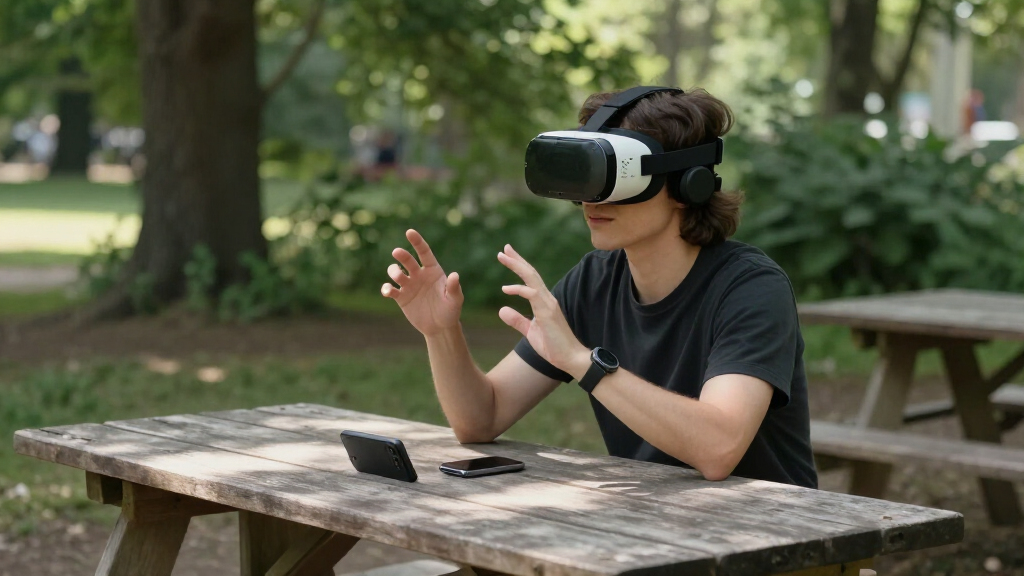
The RayNeo GT Max smart glasses demonstrate advanced VR signal monitoring, offering potential benefits for operators needing rapid, role-specific updates. Details on its full capabilities and real-world performance are still emerging.
The RayNeo GT Max smart glasses have been tested for their VR signal monitoring capabilities, showing notable potential for operators who need to act swiftly on emerging developments. This development is significant because it could improve real-time decision-making in fields requiring rapid responses, such as defense, security, or industrial operations.
According to an independent tester, the RayNeo GT Max exhibits the best VR signal monitoring performance they have seen in 2026 so far. The device is designed to filter fast-moving developments from multiple sources like RSS feeds, news, and forums, providing role-specific alerts aimed at operators who must act quickly. The tester highlighted an 88/100 signal quality score, indicating high reliability in current conditions.
While the device shows promise, detailed technical specifications and performance metrics in real-world scenarios remain limited. The testing focused on its ability to detect and filter relevant signals efficiently, but comprehensive field trials are still underway. The device’s integration with existing operator workflows and its adaptability to various operational environments are also being evaluated.
Industry observers note that the RayNeo GT Max could represent a significant step forward in VR signal monitoring, especially for roles where timely, accurate information is critical. However, the extent of its capabilities across different use cases and its durability in demanding conditions are yet to be confirmed.
Implications for Fast-Paced Decision-Making
The RayNeo GT Max’s advanced VR signal monitoring could transform how operators in fields like defense, security, and industrial management receive and act on information. By filtering relevant signals from a flood of data, it may reduce decision latency and improve response accuracy. This development aligns with broader trends toward real-time, role-specific information delivery, which can be crucial in high-stakes environments.
However, the current lack of comprehensive performance data and real-world testing means its actual impact remains to be fully assessed. If proven effective, the device could set a new standard for operational intelligence tools in fast-moving sectors.
VR signal monitoring smart glasses
As an affiliate, we earn on qualifying purchases.
As an affiliate, we earn on qualifying purchases.
Background on VR Signal Monitoring Technologies
VR signal monitoring tools have been evolving alongside advancements in augmented reality (AR) and virtual reality (VR) hardware. Prior efforts focused on integrating sensor data and communication feeds into head-mounted displays to support tactical decision-making. The RayNeo GT Max enters this landscape with a focus on filtering and prioritizing signals relevant to operators in real time.
Previous devices and systems have often struggled with information overload, leading to delayed responses or missed critical signals. The development of role-specific, fast-filtering VR monitors aims to address these issues by providing operators with timely, relevant updates directly within their field of view.
While the RayNeo GT Max is among the latest, industry experts note that many such devices are still in experimental stages, with widespread adoption contingent on proven performance and integration ease. The current testing phase is crucial for establishing its practical viability.
AR VR tactical decision-making device
As an affiliate, we earn on qualifying purchases.
As an affiliate, we earn on qualifying purchases.
Unconfirmed Aspects of Real-World Performance
Details about the device’s performance in diverse operational environments remain limited. It is not yet clear how well the RayNeo GT Max maintains signal accuracy under challenging conditions such as high interference, extreme weather, or prolonged use. Additionally, its integration with existing operator systems and workflows is still under evaluation, and long-term durability data is unavailable.
As an affiliate, we earn on qualifying purchases.
Next Steps in Validation and Deployment
Further field testing is planned to assess the RayNeo GT Max’s performance across various operational scenarios. Industry stakeholders expect detailed reports on durability, accuracy, and integration ease within the next few months. If results are favorable, commercial deployment could begin later this year, pending regulatory and safety assessments. Meanwhile, developers are likely to refine the filtering algorithms and user interface based on ongoing feedback.
As an affiliate, we earn on qualifying purchases.
Key Questions
What makes the RayNeo GT Max different from other VR monitoring devices?
The RayNeo GT Max emphasizes high signal filtering accuracy and role-specific alerts, aiming to deliver relevant, real-time updates directly within the user’s field of view, which is a step beyond many existing systems.
How reliable is the current performance score of 88/100?
The score reflects initial testing conditions and indicates high potential, but comprehensive real-world validation is still needed to confirm its reliability across diverse environments.
What operational sectors could benefit most from this technology?
Sectors such as defense, security, industrial operations, and emergency response are prime candidates due to their need for rapid, accurate situational updates.
When might the RayNeo GT Max be available for broader use?
Pending further testing and regulatory approval, commercial deployment could occur within the next six to twelve months.
What are the main challenges facing the adoption of this technology?
Key challenges include proving durability and performance in demanding conditions, seamless integration with existing systems, and ensuring user comfort and interface usability.
Source: IdeaNavigator AI