
🔍 Read the full analysis: Looking For Local AI Hardware? 10 Best Mini PCs For 2026 on ThorstenMeyerAI.com

Get smart everyday buys delivered free — and shop member deals
- Fast, free delivery on millions of items
- Access to Prime Big Deal Days deals on October 6–7
- Prime Video, Amazon Music and more included
TL;DR
A ThorstenMeyerAI.com roundup compares 10 mini PC configurations for local AI work, weighing memory, storage and expansion alongside processor class. It names the GEEKOM A9 Max as its best overall pick and the GMKtec EVO-X3 as the memory leader, but provides no benchmark results to confirm real-world performance.
ThorstenMeyerAI.com’s 2026 comparison of 10 mini PC configurations is for people considering local AI work, naming the GEEKOM A9 Max its best overall pick and the GMKtec EVO-X3 its choice for memory-heavy workloads. The comparison focuses on listed specifications and configuration tradeoffs; it does not report benchmark testing that would establish how quickly the systems run particular AI models.
The roundup selects the GEEKOM A9 Max as its balanced out-of-box option, citing a Ryzen AI 9 HX 470 processor, 32GB of DDR5 memory and a 2TB SSD. The author says the combination makes it a practical package among the systems compared, but the source does not provide measured results for specific models, applications or sustained workloads.
The GMKtec EVO-X3 is the lineup’s memory specialist, with 128GB of LPDDR5X. The article says that capacity may suit tasks that need large models or datasets in memory. It also cautions that memory capacity alone does not establish compatibility or performance: software support, memory bandwidth and processing method matter, and the source does not confirm which models each machine can run well.
For buyers considering graphics expansion, the GMKtec K15 with Oculink offers a connection intended as a route to external graphics, paired in the listed configuration with a 512GB SSD. The other cited K15 configuration has a 1TB SSD. The roundup also includes the GEEKOM GT15 Max, GEEKOM IT15 and MINISFORUM AI X1 Pro, each listed with 32GB of memory; it advises matching capacity to the intended workload rather than choosing by processor tier alone.
The 10 picks
- 1
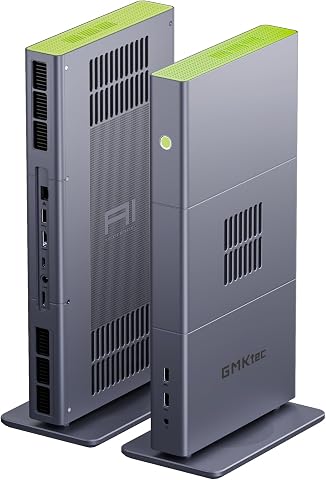 GMKtec EVO-X3 Mini PC with AMD Ryzen AI Max+ 395, 128GB LPDDR5X, and 2TB PCIe…View on Amazon →
 - 2
 GMKtec EVO-X2 AI Mini PC AMD Ryzen AI Max+ 395, Up to 5.1GHz, 16C/32TView on Amazon →
 - 3
 GEEKOM A9 Max Top AI Mini PC, AMD Ryzen AI9 HX470, 32GB DDR5, 2TB SSDView on Amazon →
 - 4
 GEEKOM IT15 Mini PC with Intel Ultra 9 285H, 32GB DDR5, 1TB SSD, Arc 140T GPU…View on Amazon →
 - 5
 MINISFORUM AI X1 Pro-370 Mini PC with AMD Ryzen AI 9 HX370, 32GB DDR5, 1TB SS…View on Amazon →
 - 6
 GEEKOM GT15 Max Business & Professional Mini PC with Intel Core Ultra 9, 32GB…View on Amazon →
 - 7
 GEEKOM IT13 MAX AI Mini PC with Intel Ultra 9 185H, 24GB LPDDR5, 500GB SSDView on Amazon →
 - 8
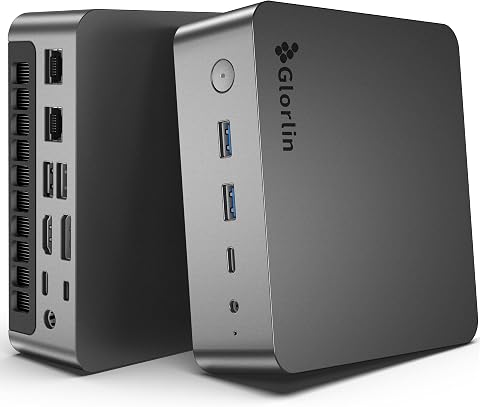 Glorlin Mini PC with AMD Ryzen 7 Pro 8845HS, 16GB DDR5 RAM, and 1TB SSDView on Amazon →
 - 9
 GMKtec K15 AI Mini PC Oculink Intel Ultra 5 125U 32GB DDR5 512GB SSD, Desktop…View on Amazon →
 - 10
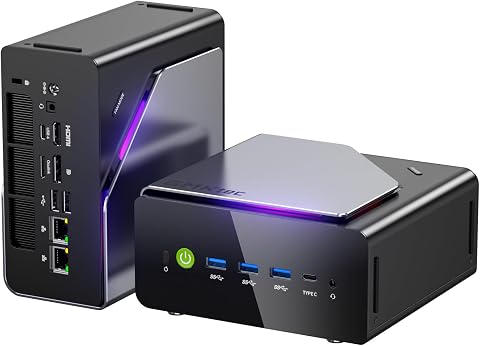 GMKtec K15 Mini PC AI Ultra 5 125U, 12-Core, 32GB DDR5, 1TB PCIe 4.0 SSDView on Amazon →
Memory and Expansion Shape the Choice
The comparison points buyers toward whole-system limits rather than processor names alone. For local AI, memory can determine whether a model or dataset fits in the available system resources, while storage affects how many models and projects can stay on the device. Cooling and connectivity also influence practical use, but the source material does not provide tests of those factors.
That distinction can affect the total cost and setup effort. A system with a smaller SSD may require an upgrade or external storage; an Oculink setup may mean buying additional graphics hardware and making room for it. The EVO-X3’s 128GB memory is a clear listed difference, but it does not by itself prove faster or broader AI capability.
How the Ten Configurations Were Ranked
The source says it compared the mini PCs by processor class, installed memory and memory type, as well as storage and expansion options. It ranked balanced configurations for practical fit, while giving specialist recognition to systems with unusually high memory or Oculink connectivity. Its top pick reflects those stated criteria, rather than reported head-to-head benchmark results.
The source names 10 picks in its title, but the supplied material identifies only six distinct model or configuration names: the A9 Max, EVO-X3, two K15 configurations, GT15 Max, IT15 and AI X1 Pro. It does not provide names and full specifications for four additional picks in the supplied text, so those entries cannot be described here. The publication date is also not stated.
“The GEEKOM A9 Max is my best overall pick.”
— ThorstenMeyerAI.com
Performance Evidence Is Missing
The supplied source gives specifications and editorial rankings, but no independent benchmarks, temperatures, noise measurements or sustained workload tests. It does not establish which AI models or software features are compatible with each processor, nor whether the systems can maintain performance under prolonged use. The source also does not identify four of the 10 configurations promised by the title, and gives no publication date.
Memory upgrade options are not specified for every machine. Buyers should confirm whether memory is replaceable, what storage upgrades the chassis supports and whether a planned Oculink graphics setup is compatible with the selected enclosure, card and power supply. Those details remain unconfirmed by the supplied material.
Check Configurations Before Buying
The next step for readers is to compare the exact configuration and current seller listing against their intended workload. Check installed and upgradeable memory, SSD capacity, supported acceleration features and cooling information, then look for independent tests using the software and models you expect to run. For the K15, weigh the Oculink expansion path against its listed 512GB SSD and the 1TB drive in the other configuration.
The source does not state a follow-up test or update schedule. Until more performance evidence or the missing four picks are supplied, the rankings are best read as a specification-based buying guide, not a verified comparison of AI speed.
Key Questions
Which mini PC does the roundup name as its best overall pick?
ThorstenMeyerAI.com names the GEEKOM A9 Max, citing its Ryzen AI 9 HX 470, 32GB of DDR5 and 2TB SSD. The source does not provide benchmarks confirming its performance on specific AI workloads.
Which model has the most memory in the supplied comparison?
The GMKtec EVO-X3 is listed with 128GB of LPDDR5X. That is the highest memory capacity identified in the supplied source, but it does not guarantee that a particular model or dataset will run well.
What does Oculink add to the GMKtec K15?
The K15 configuration with Oculink offers a route to an external graphics setup. It is listed with a 512GB SSD, compared with 1TB in the other cited K15 configuration; the source does not specify enclosure or graphics-card compatibility.
Does the article establish which mini PC runs AI models fastest?
No. The supplied material compares specifications and editorial picks but gives no benchmark results for model speed, sustained performance or software compatibility.
Source: ThorstenMeyerAI.com
Fall Picks
fall essentials
As an affiliate, we earn on qualifying purchases.