
📊 Full opportunity report: Best AI Mini PCs In 2026: A Curated Top 10 List on ThorstenMeyerAI.com — validation score, market gap, and execution plan.

Get smart everyday buys delivered free with Prime
- Fast, free delivery on millions of items
- Prime Video, Amazon Music and more included
- Member-only deals all year
TL;DR
In 2026, the AI mini PC market features high-performance models like the MINISFORUM AI X1 Pro, GEEKOM A9 Max, and others. These devices offer advanced processors, expandability, and connectivity for AI tasks. This list helps users choose the best mini PC for their needs.
In 2026, the market for AI mini PCs is led by models such as the MINISFORUM AI X1 Pro, which features a powerful AMD Ryzen AI 9 HX370 processor and Radeon 890M GPU, making it the top overall choice for AI tasks. These devices are increasingly capable, offering high processing power in compact sizes, and are critical for AI developers, researchers, and enthusiasts seeking versatile, space-efficient solutions.
The MINISFORUM AI X1 Pro stands out as the best overall AI mini PC, thanks to its high-end AMD Ryzen AI 9 HX370 CPU and Radeon 890M GPU, providing robust performance for demanding AI workloads. The GEEKOM A9 Max offers cutting-edge DDR5 memory and extensive expandability, making it ideal for users prioritizing future-proofing and high-speed data handling. Meanwhile, the GEEKOM IT15 balances performance and connectivity, supporting multiple displays and modern ports, suited for professional AI applications.
Most top-tier models feature advanced connectivity options such as WiFi 7, USB4, and Thunderbolt 4, enhancing data transfer and multi-device compatibility. Price ranges vary significantly, with premium models offering more power and expandability, while budget options focus on essential AI functionalities. These developments reflect a trend toward integrating powerful CPUs and GPUs into small form factors, catering to a growing market of AI practitioners who need high performance without large hardware.
The 10 picks
- 1
 GMKtec AI Mini PC Ryzen AI Max+ 395View on Amazon →
 - 2GMKtec EVO-X2 AI Mini PC AMD Ryzen AI Max+ 395, Up to 5.1GHz, 16C/32TView on Amazon →
- 3
 GEEKOM A9 Max Top AI Mini PC, AMD Ryzen AI9 HX470, 32GB DDR5, 2TB SSDView on Amazon →
 - 4
 GEEKOM IT15 Mini PC with Intel Ultra 9 285H, 32GB DDR5, 1TB SSD, Arc 140T GPU…View on Amazon →
 - 5
 MINISFORUM AI X1 Pro-370 Mini PC with AMD Ryzen 9 HX370, 32GB DDR5, 1TB PCIe…View on Amazon →
 - 6
 GEEKOM IT13 MAX AI Mini PC with Intel Ultra 9 185H, 24GB LPDDR5, 500GB SSDView on Amazon →
 - 7
 MINISFORUM AI X1 Pro-470 Mini PC with AMD Ryzen AI 9 HX470View on Amazon →
 - 8
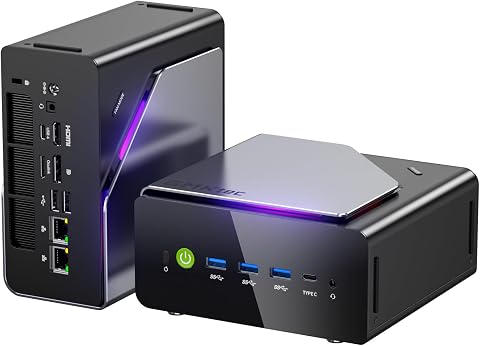 GMKtec K15 Mini PC AI Ultra 5 125U (up to 4.3GHz) 32GB DDR5 1TB PCIe 4.0 SSDView on Amazon →
 - 9
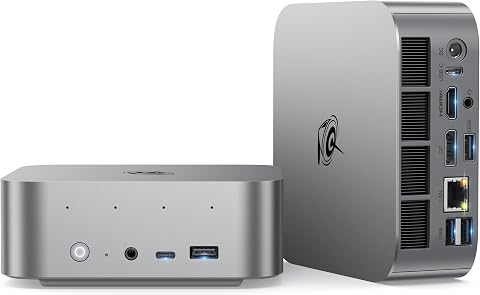 Beelink SER9 Pro AI Mini PC with AMD Ryzen 7 H255, 24GB RAM, 1TB SSD, Radeon…View on Amazon →
 - 10
 GMKtec K15 AI Mini PC with Intel Ultra 5 125U, 32GB DDR5, 512GB SSDView on Amazon →
Why High-Performance AI Mini PCs Matter in 2026
The emergence of powerful AI mini PCs like those in this list signifies a shift toward accessible, space-efficient AI computing. For AI professionals and hobbyists, these devices enable complex model training, data processing, and real-time inference without requiring traditional, bulky workstation setups. Their increasing capabilities and connectivity options also support more advanced AI workflows, including multi-GPU configurations and high-speed data transfer, which are crucial for cutting-edge AI research and development.
Choosing the right mini PC can significantly impact productivity, scalability, and cost-efficiency for AI projects, making this curated list a valuable resource for users across different skill levels and budgets.
Products Worth Considering

Logitech MX Mechanical Mini Mac Wireless Keyboard Low-Profile – Space Grey

Dell UltraSharp 27 Thunderbolt Hub Monitor (U2726DER)

Canon SELPHY CP1500 Wireless Compact Photo Printer with RP-108 Ink and Paper Set
As an affiliate, we earn on qualifying purchases.
Evolution of AI Mini PCs and 2026 Market Highlights
The market for AI mini PCs has rapidly evolved over the past few years, with models now featuring high-performance AMD Ryzen AI and Intel Ultra processors, alongside GPU integrations optimized for AI workloads. In 2025, several models gained recognition for their expandability and connectivity, setting the stage for 2026’s top offerings. The trend toward miniaturization combined with high processing power reflects broader developments in AI hardware, driven by increasing demand for compact yet capable computing solutions.
Recent releases like the GEEKOM A9 Max and MINISFORUM AI X1 Pro demonstrate how manufacturers are prioritizing future-proof features such as DDR5 RAM, PCIe SSD slots, and WiFi 7, ensuring these devices remain relevant amid rapidly advancing AI software and datasets.
Remaining Questions About AI Mini PC Capabilities
While the top models boast impressive specs, it is not yet clear how they perform under sustained, large-scale AI training sessions compared to traditional workstations. Long-term reliability, thermal management, and software optimization for these compact devices remain areas for ongoing evaluation. Additionally, the actual availability and pricing of some of these models in different regions are still emerging, which could influence their adoption.
Upcoming Developments and Market Trends for 2026
Manufacturers are expected to release updated models with even more powerful processors, GPU options, and enhanced connectivity features throughout 2026. Future mini PCs may incorporate AI-specific hardware accelerators, further boosting performance for machine learning tasks. Consumers and professionals should watch for new releases, software optimizations, and pricing adjustments that could influence their purchasing decisions in the coming months.
Key Questions
Can I run complex AI models on a mini PC without a dedicated GPU?
Running advanced AI models on a mini PC without a dedicated GPU is possible for lightweight tasks. However, for training large models or handling extensive datasets, a device with a dedicated GPU or AI-optimized integrated GPU is highly recommended to ensure efficient performance.
How much RAM is necessary for AI mini PCs in 2026?
For basic AI tasks or learning, 16GB of RAM may suffice. For more demanding workloads like large dataset processing or deep learning, 32GB or more is advisable. Many high-end models support up to 128GB, providing ample headroom for intensive AI projects.
Are expandability options common in AI mini PCs?
Expandability varies by model. High-end options typically include multiple RAM slots, PCIe SSD support, and sometimes additional GPU slots. Smaller or budget models may have limited upgrade paths, so users should consider future needs when choosing a device.
What connectivity features should I look for in an AI mini PC?
Features like WiFi 7, USB4, Thunderbolt 4, and HDMI 2.1 are important for fast data transfer, multi-display setups, and device compatibility. These features support efficient workflows, especially when working with large files or multiple peripherals.
Source: ThorstenMeyerAI.com