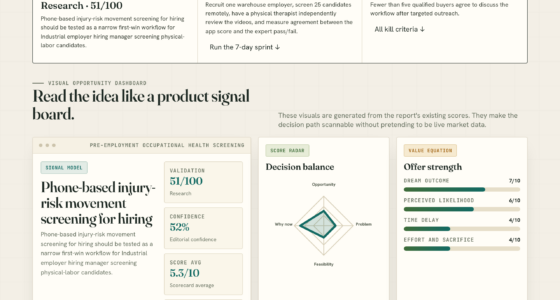
📊 Full opportunity report: Tracking Trade Operations And Supply-Chain Trends: U.S.–Belgium on IdeaNavigator AI — validation score, market gap, and execution plan.

Get smart everyday buys delivered free — and shop member deals
- Fast, free delivery on millions of items
- Access to Prime Big Deal Days deals on October 6–7
- Prime Video, Amazon Music and more included
TL;DR

IdeaNavigator AI has proposed a subscription monitor that would filter geopolitical and trade developments affecting supply-chain operations, using U.S.–Belgium as a possible test topic. The material describes a product idea and a validation plan, not a confirmed change in trade policy, shipping, or supply chains; its reported Google Trends score lacks a stated measurement period or comparison baseline.
IdeaNavigator AI has proposed a focused monitor that would turn geopolitical and trade developments into short, role-specific briefs for supply-chain operations leads, with U.S.–Belgium offered as a possible test topic. The proposal describes a product concept and a plan to test demand; it does not report a confirmed trade or supply-chain event involving the two countries.
According to the IdeaNavigator AI proposal, the monitor would watch Google Trends and similar feeds for developments related to geopolitics and trade, then filter items for an operations lead managing supply-chain and trade exposure. Each selected item would be presented as a short account of what changed, why it matters and what to do. The proposal does not specify which other feeds would be monitored or how the system would verify the underlying developments.
IdeaNavigator AI says Google Trends surfaced the phrase “estados unidos – belgica” with an 88/100 signal. The proposal gives no date, time window, geographic scope, scoring method or comparison baseline for that figure. The score is therefore a reported signal in the proposal, not evidence by itself of a particular policy change, disruption or increase in trade activity.
The proposal recommends hand-delivering the brief, along with two other geopolitical and trade items, to five people matching the intended operations-lead profile during the same week. It says the test would track whether any recipient changes a decision or forwards a brief to a colleague. IdeaNavigator AI reports no completed interviews, recipient responses, subscription commitments or operational outcomes.
Testing Demand for Trade Alerts
For operations teams, the concept addresses a practical information problem: trade and geopolitical developments can appear across multiple news sources, forums and filings, while a manager needs to determine whether an item affects a supplier, route, cost or compliance obligation. A role-filtered summary could reduce the time spent sorting general news, but its value would depend on accurate sourcing and a clear link between an event and an operational decision.
The proposal’s test is small and exploratory. Five people receiving hand-delivered briefs could offer early feedback about relevance and usefulness, but their actions would not establish broad market demand or prove that a paid service improves supply-chain outcomes. The proposed decision-change and forwarding measures are initial signs of engagement, not a defined measure of financial return.
Readers should distinguish this product proposal from a report of current U.S.–Belgium trade conditions. The IdeaNavigator AI material identifies no new tariff, agreement, restriction, port disruption or other bilateral development. Its immediate significance is that a potential monitoring service is being framed for validation, not that companies have been told to change sourcing or logistics plans.
As an affiliate, we earn on qualifying purchases.
The Proposed U.S.–Belgium Test
IdeaNavigator AI’s proposal frames “estados unidos – belgica”—Spanish wording for United States–Belgium—as a narrow first use case for a broader trade and supply-chain operations signal monitor. It identifies the intended user as an operations lead responsible for supply-chain and trade exposure, and describes a subscription as the proposed commercial model for early, filtered reads on developments relevant to that role.
The proposal says developments are scattered among news, forums and filings and argues that a same-day briefing may be more useful than a general weekly roundup. That is the rationale offered for the product, not an independently documented finding about how often companies miss developments or how much time they currently spend tracking them. The material identifies no specific trade episode, affected industry, supplier or shipping lane.
Accordingly, the U.S.–Belgium label functions in IdeaNavigator AI’s proposal as a candidate monitoring topic, rather than proof that a specific bilateral event prompted the idea. The available details describe an MVP and a customer-validation exercise, not a launched service, confirmed customer base or established monitoring record.
supply chain geopolitical risk alerts
As an affiliate, we earn on qualifying purchases.
As an affiliate, we earn on qualifying purchases.
No Trade Event Identified
IdeaNavigator AI’s proposal does not identify what, if anything, changed in U.S.–Belgium trade or supply-chain conditions. It provides no dated news item, government filing, company notice or other underlying evidence tied to the search phrase. As a result, the operational impact is unknown, and there is no basis in the material to infer that shipments, tariffs, sourcing decisions or compliance requirements have changed.
The meaning of the 88/100 Google Trends signal reported by IdeaNavigator AI is also unclear without its time period, geography, search term settings and scoring baseline. The proposal does not show how the monitor would separate a meaningful trade development from general public interest, or how it would check accuracy, rank urgency or handle conflicting reports.
It remains unknown whether the five-person test will take place, whether participants will find the briefs useful, or whether any will pay for a subscription. The proposal gives no price, delivery schedule, coverage limits or performance results. These are open questions rather than confirmed features or outcomes.
As an affiliate, we earn on qualifying purchases.
The Five-Reader Validation Test
IdeaNavigator AI proposes delivering the U.S.–Belgium brief and two additional geopolitical or trade briefs to five people who fit the target operations role during one week. The proposal says the test would look for recipients changing a decision or forwarding an item to a colleague. It provides no launch date or confirmation that this exercise has begun.
If the test proceeds, useful follow-up details would include how recipients judged relevance and accuracy, what decisions were affected, and whether any interest translated into willingness to subscribe. The proposal also leaves open which information feeds would be used and how a brief would cite and distinguish verified developments from early reports.
Until those results or a specific underlying trade development are documented, the announcement should be read as an early product hypothesis. It does not establish a current U.S.–Belgium supply-chain alert or recommend a change to operators’ plans.
Source: IdeaNavigator AI
supply chain risk assessment reports
As an affiliate, we earn on qualifying purchases.
As an affiliate, we earn on qualifying purchases.
Key Questions
Did a new U.S.–Belgium trade restriction or disruption occur?
The IdeaNavigator AI proposal does not document a new restriction, disruption or other bilateral trade event. It names U.S.–Belgium as a possible topic for a monitoring workflow.
What would the proposed monitor do?
According to IdeaNavigator AI, it would track Google Trends and similar feeds, filter developments for supply-chain operations leads, and produce briefings covering what changed, why it matters and what action may be relevant. The proposal does not specify the feeds or verification process.
What does the 88/100 signal mean?
IdeaNavigator AI reports that Google Trends surfaced the phrase with an 88/100 signal. The proposal supplies no measurement window, comparison baseline, geographic scope or scoring method, so the figure cannot be interpreted as a measured increase in trade activity.
Has the proposed service been tested with customers?
IdeaNavigator AI reports no test results. Its proposal suggests giving briefs to five people in the intended operations role and measuring whether they change a decision or forward an item.
Source: IdeaNavigator AI
Halloween Picks
halloween
As an affiliate, we earn on qualifying purchases.