📊 Full opportunity report: Federal vendor registration renewal assistant on IdeaNavigator AI — validation score, market gap, and execution plan.

Get smart everyday buys delivered free with Prime
- Fast, free delivery on millions of items
- Prime Video, Amazon Music and more included
- Member-only deals all year
TL;DR
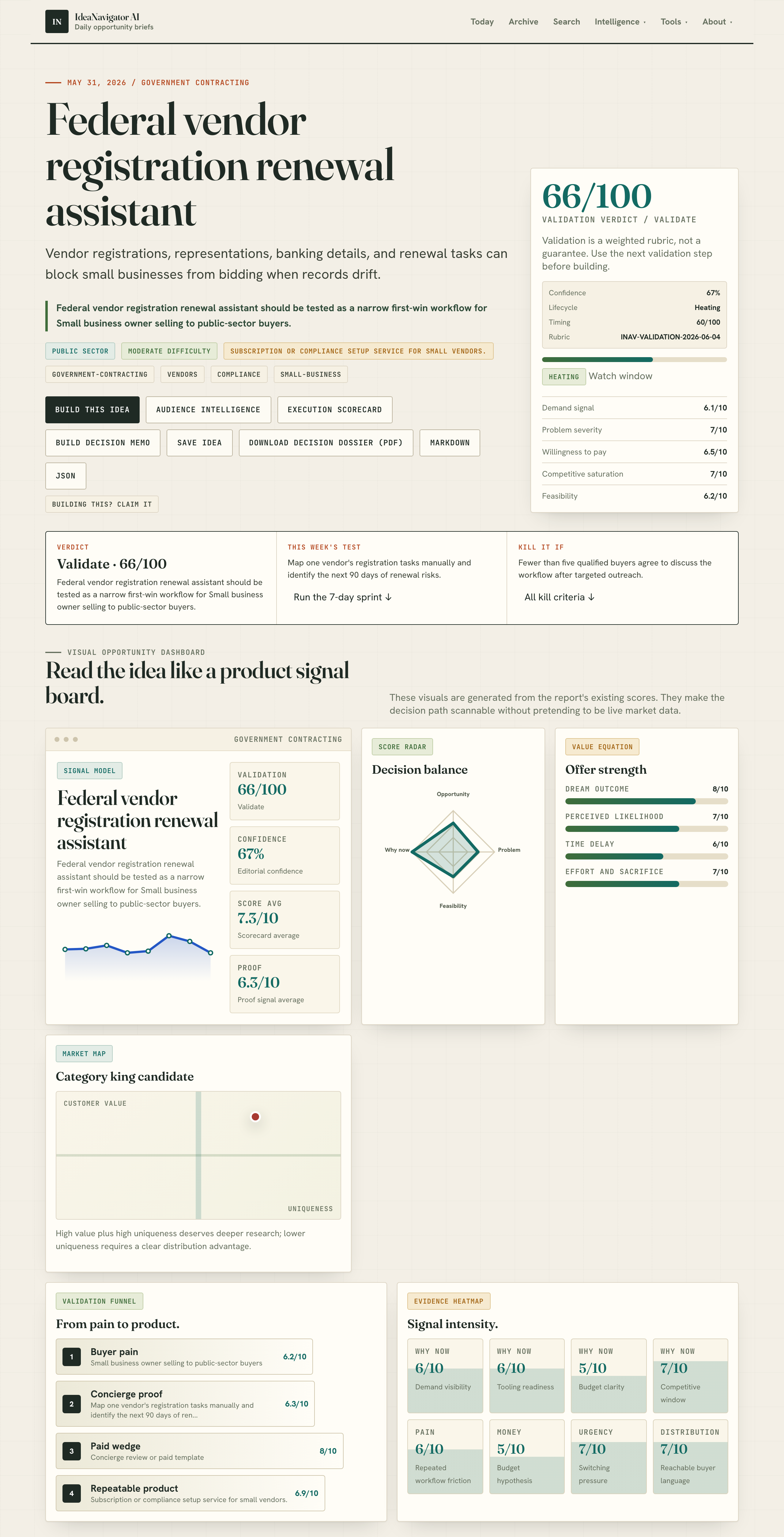
The federal vendor registration renewal assistant is being tested as a streamlined tool for small businesses selling to government. It focuses on tracking renewal tasks and compliance, aiming to reduce barriers to bidding.
Federal officials are testing a new vendor registration renewal assistant aimed at helping small businesses manage compliance tasks when selling to government agencies. The initiative addresses a common obstacle: registration and renewal requirements that can block vendors from bidding on contracts, especially when records drift or become outdated. This development is part of an effort to streamline the process and reduce administrative burdens for small vendors in the federal procurement market.
The proposed vendor registration renewal assistant is designed as a minimal viable product (MVP) that includes a registration checklist tracking entity status, renewal deadlines, required fields, and supporting documents. It is intended to be tested initially as a narrow workflow targeting small businesses that sell to public-sector buyers.
According to sources, the assistant will help vendors identify upcoming renewal risks by mapping one vendor’s registration tasks over the next 90 days. The goal is to prevent lapses that could disqualify vendors from bidding on federal contracts. The tool is expected to be offered via a subscription or compliance setup service, providing ongoing support for small vendors.
This initiative is part of a broader market effort to improve government contracting processes, which remain heavily document-driven. The testing phase aims to validate whether a simplified workflow can effectively reduce renewal failures and improve vendor participation in federal procurement.
Potential Impact on Small Business Participation in Federal Contracts
This development could significantly lower barriers for small businesses seeking to contract with the federal government. By simplifying renewal management, the assistant may reduce the administrative burden that often deters small vendors from maintaining active registrations. If successful, it could lead to increased competition and more diverse vendors in government procurement, ultimately benefiting public sector buyers and taxpayers.
federal vendor registration renewal checklist
As an affiliate, we earn on qualifying purchases.
As an affiliate, we earn on qualifying purchases.
Background of Federal Vendor Registration Challenges
Federal vendor registration involves multiple steps, including maintaining current representations, banking details, and renewal documentation. Vendors often face challenges when records become outdated or when renewal deadlines are missed, which can lead to disqualification from bidding opportunities. Small businesses, in particular, may lack dedicated compliance staff, making manual tracking burdensome.
Previous efforts have aimed to digitize and streamline registration processes, but renewal management remains a persistent pain point. The new assistant builds on these efforts by focusing specifically on renewal tasks, with an initial test targeting a narrow workflow to evaluate its effectiveness before broader deployment.
“The goal is to help small vendors stay compliant and avoid losing registration status due to overlooked renewal deadlines.”
— an anonymous source involved in the testing
government contractor compliance tracking tool
As an affiliate, we earn on qualifying purchases.
As an affiliate, we earn on qualifying purchases.
Uncertainties About Effectiveness and Adoption
It is not yet clear how well the renewal assistant will perform in real-world settings or whether small vendors will adopt the tool widely. The testing phase is ongoing, and results are expected to determine if the workflow can be scaled or integrated into existing government systems.
Further questions include how the tool will handle diverse registration requirements across agencies and whether it will be accessible to vendors with limited digital resources.
small business federal registration management software
As an affiliate, we earn on qualifying purchases.
As an affiliate, we earn on qualifying purchases.
Next Steps for Validation and Broader Rollout
The testing phase will continue over the coming months, with officials monitoring the tool’s ability to identify renewal risks and improve compliance. If successful, the assistant may be expanded to cover additional workflows and offered as a standard part of the federal vendor registration process. Vendors and stakeholders will be able to provide feedback during this period to refine the tool’s features.
Further developments could include integration with existing government portals and automation features to streamline renewal notifications.
federal contract renewal reminder service
As an affiliate, we earn on qualifying purchases.
As an affiliate, we earn on qualifying purchases.
Key Questions
Who is the target user for the renewal assistant?
The primary target users are small business owners selling to federal agencies, especially those managing their own compliance without dedicated staff.
What specific tasks will the assistant help with?
The tool will track registration status, renewal deadlines, required fields, and supporting document owners, providing reminders and a checklist to prevent lapses.
Is this tool available to all vendors now?
It is currently in the testing phase and not yet available broadly. Its effectiveness and potential rollout are still being evaluated.
How will the assistant make money?
The service is expected to operate via a subscription or compliance setup fee for small vendors seeking ongoing support.
What challenges remain for the project?
Uncertainties include how well the tool will scale across different agencies, its adoption rate among small vendors, and its ability to handle complex, varied registration requirements.
Source: IdeaNavigator AI
Fall Picks
fall essentials
As an affiliate, we earn on qualifying purchases.