📊 Full opportunity report: Fair-value appraisals for used GPUs and AI hardware on IdeaNavigator AI — validation score, market gap, and execution plan.

Get smart everyday buys delivered free with Prime
- Fast, free delivery on millions of items
- Prime Video, Amazon Music and more included
- Member-only deals all year
TL;DR
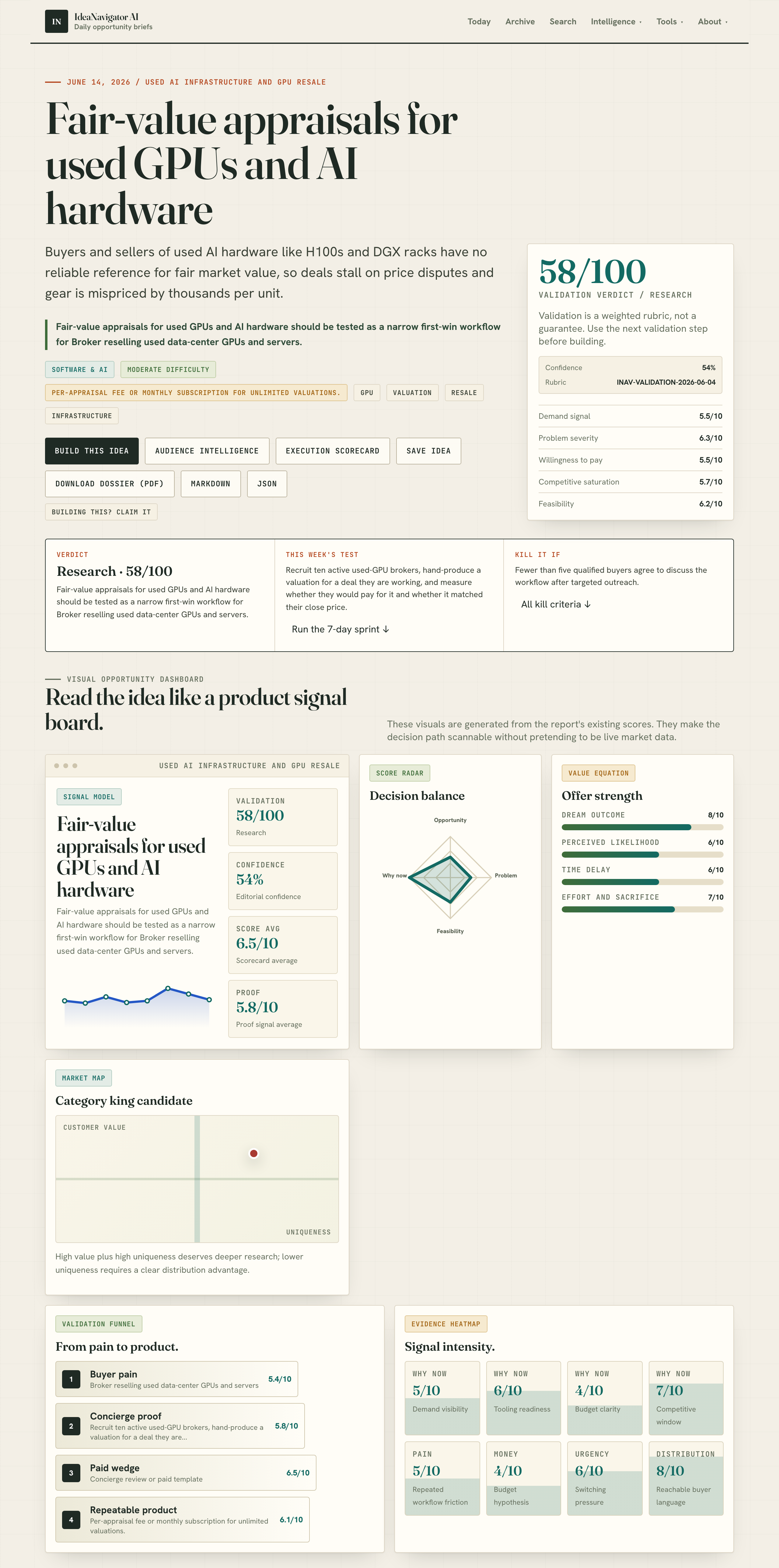
A proposed manual fair-value appraisal system for used GPUs and AI hardware seeks to create transparent pricing benchmarks. This aims to reduce price disputes and mispricing in the secondary market, especially as hyperscalers refresh their hardware fleets.
IdeaNavigator AI is testing a manual fair-value appraisal system for used data-center GPUs and AI hardware, aiming to create reliable market benchmarks for brokers involved in resale. This development addresses longstanding issues of price disputes and mispricing in a rapidly expanding secondary market.
The proposed system involves a manual valuation sheet where brokers input details such as GPU model, condition, and quantity. The tool then provides a curated fair-value range based on three recent comparable sales from public listings. This approach is designed to give brokers a transparent reference point for pricing used hardware like H100s and DGX racks.
Market participants have highlighted the lack of reliable pricing benchmarks for used AI hardware, which leads to stalled deals and significant discrepancies in perceived value. As hyperscalers and research labs quickly refresh their GPU fleets, large volumes of recent-generation hardware are entering the secondary market, intensifying the need for transparent valuation methods. The system is intended to be a first step, with potential for expansion into automated tools and broader market adoption.
Why Reliable Pricing Benchmarks Are Critical for Resale Markets
This development could significantly improve the efficiency of the used AI hardware market by reducing disputes over pricing and decreasing mispricing risks. For brokers, having a trusted, transparent valuation method can streamline negotiations and foster greater market confidence. As the secondary market for GPUs and AI servers grows rapidly, establishing fair-value benchmarks becomes increasingly vital to prevent market distortions and ensure liquidity.
As an affiliate, we earn on qualifying purchases.
Rapid Hardware Refreshes Drive Secondary Market Growth
Recently, hyperscalers and research labs have been aggressively upgrading their GPU fleets, often selling off recent-generation hardware into the secondary market. This influx has created a fragmented pricing landscape, with no standardized reference points for valuation. Currently, brokers rely on anecdotal data or manual comparisons, leading to inconsistent pricing and deal delays. The lack of transparent, reliable benchmarks has become a bottleneck for efficient resale of high-value AI hardware.
“The absence of a standardized fair-value reference causes deal stalls and mispricing, which can be costly for both buyers and sellers.”
— an anonymous researcher
As an affiliate, we earn on qualifying purchases.
Uncertainties About Market Adoption and Validation
It remains unclear how quickly brokers will adopt the manual valuation system and whether it will prove accurate enough to influence pricing negotiations. The effectiveness of the tool depends on the availability of recent comparable sales and the consistency of hardware conditions, which can vary widely. Further testing and validation are ongoing, and broader industry acceptance has yet to be demonstrated.
As an affiliate, we earn on qualifying purchases.
Next Steps Include Broader Testing and Automation
IdeaNavigator AI plans to recruit ten active used-GPU brokers to test the valuation tool on real deals, measuring its accuracy and willingness to pay for the service. If successful, the company aims to develop automated valuation models and expand adoption across the secondary AI hardware market. Monitoring how the market responds will be key to determining the tool’s long-term viability.
As an affiliate, we earn on qualifying purchases.
Key Questions
How does the manual valuation tool work?
It allows brokers to input GPU model, condition, and quantity, then provides a fair-value range based on three recent comparable sales from public listings.
Will this system replace automated valuation tools?
Initially, it is a manual process intended as a first step. Automation may follow once the manual approach proves effective and gains acceptance.
Who benefits most from this valuation system?
Used-GPU brokers and resellers seeking transparent, reliable benchmarks to price hardware accurately and close deals more efficiently.
What are the main challenges for implementing this system?
Ensuring the availability of recent comparable sales, managing hardware condition variability, and encouraging industry adoption are key hurdles.
When will this valuation system be widely available?
It is currently in testing; broader availability depends on successful validation with early users and subsequent development of automation features.
Source: IdeaNavigator AI
Halloween Picks
halloween
As an affiliate, we earn on qualifying purchases.