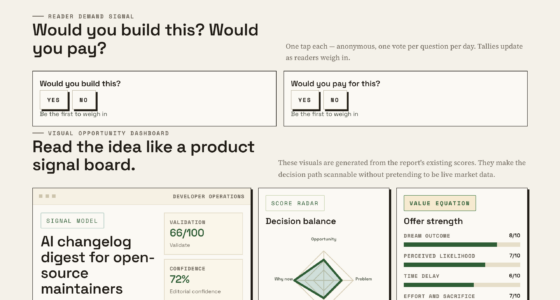

📊 Full opportunity report: Ensuring AI Agent Safety: Security Layer Fundamentals on IdeaNavigator AI — validation score, market gap, and execution plan.

Get smart everyday buys delivered free with Prime
- Fast, free delivery on millions of items
- Prime Video, Amazon Music and more included
- Member-only deals all year
TL;DR
A security proxy for MCP servers has been developed to add permission controls, audit trails, and safety features. This addresses vulnerabilities in enterprise AI agent infrastructure. The initiative is in early validation stages, with next steps focused on open-source adoption.
A new security proxy for MCP servers has been developed to add permission controls, audit logging, and safety features, addressing critical vulnerabilities in enterprise AI agent deployments. This initiative is driven by the need to prevent unauthorized tool calls and potential security breaches as MCP becomes the industry standard.
Security and guardrail layers for MCP servers are being tested as a first step toward safer AI agent infrastructure, according to industry sources. The proxy acts as an intermediary that enforces per-tool allowlists, per-agent identity verification, human approval for destructive actions, rate limiting, and maintains a searchable audit log of all tool invocations. This development responds to the widespread deployment of MCP servers in enterprises, often without adequate permission models or security controls, which exposes internal tools to potential misuse.
Experts note that MCP has become the dominant framework for agent-tool integration since 2025-2026, and the rapid deployment has outpaced security reviews. The lack of permission controls and audit capabilities has created vulnerabilities, especially with documented attack vectors like prompt injection and tool abuse. The new proxy aims to mitigate these risks by providing a security layer that can be integrated into existing MCP setups through a simple deployment.
The initial MVP (minimum viable product) is a proxy that can be deployed in front of existing MCP servers. It is designed to be open-source, with plans to gather feedback from industry teams. The approach has been validated through early testing and interviews with twenty teams currently using MCP in production environments. The goal is to develop a paid enterprise tier offering features like SSO integration, policy packs, and compliance exports, with monetization based on per-server subscriptions.
Why This Security Layer Is a Critical Step Forward
This development matters because it addresses a growing security gap in enterprise AI infrastructure. As MCP becomes the standard for integrating AI agents with internal tools, the lack of permission controls and audit logs exposes organizations to security breaches, data leaks, and misuse. Implementing a security proxy with guardrails can significantly reduce these risks, making AI deployment safer and more compliant with enterprise security standards.
By adding per-tool allowlists, human approval gates, and audit capabilities, companies can better control agent behavior, track all interactions, and prevent malicious or accidental damage. This is especially important given the documented attack class of prompt injections and tool abuse, which could lead to serious security incidents if left unmitigated.
Overall, this initiative could become a foundational component of enterprise AI security, enabling organizations to deploy AI agents with confidence and meet compliance requirements more easily.
As an affiliate, we earn on qualifying purchases.
Industry Shift Toward Secure MCP Deployments
Since MCP (Managed Cloud Platform) became the de facto standard for AI agent-tool integration in 2025-2026, enterprises have rapidly adopted it to streamline AI workflows. However, this rapid adoption has revealed significant security vulnerabilities, as many teams have integrated MCP servers into production without permission models, audit trails, or guardrails. This has led to documented cases of tool abuse and prompt injection attacks, prompting industry calls for improved security measures.
Security experts and platform engineers recognize that existing MCP deployments often lack safeguards, making them vulnerable to malicious actors and accidental misuse. The development of a proxy that enforces security policies and logs all activity is seen as a necessary step to address these risks. Early prototypes and pilot programs are underway, with feedback being collected from industry teams to refine the solution before wider adoption.
This shift reflects a broader trend toward embedding security into AI infrastructure, moving from ad hoc controls to formalized, enforceable policies that can scale with enterprise needs.
“The security proxy represents a significant step forward in making enterprise AI infrastructure safer and more controllable.”
— an anonymous industry engineer
enterprise AI agent security tools
As an affiliate, we earn on qualifying purchases.
As an affiliate, we earn on qualifying purchases.
Uncertainties Around Adoption and Feature Scope
It is still unclear how widely the open-source MCP audit proxy will be adopted across different enterprise environments. The specific features of the paid policy tier, such as SSO integration and compliance exports, are still under development, and industry feedback will shape their final scope. Additionally, questions remain about how the proxy will integrate with various existing security frameworks and whether it can scale effectively in large, complex deployments.
Further testing and real-world deployment results are needed to confirm the proxy’s effectiveness and usability at scale, and it is not yet clear when the full commercial version will be available.
As an affiliate, we earn on qualifying purchases.
Next Steps in Security Proxy Development and Deployment
The immediate next step is to publish the open-source MCP audit proxy for community testing and feedback. Industry teams are being invited to pilot the proxy in their production environments to evaluate its security and usability. Concurrently, the development team plans to gather detailed requirements for the enterprise policy tier, including features like SSO and compliance reporting.
In the coming months, the focus will be on refining the proxy based on user feedback, expanding testing, and preparing for broader deployment. The goal is to finalize the paid tier offering, establish pricing models, and promote adoption among enterprise users concerned with securing their AI infrastructure.
As an affiliate, we earn on qualifying purchases.
Key Questions
What is the main purpose of the new security proxy for MCP servers?
The proxy is designed to add security guardrails, permission controls, audit logging, and safety features to MCP servers, reducing risks of tool abuse and security breaches.
Will this security layer be available as open source?
Yes, the initial MCP audit proxy will be published as open source to encourage community testing and feedback.
What features are planned for the paid enterprise tier?
The enterprise tier will include features like single sign-on (SSO) integration, policy packs, and compliance export capabilities.
When can organizations expect to deploy this security proxy widely?
Deployment timelines depend on pilot results and feedback, but broader adoption is expected within the next several months after refinement and finalization of features.
How does this development impact enterprise AI security?
It provides a crucial layer of control and monitoring, helping organizations prevent misuse, enforce policies, and comply with security standards as they deploy AI agents at scale.
Source: IdeaNavigator AI
Fall Picks
fall essentials
As an affiliate, we earn on qualifying purchases.