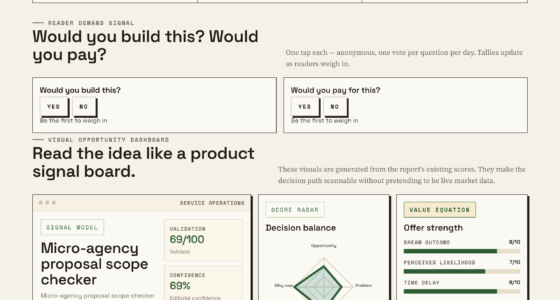

📊 Full opportunity report: A Skill Is a Folder, Not a Prompt: What Anthropic Learned Running Hundreds of Them on ThorstenMeyerAI.com — validation score, market gap, and execution plan.

Get smart everyday buys delivered free with Prime
- Fast, free delivery on millions of items
- Prime Video, Amazon Music and more included
- Member-only deals all year
TL;DR
Anthropic has demonstrated that ‘Skills’ for AI agents are best understood as comprehensive folders containing instructions, scripts, and knowledge assets. This approach improves consistency, onboarding, and institutional memory, marking a shift from simple prompts to durable operational assets.
Anthropic has revealed that its approach to creating AI skills involves packaging them as folders—containing instructions, scripts, and knowledge—rather than just saving prompts. This shift aims to make AI agent behaviors more consistent, reusable, and scalable across organizations, marking a significant evolution in enterprise AI deployment.
According to a write-up from a Claude Code engineer, Anthropic’s internal practice involves designing Skills as folders that hold a variety of assets—ranging from instructions and reference documents to executable scripts and configuration data. This contrasts with the common practice of saving static prompts as text files or markdown notes. The folder structure allows the AI agent to discover, read, and execute components within, enabling more dynamic and reliable operations.
Anthropic emphasizes that this method transforms ad-hoc prompting into durable institutional capabilities. Instead of relying on one-off instructions, organizations can build a library of Skills that encapsulate tribal knowledge, guardrails, and procedures, which are versioned and shared across teams. This approach supports improved output consistency, faster onboarding, and continuous improvement through iterative refinement of the Skills.
Anthropic identified nine categories of Skills, including data analysis, product verification, automation, code scaffolding, and infrastructure operations. The most impactful, according to the company, is verification—ensuring the AI’s output is correct—since it directly improves quality and reduces errors. The company advocates for investing significant effort into developing high-quality Skills in these categories, with the understanding that Skills are assets that appreciate over time.
A Skill is a folder, not a prompt
Anthropic published what it learned running hundreds of Skills across its own engineering org. Read as a business memo, the point is bigger than a coding trick: this is how ad-hoc prompting becomes durable institutional capability — the SOPs your agents actually follow, versioned and shared.
“A Skill is just a clever markdown prompt you save in a file.”
A folder the agent can discover, read & run — instructions, scripts, references, templates, config & on-demand hooks.
The knowledge of how your organization actually operates can be captured, versioned, shared & executed — and the thing capturing it is a humble folder with a script and a gotchas list inside. For the builder, that’s context engineering with real tools attached. For whoever owns the budget, it’s the difference between AI that starts from zero every morning and an asset that compounds. Caveats: best practices are still evolving, checked-in Skills cost context, and curation beats accumulation. Start with one Skill, one gotcha, and the category that catches your mistakes.
Implications of Skills as Folders for Enterprise AI
This new understanding of Skills as folders containing comprehensive operational assets marks a shift in how organizations deploy AI. It enables more consistent outputs across teams, accelerates knowledge transfer during onboarding, and creates a scalable, maintainable library of organizational procedures. For businesses, this approach reduces reliance on individual tribal knowledge and helps embed AI-driven processes into everyday workflows, potentially transforming operational efficiency and reliability.
As an affiliate, we earn on qualifying purchases.
Evolution of AI Skills and Organizational Practices
Traditionally, AI teams have relied on static prompts or simple scripts, often retyped or manually adjusted for each task. Anthropic’s recent publication builds on ongoing industry efforts to formalize and standardize AI behaviors through reusable components. Their approach reflects a broader trend toward operationalizing AI as a systematic, asset-based practice, emphasizing versioning, documentation, and continuous improvement. This development follows years of experimentation with prompt engineering and modular AI design, now moving toward more durable, organizational-level assets.
“A Skill is not just a prompt; it’s a container for everything your organization needs to do a task reliably—instructions, scripts, and tribal knowledge all in one place.”
— Anthropic engineer involved in the project
AI scripting and knowledge management tools
As an affiliate, we earn on qualifying purchases.
As an affiliate, we earn on qualifying purchases.
Unanswered Questions About Skill Implementation
While Anthropic’s internal documentation provides a compelling framework, it is not yet clear how widely this approach has been adopted outside the company or how it performs in large-scale, real-world deployments. Specific metrics on efficiency gains, error reduction, or onboarding time improvements are still emerging, and the practical challenges of managing and updating large Skill libraries remain to be seen.
As an affiliate, we earn on qualifying purchases.
Next Steps for AI Teams Adopting Folder-Based Skills
Organizations interested in this approach should evaluate how to structure their own Skills as folders, including defining categories and best practices for documentation and scripting. Further research and case studies are expected to emerge as companies experiment with this model, potentially leading to industry standards for reusable AI assets. Additionally, tools and platforms may evolve to better support versioning, discovery, and automation of Skills libraries.
As an affiliate, we earn on qualifying purchases.
Key Questions
How does treating Skills as folders improve AI reliability?
By consolidating instructions, scripts, and tribal knowledge into a single, versioned container, Skills as folders enable consistent, repeatable outputs and easier updates across teams.
Can this approach be applied to existing AI workflows?
Yes, organizations can start by cataloging current procedures into folder-based Skills, then gradually integrate them into their AI systems to enhance consistency and onboarding.
What are the main challenges of implementing Skills as folders?
Managing and updating large libraries, ensuring proper tagging and description for discovery, and maintaining scripts and documentation over time are potential hurdles.
Will this change how AI prompts are written?
Yes, the focus shifts from crafting single prompts to designing comprehensive, reusable container assets that include instructions, code, and context.
Source: ThorstenMeyerAI.com
Fall Picks
fall essentials
As an affiliate, we earn on qualifying purchases.