📊 Full opportunity report: A Step-by-Step Guide To Civic Engagement Logistics Planning on IdeaNavigator AI — validation score, market gap, and execution plan.

Get smart everyday buys delivered free with Prime
- Fast, free delivery on millions of items
- Prime Video, Amazon Music and more included
- Member-only deals all year
TL;DR
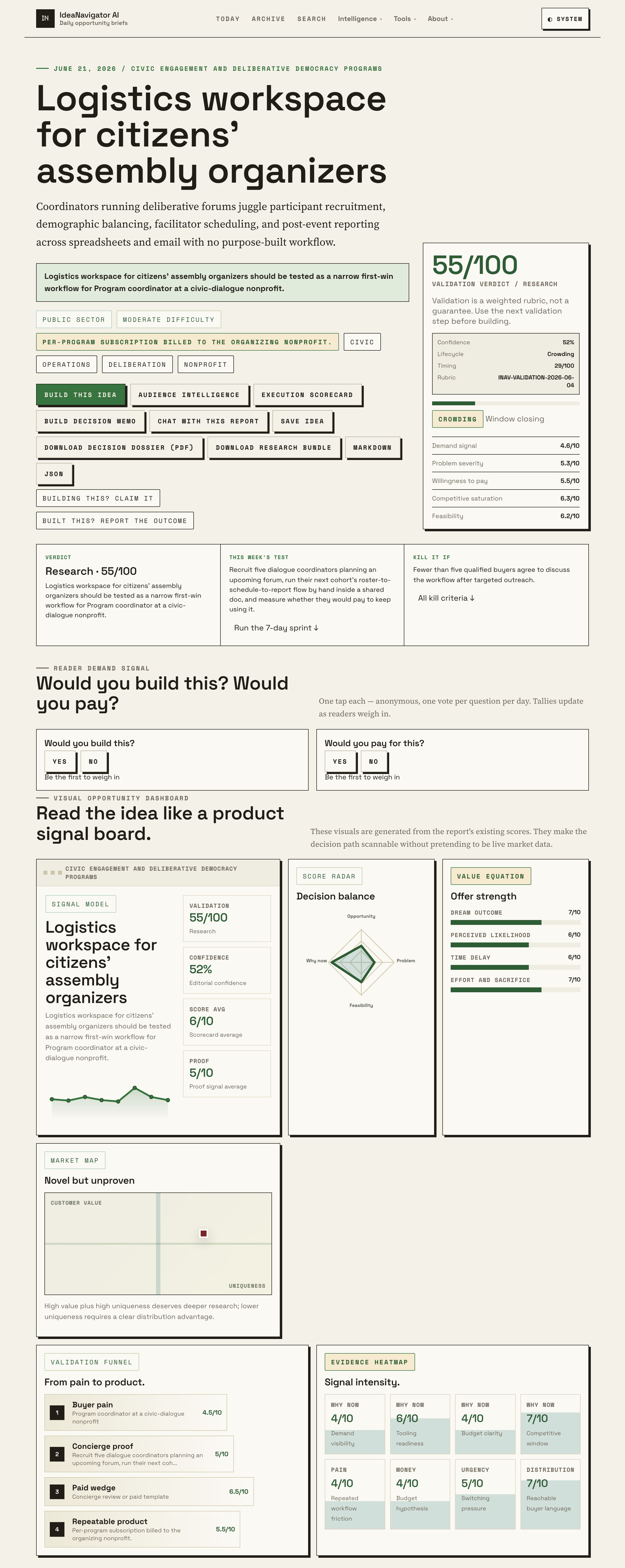
A civic-dialogue nonprofit is piloting a new logistics workspace designed to automate participant recruitment, scheduling, and reporting for citizens’ assemblies. This development aims to address manual workflows and improve scalability as demand for deliberative forums grows.
A civic-dialogue nonprofit is testing a new, purpose-built logistics workspace designed to automate key tasks involved in organizing citizens’ assemblies. This initiative aims to address the manual, spreadsheet-based processes currently used by coordinators, and to support scalable civic engagement programs amid increasing demand from funders and local governments.
The nonprofit’s program coordinator is developing a minimum viable product (MVP) that guides coordinators through participant roster management, demographic balancing, scheduling, and attendance tracking, culminating in a final report. This workflow is intended to replace labor-intensive manual processes that currently rely on spreadsheets and email correspondence.
To validate this approach, the nonprofit plans to recruit five coordinators preparing for upcoming civic forums. The pilot involves running their current manual workflow within the new workspace to assess whether coordinators find it useful and are willing to pay for such a tool. The subscription model would bill per program, providing a scalable revenue stream for the nonprofit.
Why Streamlined Logistics Matter for Civic Engagement
As demand for citizens’ assemblies and deliberative panels increases, nonprofits face growing logistical challenges in coordinating these events efficiently. Manual workflows limit capacity and scalability, potentially hindering broader civic participation. Implementing purpose-built tools could enhance operational efficiency, enabling more organizations to run larger and more frequent forums, ultimately strengthening democratic engagement.
event planning software for civic engagement
As an affiliate, we earn on qualifying purchases.
As an affiliate, we earn on qualifying purchases.
Growing Demand for Citizens’ Assemblies Drives Need for Better Tools
Over recent years, local governments and funders have increasingly commissioned citizens’ assemblies to foster inclusive decision-making. However, most small civic nonprofits still rely on manual, spreadsheet-based workflows, which are time-consuming and difficult to scale. This gap presents an opportunity for technological innovation to support civic engagement at a larger scale.
The nonprofit’s initiative is part of a broader movement to develop digital tools tailored for deliberative democracy, aiming to reduce administrative burdens and improve participant experience. The pilot project reflects a practical step toward operationalizing this vision.
“Automating logistics workflows can significantly increase the capacity of civic organizations to run more assemblies without sacrificing quality.”
— an anonymous researcher
citizens' assembly logistics management tool
As an affiliate, we earn on qualifying purchases.
As an affiliate, we earn on qualifying purchases.
Uncertainties Around Adoption and Effectiveness
It is not yet clear whether coordinators will find the new workflow sufficiently user-friendly or if they will be willing to pay for it at scale. The pilot is ongoing, and results regarding usability, cost-effectiveness, and broader adoption are still to be determined.
participant scheduling software for community events
As an affiliate, we earn on qualifying purchases.
As an affiliate, we earn on qualifying purchases.
Next Steps for Validation and Scaling
The nonprofit plans to complete pilot testing with the five recruited coordinators over the coming months. Success will be measured by adoption willingness and workflow efficiency improvements. If positive, the organization intends to refine the tool and expand its deployment to other civic groups, aiming for a broader rollout in the next year.
demographic balancing tools for civic forums
As an affiliate, we earn on qualifying purchases.
As an affiliate, we earn on qualifying purchases.
Key Questions
How will this tool improve the planning of citizens’ assemblies?
The tool aims to automate participant recruitment, demographic balancing, scheduling, and reporting, reducing manual effort and errors, and enabling organizations to run more assemblies efficiently.
Who will pay for this logistics workspace?
The nonprofit plans to offer it as a per-program subscription billed to civic organizations or local governments organizing deliberative forums.
When will the tool be available for wider use?
If pilot results are positive, a broader rollout could occur within the next 12 months, after further development and testing.
What challenges might affect adoption?
Potential challenges include user-friendliness, integration with existing workflows, and convincing organizations to switch from manual processes to a new digital system.
Will this tool support larger or more complex assemblies?
The initial focus is on small to medium-sized forums, but future versions may be adapted for larger or more complex deliberative processes as the platform matures.
Source: IdeaNavigator AI
Halloween Picks
halloween
As an affiliate, we earn on qualifying purchases.