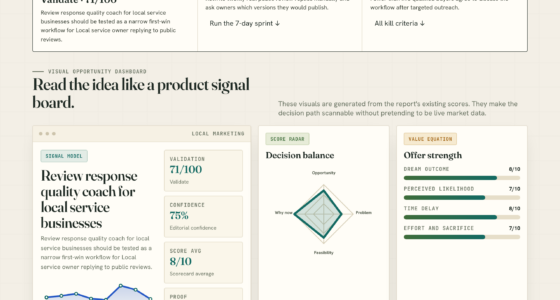

📊 Full opportunity report: IdeaClyst: The Validation Council on ThorstenMeyerAI.com — validation score, market gap, and execution plan.

Get smart everyday buys delivered free with Prime
- Fast, free delivery on millions of items
- Prime Video, Amazon Music and more included
- Member-only deals all year
TL;DR
IdeaClyst has launched a new validation council that uses two AI models to critically assess ideas before they reach roadmaps. This process aims to improve decision quality and reduce costly failures by structured disagreement and evidence-based debate.
IdeaClyst has unveiled a new ‘Validation Council’ that employs two AI models — Claude and Codex — to evaluate ideas through structured disagreement, aiming to improve decision-making and prevent costly roadmapping errors.
The Validation Council is a process where an idea undergoes an initial research phase, gathering context and prior art, followed by five deliberation steps: framing, steelmanning, red-teaming, evidence-checking, and synthesizing a verdict. This structured approach ensures ideas are thoroughly stress-tested from opposing perspectives.
Unlike simple chatbot assessments, the council’s design emphasizes transparent reasoning, with outputs that include detailed arguments and evidence, making the decision process auditable. The process is open source and runs locally on owned hardware, reducing costs and enabling frequent use.
While the system aims to reduce the risk of unchallenged, overly plausible ideas progressing into development, experts acknowledge it cannot eliminate all errors, as models share blind spots and cannot verify market realities.
IdeaClyst — the validation council
Most ideas don’t die from being bad — they die from being plausible and untested. A research pre-step, then two models cross-examining the idea before it earns a roadmap slot.
Independent commentary, produced with AI assistance under human editorial oversight. The views are the author’s own and may change. IdeaClyst is open source under MIT, provided “as is” without warranty; see the repository LICENSE. The council’s research, deliberation and verdicts are produced by automated models and may contain errors or shared blind spots — a verdict is auditable reasoning, not validated demand; verify independently before committing. Product and company names are trademarks of their respective owners; mention does not imply endorsement.
Why Structured AI Disagreement Enhances Decision Quality
By formalizing a process that involves opposing AI models, IdeaClyst’s Validation Council aims to improve the quality of early-stage decision-making. It reduces the risk of pursuing ideas that seem plausible but are weak upon scrutiny, potentially saving companies time and resources.
This approach also introduces a more transparent, auditable process for idea evaluation, shifting decision-making from intuition to evidence-backed reasoning. It offers a high-leverage tool for operators to filter out weak ideas before they reach development, thus increasing strategic focus and reducing costly failures.
As an affiliate, we earn on qualifying purchases.
The Evolution of AI-Driven Idea Validation
IdeaClyst originated from the need to improve idea vetting processes in fast-paced innovation environments. Its predecessor, IdeaNavigator, provided open, evidence-mined ideas publicly. The new Validation Council extends this concept into private, rigorous evaluation, emphasizing structured disagreement using multiple AI models.
This development builds on prior efforts to leverage AI for decision support, but uniquely emphasizes the importance of opposing viewpoints and transparent reasoning to prevent sycophantic model agreement, which can be misleading.
“The Validation Council is designed to make idea stress-testing more rigorous, transparent, and repeatable, reducing costly roadmapping mistakes.”
— Thorsten Meyer, founder of IdeaClyst
As an affiliate, we earn on qualifying purchases.
Limitations of AI-Based Idea Validation
While the Validation Council enhances idea scrutiny, it cannot guarantee correctness or market validation. Both models share training data biases and blind spots, meaning they can still confidently endorse weak ideas. Additionally, the process relies on the quality of initial research and evidence, which may be incomplete or biased.
Furthermore, the process’s effectiveness depends on careful interpretation of the arguments, and it does not replace human judgment or market validation. The risk of process-theater — where rigorous-sounding outputs mask weak reasoning — remains.
As an affiliate, we earn on qualifying purchases.
Next Steps for Adoption and Improvement
IdeaClyst plans to expand its user base and gather feedback to refine the council process. Future developments may include integrating additional models, enhancing evidence-gathering, and developing user interfaces that better visualize debate outcomes. Adoption by early users will help assess its real-world impact on decision quality and resource allocation.
Further research will explore how to mitigate the shared blind spots of models and incorporate human oversight, ensuring the process remains a tool for better, not infallible, decision-making.
As an affiliate, we earn on qualifying purchases.
Key Questions
How does the IdeaClyst Validation Council differ from regular AI idea assessments?
It employs two AI models—Claude and Codex—to critically evaluate ideas from opposing perspectives, with a structured, transparent debate process that produces an auditable verdict, unlike simple single-model assessments.
Can the Validation Council eliminate all idea flaws?
No. While it reduces the risk of unchallenged, plausible ideas progressing, it cannot eliminate all errors due to shared model biases and the inability to verify market realities.
Is the process open source or proprietary?
The core process and internals are open source under MIT license, and it runs locally on owned hardware, making it accessible and customizable for users.
What are the main limitations of using AI for idea validation?
AI models share training data biases, may confidently endorse weak ideas, and cannot replace human judgment or market validation efforts. The process also risks creating an appearance of rigor that might mask underlying weaknesses.
What are the plans for future development of IdeaClyst?
Future plans include integrating more models, improving evidence collection, refining user interfaces, and expanding adoption to better assess its impact on decision-making processes.
Source: ThorstenMeyerAI.com
Halloween Picks
halloween
As an affiliate, we earn on qualifying purchases.