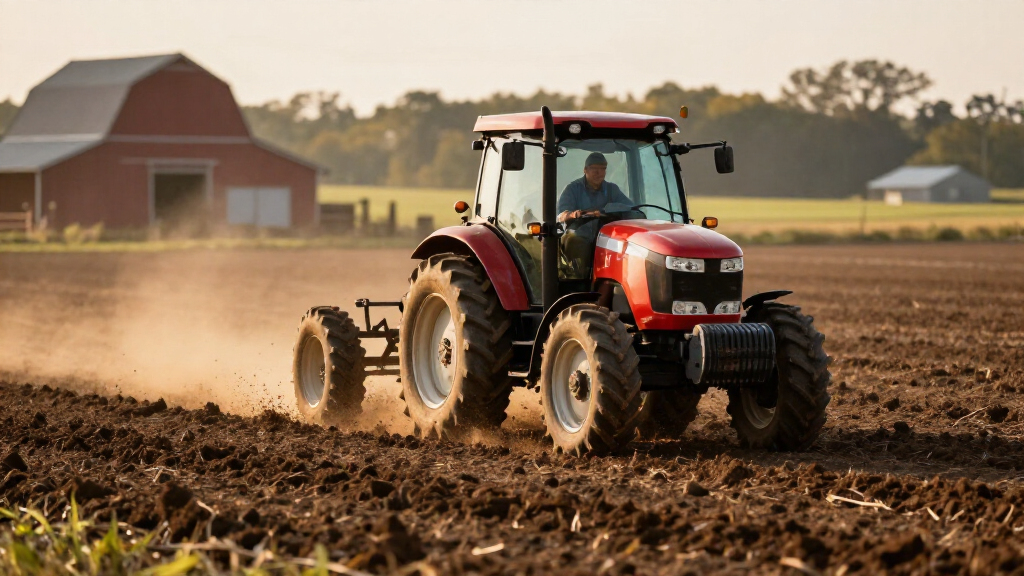

🔍 Read the full analysis: From Animal Power To Tractors: What Happened On Farms? on ThorstenMeyerAI.com

Get smart everyday buys delivered free with Prime
- Fast, free delivery on millions of items
- Prime Video, Amazon Music and more included
- Member-only deals all year
TL;DR
U.S. farm horses and mules peaked at 26.7 million in 1918, then fell to 3.1 million by 1960 as tractors and other machinery took over farm work. Farm employment also declined while the wider labor force grew, but the transition involved workers moving into other jobs and places—not a simple one-to-one replacement.
American farms shifted from animal power to machinery over the first half of the 20th century, with farm horses and mules falling from a peak of 26.7 million in 1918 to 3.1 million by 1960, according to federal historical statistics. The change freed land once used to grow animal feed and helped reduce the number of workers needed on farms, while raising a question that remains relevant as automation advances: what happens to workers when machines take over tasks?
The switch was visible in the machinery count. There were about 1,000 tractors on U.S. farms in 1910, 246,000 in 1920 and 4.69 million in 1960. Around 1955, tractors first outnumbered farm horses and mules: approximately 4.35 million tractors compared with 4.31 million animals. These figures come from historical series compiled by the U.S. Census Bureau and the Department of Agriculture; the tractor counts use census dates that varied slightly.
The animals required land as well as labor. In 1915, about 93 million acres of harvested cropland—more than a quarter of the total—grew feed for horses and mules, according to the historical statistics cited in the source account. By 1960, the feed acreage had fallen to about 5 million acres. A tractor required fuel when operated, while working animals needed feed year-round, making machinery attractive in part because the land could instead produce crops for people or sale.
Tractors were only one part of the change. Combine harvesters, which cut, thresh and clean grain in one pass, increased from about 4,000 on U.S. farms in 1920 to 1.042 million in 1960. Other equipment included corn pickers, balers and milking machines. The Department of Agriculture estimated that each farm worker supplied 7.1 people in 1910 and 47.1 in 1970; the latter figure includes people abroad supplied by U.S. exports.
Farm Work and Land Shifted
Mechanization changed both what farms produced and how many workers they needed. The decline in feed acreage made more land available for other crops, while machinery allowed fewer people to produce a growing supply of agricultural goods. The Department of Agriculture’s measure of people supplied per farm worker rose from 7.1 in 1910 to 47.1 in 1970, illustrating the increase in output per worker, though that measure does not by itself establish what caused every part of the gain.
The employment figures show the scale of the labor shift. U.S. farm employment peaked at 13.6 million in 1916 and was 4.5 million in 1970, while the overall U.S. labor force doubled, according to the source account. That contrast suggests workers did not simply disappear from the economy: many jobs were created elsewhere, especially in cities, and people had to move to take them. The data cited here do not trace each worker’s path or show how evenly the benefits and costs were distributed.
Products Worth Considering

Apple iMac Pro (27-inch Retina 5K Display, 3.2GHz 8-core Intel Xeon W, 32GB RAM, 1TB SSD) – Space Gray

HP OfficeJet 250 Wireless Mobile All-in-One Inkjet Printer

Apple MacBook Air 15-inch with M5 chip, 16GB Memory, 512GB SSD, and Liquid Retina Display
As an affiliate, we earn on qualifying purchases.
From Fordson to Modern Tractors
Tractors existed before World War I, but early models were heavy, expensive and better suited to large farms. In 1917, Ford introduced the Fordson. The Henry Ford museum describes it as “the first mass-produced and inexpensive lightweight tractor” and says it was built to meet small farmers’ needs. The 100,000th Fordson left the assembly line on February 21, 1920, a milestone during the rapid growth in tractor numbers.
The animal decline was gradual rather than a single event. Horses alone peaked at 21.4 million in 1915; mules continued increasing for a few more years, bringing the combined peak to 26.7 million in 1918. By 1960, horses and mules on farms numbered 3.1 million, a fall of almost 90% from that peak. The source account says farmers stopped breeding replacements as machinery spread, and the working population aged out; it does not describe a mass removal event.
The comparison now appears in discussions of automation. In 1983, economist Wassily Leontief compared human workers with horses displaced by tractors. But the analogy has limits: Leontief himself pointed to a difference, noting that horses could not vote. Today’s farm automation also remains task-specific. The source reports that John Deere’s 16-camera autonomy kit, announced in February 2025, performs tillage on select large tractors, while China reported that about 74% of ploughing, sowing and harvesting was mechanized in 2023. Those figures describe particular systems and activities, not fully autonomous farming everywhere.
““The first mass-produced and inexpensive lightweight tractor.””
— The Henry Ford museum, describing the Fordson
What the Historical Figures Miss
The figures establish the broad change in farm machinery, animal numbers and employment, but they do not show what happened to each displaced worker, how quickly different regions changed, or how the benefits were shared. The employment totals also do not distinguish among people who moved to city jobs, changed occupations, left the labor force or experienced other outcomes.
There are limits to the comparisons across years. The source notes that tractor counts for several census years were taken on slightly different dates, and that from 1951 the Department of Agriculture counted horses and mules together. The cited information also does not quantify the specific roles of improved seed, fertilizer and other farm changes alongside machinery. Current examples of driverless equipment are narrower than the historical shift: the cited autonomy system handles tillage on select large tractors, and the China mechanization figure covers ploughing, sowing and harvesting in 2023. Neither establishes how soon, or how fully, automation will reshape farm employment today.
Tracking Automation on Farms
The historical account sets a baseline for comparing newer farm technologies, but the next useful evidence will be about their actual use and effects: which tasks autonomous equipment can handle, how widely farmers adopt it, and whether it changes farm labor needs or costs. The source material does not provide a future adoption forecast or a scheduled next milestone.
For now, the reported examples point to a gradual, task-by-task process rather than a complete move to driverless farms. Further data on equipment deployment, farm employment and productivity would help distinguish demonstrations or limited applications from broad changes in agricultural work.
Key Questions
How many horses and mules worked on U.S. farms at the peak?
Historical estimates put the combined total at 26.7 million on January 1, 1918, including about 21.2 million horses and 5.5 million mules.
When did tractors outnumber horses and mules?
The source account places the crossover around 1955, when the estimates were about 4.35 million tractors and 4.31 million horses and mules.
What happened to the farm horses?
The account says farmers generally stopped breeding replacements as machinery took over. The working animal population declined over time; the source does not describe a single mass event.
Did mechanization eliminate farm work?
No. U.S. farm employment fell from a peak of 13.6 million in 1916 to 4.5 million in 1970, while the overall labor force doubled. The figures indicate a major shift, but do not specify the individual outcomes of displaced farm workers.
Are modern farm tractors fully autonomous?
The cited example is limited: a 16-camera autonomy kit reported in February 2025 performs tillage on select large tractors. The source material does not establish that farms generally operate without drivers.
Source: ThorstenMeyerAI.com