
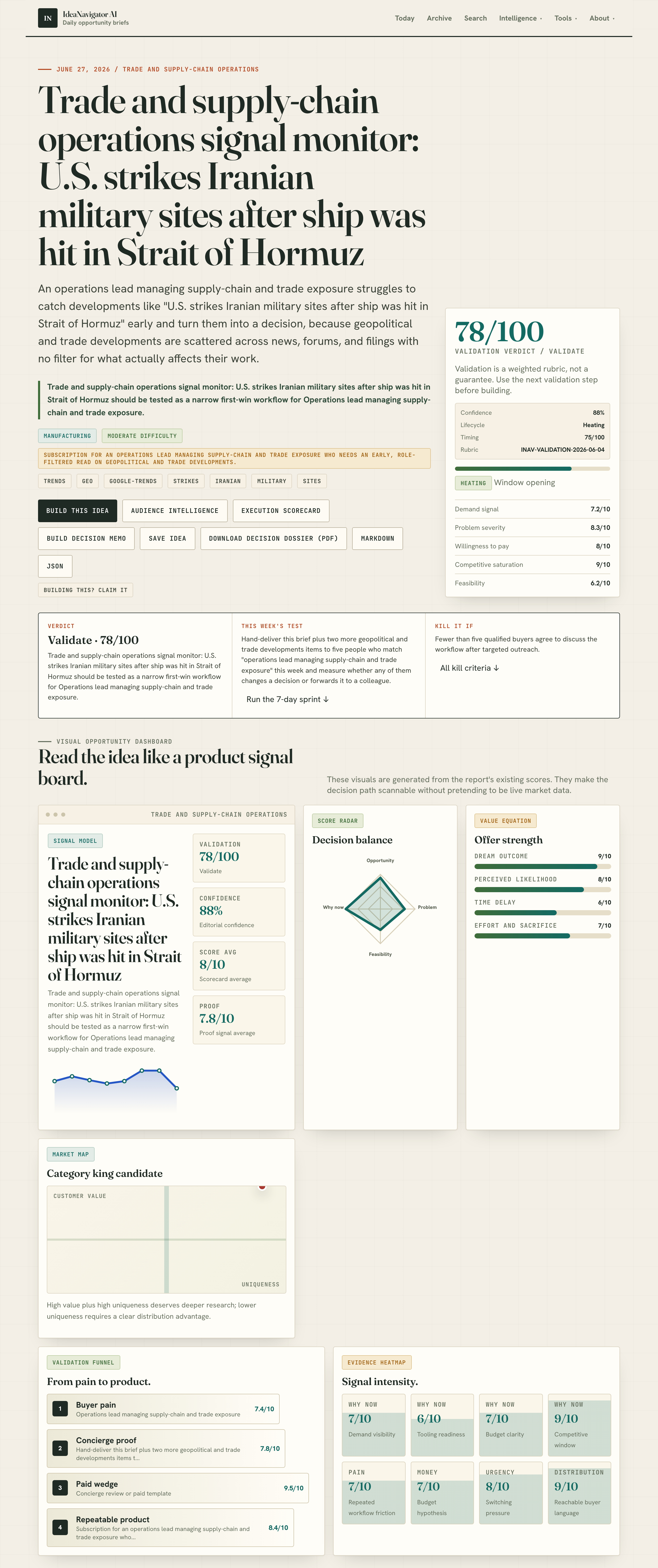
📊 Full opportunity report: Trade and supply-chain operations signal monitor: U.S. strikes Iranian military sites after ship was hit in Strait of Hormuz on IdeaNavigator AI — validation score, market gap, and execution plan.

Get smart everyday buys delivered free with Prime
- Fast, free delivery on millions of items
- Prime Video, Amazon Music and more included
- Member-only deals all year
TL;DR
The United States confirmed it conducted military strikes on Iranian military sites after a commercial ship was attacked in the Strait of Hormuz. The development impacts regional stability and trade routes, with ongoing uncertainty about Iran’s response.
The United States has confirmed it carried out military strikes on Iranian military sites in response to an attack on a commercial ship in the Strait of Hormuz. This escalation underscores rising tensions in the region and has immediate implications for global trade routes.
U.S. officials stated that the strikes targeted Iranian military infrastructure believed to be involved in the attack on the vessel, which occurred earlier today in the strategic Strait of Hormuz. The attack on the ship, a commercial vessel transporting goods, prompted swift U.S. military action, according to Pentagon spokespersons.
Iran has not officially responded to the strikes, and it remains unclear whether the Iranian government was directly involved or if the targets were solely military installations linked to Iran’s armed forces. The incident has heightened concerns over regional stability and the security of maritime trade routes.
Implications for Regional Stability and Global Trade
This development matters because the Strait of Hormuz is a critical chokepoint for global oil and trade shipments. Increased military activity raises the risk of further escalation, which could disrupt supply chains and influence energy markets. For international stakeholders, the event signals a potential shift toward heightened conflict in the region, affecting trade and security policies worldwide.
Products Worth Considering

Samsung 27-Inch Odyssey G5 QHD Gaming Monitor (G50F)

FLEXISPOT 3-in-1 Convertible Chair and Table for Four

Logitech MX Master 4 Ergonomic Wireless Mouse with Haptics – Graphite
As an affiliate, we earn on qualifying purchases.
Recent Escalations in Iran-U.S. Tensions
Over the past year, tensions between Iran and the United States have escalated amid incidents involving maritime security, sanctions, and military posturing. The Strait of Hormuz has been a focal point, with previous attacks on ships and Iran’s threats to block the waterway. The current strikes follow a series of recent provocations, including Iran’s increased military activity in the region and U.S. warnings of potential retaliation.
“The strikes targeted Iranian military sites responsible for the attack on the vessel in the Strait of Hormuz. We are committed to protecting maritime security and regional stability.”
— U.S. Defense Department spokesperson
Unclear Iranian Response and Regional Impact
It is not yet clear how Iran will respond to the strikes, whether through military retaliation, diplomatic measures, or other actions. The scope of the targeted sites and potential escalation remains uncertain, as does the broader impact on regional stability and trade routes.
Expected Follow-Up Actions and Diplomatic Efforts
Monitoring will focus on Iran’s official responses, potential retaliatory actions, and shifts in regional military postures. Diplomatic efforts may increase to de-escalate tensions, but further military developments are possible. Market and supply chain stakeholders will need to watch for disruptions and prepare for possible escalation scenarios.
Key Questions
What specific sites did the U.S. target in Iran?
U.S. officials have stated the strikes targeted Iranian military sites involved in the attack on the ship, but exact locations have not been publicly disclosed.
Has Iran confirmed involvement in the attack on the vessel?
No, Iran has not officially confirmed involvement. The Iranian government has condemned the attack but has not specified who was responsible.
Could this lead to wider military conflict?
The situation remains fluid; escalation to wider conflict depends on Iran’s response and regional developments. Currently, there is significant uncertainty about future actions.
How might this affect global oil supplies?
Disruptions in the Strait of Hormuz could impact global oil shipments, potentially causing price volatility and supply concerns in international markets.
What are the immediate risks for international shipping?
Increased military activity raises the risk of further attacks or blockades, which could threaten maritime safety and lead to rerouting of ships, increasing costs and delays.
Source: IdeaNavigator AI