
🔍 Read the full analysis: Best External GPU Technologies For AI In 2026 on ThorstenMeyerAI.com

Get smart everyday buys delivered free with Prime
- Fast, free delivery on millions of items
- Prime Video, Amazon Music and more included
- Member-only deals all year
TL;DR
In 2026, the top external GPU technologies for AI include the Razer Core X V2, ASUS ROG XG Mobile, and MINISFORUM DEG1, offering a range of performance and portability. These choices impact AI research, gaming, and professional workflows by providing high-end graphics support without upgrading hardware.
In 2026, the external GPU market for AI applications is seeing significant advancements, with models like the Razer Core X V2, ASUS ROG XG Mobile, and MINISFORUM DEG1 gaining prominence. These external GPU enclosures are increasingly vital for AI professionals, gamers, and content creators seeking high performance without hardware upgrades, as detailed in the original analysis. The developments matter because they enable more accessible, flexible, and powerful AI workflows across a range of devices, especially laptops and mini PCs. For a comprehensive overview, see the 2026 external GPU guide.
The Razer Core X V2 remains the top overall choice in 2026, praised for its reliable compatibility with most Thunderbolt 3 and 4-enabled laptops and mini PCs, and its robust power delivery supporting high-end GPUs. The ASUS ROG XG Mobile caters specifically to gamers and high-performance users, offering extreme graphics capabilities in a portable form factor, though at a higher cost. The MINISFORUM DEG1 provides excellent value for users seeking support for flagship graphics cards at a more affordable price point, emphasizing versatility and support for demanding AI workloads.
Connectivity standards like Thunderbolt 3/4 and USB4 are central to performance, with Thunderbolt offering the highest data transfer rates of up to 40Gbps, essential for minimizing latency in AI processing and gaming. Power delivery and cooling solutions have also advanced, allowing these enclosures to support increasingly powerful GPUs while maintaining thermal stability. Pricing spans from budget-friendly options under $300 to premium models exceeding $1,000, with higher-priced units typically offering better build quality, future-proof features, and enhanced thermal management. For more insights, see the economic toll of free AI technologies.
The 10 picks
- 1
 ASUS ROG XG Mobile (2025) External Graphics Card with NVIDIA GeForce RTX 5090View on Amazon →
 - 2ASUS ROG XG Mobile (2025) External Graphics Card with NVIDIA GeForce RTX 5070 TiView on Amazon →
- 3
 Razer Core X V2 External Graphics Enclosure (eGPU)View on Amazon →
 - 4
 AOOSTAR AG02 OCuLink eGPU Dock with 800W PSU and USB4 Port, External GPU Dock…View on Amazon →
 - 5
 External GPU Dock Station, Mini eGPU Enclosure Compatible with Thunderbolt 3/…View on Amazon →
 - 6
 MINISFORUM DEG1 eGPU Dock, External GPU Docking Station for RTX 4090, AMD RX…View on Amazon →
 - 7
 OwlTree PCIe 5.0 x4 128Gbps eGPU Dock for 50 Series Graphics Cards, M.2 NVMe…View on Amazon →
 - 8
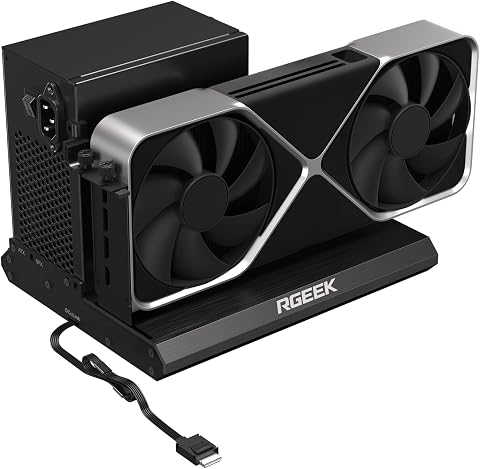 RGEEK OCuLink eGPU Dock PCIe 5.0 x4 for External Graphics CardView on Amazon →
 - 9
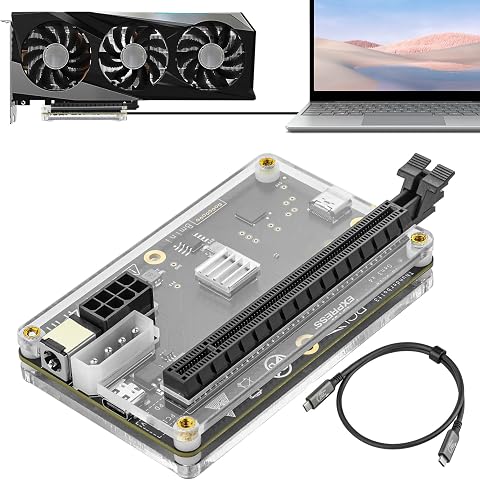 PCIe 3.0 x16 22Gbps eGPU Dock with Thunderbolt 4 Cable for Windows/LinuxView on Amazon →
 - 10
 OCuLink eGPU Dock, PCIe 4.0 x4 64Gbps, 19.7-inch SFF-8611 Cable, External GPU…View on Amazon →
Impact of External GPU Advancements on AI and Gaming
The evolution of external GPU technology in 2026 significantly impacts AI research, gaming, and professional content creation by enabling high-performance graphics processing without the need for full desktop setups. This flexibility allows AI developers and researchers to run complex models on portable devices, democratizing access to powerful computational resources. For gamers and content creators, these GPUs offer desktop-level performance in portable formats, expanding possibilities for on-the-go workflows. As compatibility and performance standards improve, external GPUs are becoming essential tools for a broad spectrum of demanding applications.
2026 External GPU Market and Technological Progress
Over the past few years, external GPU technology has evolved rapidly, driven by increasing demands for portable yet powerful graphics solutions. The market has seen a surge in models supporting the latest connection standards like Thunderbolt 4 and USB4, which are critical for high-bandwidth data transfer required by AI workloads. Previously, external GPUs were primarily used for gaming or casual graphics enhancement, but 2026 marks a shift as these enclosures now support enterprise-level AI tasks and professional content creation.
Leading brands like Razer, ASUS, and MINISFORUM have introduced models tailored to different user needs, from high-end gaming to affordable AI development platforms. The focus has shifted toward thermal management, power delivery, and compatibility with a wide range of devices, making external GPUs more accessible and reliable than ever before.
Remaining Challenges and Unknowns in 2026 External GPU Tech
While many external GPU options now support the latest standards, some uncertainties remain. Compatibility issues with certain laptops or mini PCs, especially those with proprietary hardware or BIOS restrictions, can limit usability. The long-term durability and thermal performance of high-power models under continuous AI workloads are still being tested, and real-world data on lifespan and stability is limited. Additionally, the impact of upcoming connection standards or potential new GPU architectures could alter the current landscape, but details are still emerging.
Future Developments and Market Trends in External GPUs
Looking ahead, external GPU manufacturers are expected to focus on improving thermal management, power efficiency, and compatibility with emerging AI hardware. Innovations in smaller form factors and integrated cooling solutions are likely to expand portability options. Software support and driver updates for seamless integration with AI frameworks and professional applications will also advance. Market analysts anticipate that upcoming models will further close the performance gap with internal GPUs, making external GPUs an even more integral part of AI and gaming workflows in 2027 and beyond.
Key Questions
Can I use an external GPU with any laptop in 2026?
No, compatibility depends mainly on the presence of Thunderbolt 3/4 or USB4 ports. Some laptops may have proprietary hardware or BIOS restrictions that limit external GPU support, so always verify your device’s specifications before purchasing.
Are external GPUs worth it for AI workloads in 2026?
Yes, especially for portable AI development, research, and training large models, external GPUs provide significant performance boosts. However, the actual benefit depends on connection standards, GPU support, and thermal management features.
What connection standard offers the best performance for external GPUs?
Thunderbolt 3 and Thunderbolt 4 are currently the best options, offering data transfer rates up to 40Gbps, which are essential for minimizing latency in AI and graphics-intensive tasks.
Will the prices of external GPUs decrease in the future?
Market trends suggest that prices may stabilize or decrease as newer models with enhanced features are introduced, but high-end models with advanced cooling and power delivery are likely to remain premium investments for the foreseeable future.
Source: ThorstenMeyerAI.com
Halloween Picks
halloween
As an affiliate, we earn on qualifying purchases.