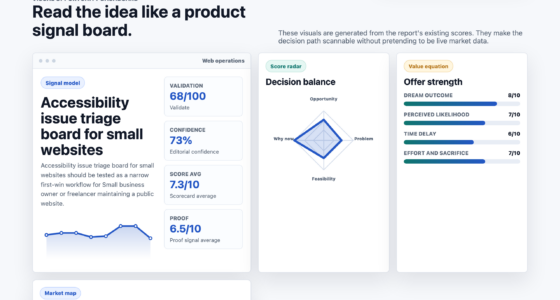

🔍 Read the full analysis: Enhance Your Business With 15 Leading AI Workflow Automation Tools In 2026 on ThorstenMeyerAI.com

Get smart everyday buys delivered free — and shop member deals
- Fast, free delivery on millions of items
- Access to Prime Big Deal Days deals on October 6–7
- Prime Video, Amazon Music and more included
TL;DR
In 2026, 15 top AI workflow automation tools are transforming business operations by simplifying processes, increasing efficiency, and offering scalable solutions. This guide highlights the best options and what to consider when choosing the right platform.
In 2026, the landscape of AI workflow automation tools has expanded significantly, with 15 leading platforms now available to streamline business processes. These tools are designed to reduce manual effort, improve productivity, and seamlessly integrate with existing systems, making automation accessible to organizations of all sizes. This development matters because adopting the right automation solutions can directly impact operational efficiency and competitive advantage, as detailed in the original analysis.
The top-performing AI workflow automation tools in 2026 include AutoFlow Pro, noted for its robust automation capabilities and user-friendly interface; Zapier AI, recognized for its extensive integrations across a wide range of apps; and AI TaskMaster, which offers powerful no-code options suitable for non-technical users. These platforms vary in complexity, cost, and scalability, catering to different organizational needs. To explore the broader landscape, see The Future Is Here: 13 Best AI Automation Tools For 2026. For instance, AutoFlow Pro emphasizes ease of use, while Zapier AI provides a broad ecosystem of integrations, and AI TaskMaster focuses on accessibility for non-technical staff.
Selection criteria for these tools included performance, usability, build quality, and value. For more insights, visit Achieve More With These AI Tools & Automation Tips In 2026. The evaluation process examined how well each platform automates common workflows, their learning curves, and customization options. Cost-effectiveness was also a key factor, with solutions offering clear documentation, support, and scalability ranking higher. These tools are suitable for a range of users, from small startups to large enterprises, highlighting the diversity of the automation landscape in 2026.
The 15 picks
- 1
 Agentic Coding with OpenAI Codex CLIView on Amazon →
 - 2
 Building AI Agents for Network OperationsView on Amazon →
 - 3
 50 AI Workflows for Engineers: From Debugging to System Design, Code Review &…View on Amazon →
 - 4
 The AI-Powered Accountant: How to Use ChatGPT, AI Tools and Smart Automation…View on Amazon →
 - 5
 OpenCode Custom Workflows: Building Intelligent Automation with AI AgentsView on Amazon →
 - 6
 The No-BS Guide to AI Agents & Automation: Build AI Workflows, Automate Your…View on Amazon →
 - 7
 Practical AI Workflow Automation: A Beginner-Friendly Guide to No-Code ToolsView on Amazon →
 - 8
 Generative AI Workflows and Practical Automation: Mastering ChatGPT, Claude,…View on Amazon →
 - 9
 AI Workflow Automation for BloggersView on Amazon →
 - 10
 AI Workflow Mastery: 100 Practical AI Workflows to Save Hours Every Week, Aut…View on Amazon →
 - 11
 Claude Cowork Automation: Build AI-Powered Workflows, Delegate Repetitive Tas…View on Amazon →
 - 12
 Claude AI Automation & Monetization: Build AI-Powered Systems, Automate Workf…View on Amazon →
 - 13
 Google AI Studio Guide 2026: Build Intelligent AI Workflows and Scalable Auto…View on Amazon →
 - 14
 AI for Workflow Automation (Makola Practical AI Mastery, Book 9)View on Amazon →
 - 15
 Claude Mastery: Claude AI for Beginners – Build Prompts, Skills, and AI Agent…View on Amazon →
Why Leading AI Automation Tools Are Game-Changers in 2026
Adopting top AI workflow automation tools in 2026 can significantly enhance operational efficiency, reduce manual workload, and enable faster decision-making. Organizations that leverage these platforms are better positioned to compete in a rapidly evolving digital economy. Moreover, choosing the right tool can lead to cost savings, improved accuracy, and the ability to scale automation efforts as business needs grow. As automation becomes a core component of business strategy, understanding the capabilities and limitations of these tools is essential for sustained success.
Evolution of AI Workflow Automation Leading to 2026
Over the past few years, AI workflow automation has transitioned from niche solutions to mainstream business tools. Early platforms focused on simple task automation, but recent advancements have introduced sophisticated features like conditional logic, deep integrations, and no-code interfaces. The rise of AI-driven automation reflects a broader trend toward digital transformation, with companies increasingly relying on automation to handle repetitive tasks, data analysis, and customer interactions. In 2026, the market features a diverse array of options tailored to different levels of technical expertise and organizational complexity.
“The most effective AI workflow tools in 2026 combine ease of use with extensive integration capabilities, enabling organizations to automate complex processes without heavy technical overhead.”
— Thorsten Meyer, AI Solutions Expert
Remaining Questions About AI Workflow Automation in 2026
While the top tools are clearly identified, some uncertainties remain. It is not yet confirmed how these platforms will evolve to handle emerging technologies like advanced AI models or new regulatory standards. Additionally, the long-term security and data privacy implications of widespread automation are still under assessment, with some providers offering limited transparency on their security protocols. The full impact of these tools on workforce dynamics and organizational structures also remains to be seen, as adoption rates accelerate and new features are introduced.
Future Developments in AI Workflow Automation Post-2026
Moving forward, expect continued innovation in AI-driven automation, including deeper integration with emerging technologies like machine learning, natural language processing, and robotic process automation. Vendors are likely to focus on enhancing security features, expanding customization options, and improving user interfaces to accommodate less technical users. Organizations should monitor updates from leading providers, prepare for evolving compliance requirements, and consider investing in training to maximize the benefits of these advanced tools. The next phase of automation will likely emphasize smarter, more adaptive workflows that further reduce manual intervention.
Key Questions
Can small businesses benefit from these AI automation tools?
Yes, many of the top tools in 2026 are designed with scalability in mind and offer plans suitable for small and medium-sized enterprises. Features like no-code interfaces and pre-built templates make automation accessible without extensive technical expertise.
Are these tools secure for handling sensitive data?
Security varies by platform; reputable tools implement encryption, access controls, and compliance with standards like GDPR and SOC 2. It is essential to review each provider’s security policies before deployment, especially for sensitive or regulated data.
How do I choose the best automation tool for my organization?
Consider factors such as your existing tech stack, automation complexity, budget, and user skill level. Prioritize tools with extensive integrations, ease of use, and scalability to ensure they meet your current needs and future growth.
Will adopting these tools eliminate the need for human workers?
No, these tools are designed to augment human effort by automating repetitive tasks, allowing staff to focus on higher-value activities. They are meant to improve efficiency, not replace the entire workforce.
Source: ThorstenMeyerAI.com
Halloween Picks
halloween
As an affiliate, we earn on qualifying purchases.