
🔍 Read the full analysis: The Future Is Here: 13 Best AI Automation Tools For 2026 on ThorstenMeyerAI.com

Get smart everyday buys delivered free — and shop member deals
- Fast, free delivery on millions of items
- Access to Prime Big Deal Days deals on October 6–7
- Prime Video, Amazon Music and more included
TL;DR
In 2026, the AI automation landscape features 13 leading tools that enhance workflow automation, integration, and scalability. This article details their capabilities and significance for businesses.
Thirteen AI automation tools have emerged as industry leaders in 2026, offering advanced features that streamline complex workflows across sectors. For an overview of the top tools, see the original analysis. These tools are crucial for organizations seeking to improve efficiency, scalability, and integration in their operations.
The top-ranked tools combine AI with automation capabilities, supporting seamless integration with existing development environments through APIs and CI/CD pipelines. Notable examples include Google AI Studio, which excels in building scalable workflows, and Spec-Driven AI Testing, specialized for testing automation. These tools vary in complexity; some prioritize ease of use for small teams, while others cater to enterprise-scale needs with extensive customization options.
Pricing models differ widely, with premium solutions offering advanced features suitable for large organizations, and more accessible options designed for startups and individual developers. To learn how to choose the right tools, check out how to invest in AI & automation tools. Many tools emphasize minimal coding, enabling rapid deployment of automation tasks across platforms. The selection process for these tools involved evaluating their ability to automate complex workflows, support integration, scalability, user experience, and long-term reliability, based on active development and community support. For tips on maximizing AI tool benefits, see AI Tools & Automation: Elevate Your Productivity.
The 13 picks
- 1
 Software Testing with Generative AIView on Amazon →
 - 2
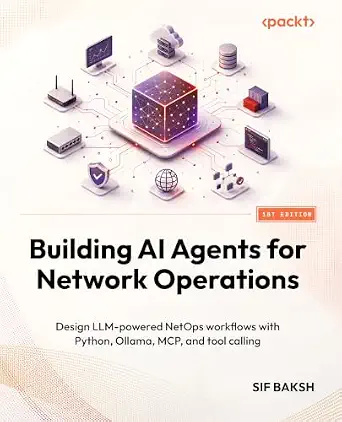 Building AI Agents for Network Operations: Design LLM-powered NetOps workflow…View on Amazon →
 - 3
 40 Python Programming Projects for AI Agents and AutomationsView on Amazon →
 - 4
 The Claude Code Operating Model: Build Scalable AI Coding Systems with Skills…View on Amazon →
 - 5
 Spec-Driven AI Engineering: Build Reliable Software from Requirements to Code…View on Amazon →
 - 6
 Building Agentic AI Systems: A Step-by-Step Guide to Creating LLM-Powered AI…View on Amazon →
 - 7
 AI for Quality Assurance and Software Testing: The Practitioner’s Complete Gu…View on Amazon →
 - 8
 Building Intelligent Applications with Claude AI: A Practical Guide to Creati…View on Amazon →
 - 9
 Spec-Driven Software Testing with AI: Build Reliable Test Suites from Specifi…View on Amazon →
 - 10
 Mastering Claude AI: The Complete Practical Guide to Prompt Engineering, Proj…View on Amazon →
 - 11
 Claude AI Automation & Monetization: Build AI-Powered Systems, Automate Workf…View on Amazon →
 - 12
 Google AI Studio Guide 2026: Master Google AI Studio to Build Intelligent AI…View on Amazon →
 - 13
 Agentic Coding with Claude Code (5-in-1): A Practical Developer’s Handbook fo…View on Amazon →
Why These AI Tools Are Game-Changers in 2026
The adoption of these 13 AI automation tools marks a significant shift in how organizations approach operational efficiency. They enable rapid automation development with minimal coding, facilitate integration into existing workflows, and support scalability from small teams to large enterprises. This evolution reduces manual effort, accelerates deployment cycles, and enhances testing and network management capabilities. For businesses, adopting these tools can lead to cost savings, faster innovation, and competitive advantages in a digital-first economy.
Evolution of AI Automation in 2026
Over the past few years, AI automation has transitioned from niche applications to mainstream business solutions. In 2026, the market is saturated with options that vary in complexity and specialization, reflecting a maturation of the technology. Earlier tools focused on basic scripting and task automation, but recent developments emphasize AI-driven decision-making, intelligent workflows, and minimal-code platforms. Major players like Google AI Studio and emerging startups have contributed to a landscape where automation is more accessible and powerful than ever.
The evaluation of these tools was based on their ability to automate complex workflows, ease of integration, scalability, and community support. Continuous improvements and active development indicate a robust ecosystem that is likely to evolve further, driven by increasing demand for AI-enhanced automation across industries.
Unresolved Questions About Future Developments
While these 13 tools are leading the market, it remains unclear how their capabilities will evolve in response to emerging AI challenges such as ethical concerns, data privacy, and the need for transparency. Additionally, the long-term reliability and adaptability of these platforms to rapidly changing technology standards are still being tested. The competitive landscape may also shift as new entrants and innovations emerge.
Next Steps for Adoption and Innovation
Organizations should monitor updates from these leading tools, particularly regarding new features that enhance scalability and security. Further integration with emerging AI standards and compliance protocols is expected. Businesses planning to adopt these solutions should evaluate their current workflows and consider pilot programs to test compatibility and performance. Industry conferences and vendor updates are likely to showcase upcoming innovations that could redefine automation in 2026 and beyond.
Key Questions
How do I choose the right AI automation tool for my organization?
Assess your team’s technical skills, automation needs, and budget. Look for tools that support your existing systems, offer scalability, and provide good support resources. Prioritize ease of use for small teams or advanced features for enterprise needs, depending on your specific requirements.
Can these tools integrate with my current development pipeline?
Most of the leading tools support integration with popular development environments, APIs, and CI/CD pipelines like Jenkins, GitHub, and Docker. Verify compatibility with your existing systems before adoption to ensure seamless workflow automation.
Are these AI automation tools suitable for non-technical users?
Several tools emphasize user-friendly interfaces and minimal coding, making them suitable for non-technical users. However, more advanced platforms may require some technical expertise to leverage their full capabilities.
What are the main factors to consider when evaluating AI automation tools?
Key factors include ease of use, integration capabilities, scalability, cost, community support, and the ability to customize workflows. Consider your current and future needs to select the most appropriate solution.
Source: ThorstenMeyerAI.com
Fall Picks
fall essentials
As an affiliate, we earn on qualifying purchases.