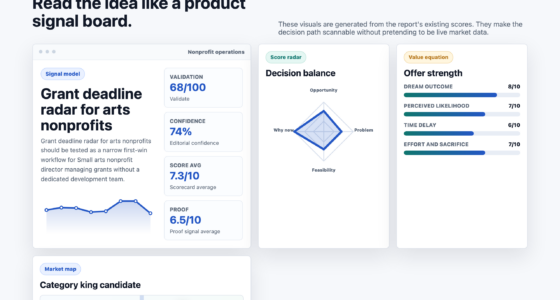

📊 Full opportunity report: How Upstream Risk Assessment Supports E-Commerce Migration Success on IdeaNavigator AI — validation score, market gap, and execution plan.

Get smart everyday buys delivered free with Prime
- Fast, free delivery on millions of items
- Prime Video, Amazon Music and more included
- Member-only deals all year
TL;DR
A new pre-migration risk assessment approach is gaining traction among e-commerce businesses and agencies. It helps identify potential issues before platform switches, reducing traffic loss and data errors. This development addresses a critical gap in current migration practices.
Pre-migration risk scans are being introduced as a critical step for e-commerce businesses planning platform migrations, offering a quantified assessment of potential issues before the cutover. This approach aims to reduce common risks such as traffic loss, data drop, and broken integrations, which often surface during or after migration. The development addresses a significant gap in current practices, where risks are typically discovered too late, causing operational disruptions and revenue impact.
The risk assessment tool, developed by IdeaNavigator AI, connects to a source store via URL crawl and optional API access, generating a comprehensive risk report. This report includes a full URL and redirect inventory, SEO asset analysis, app-stack dependency maps, custom field flags, and an estimated traffic and downtime risk score. The goal is to enable migration teams—whether in-house or agency-led—to scope projects more accurately and proactively address potential issues.
Currently, the market is seeing increased demand due to the high volume of replatforming projects. Only 14% of merchants are satisfied with their current platform, and 77% plan to migrate within a year, driven by end-of-life deadlines for legacy systems like Magento 1 and the limitations of automated migration tools. These factors create a pressing need for tools that can de-risk migrations and improve success rates.
Initial validation involves offering free manual risk scans to Shopify Plus and BigCommerce migration agencies, with the aim of measuring their willingness to pay per scan and whether they incorporate risk reports into their project scoping. Early results could determine the viability of a paid service model and integration into existing migration workflows.
Why Upstream Risk Assessment Matters for E-Commerce Success
This development is significant because it directly addresses a major pain point in e-commerce replatforming—unexpected risks surfacing during cutover, leading to traffic drops, data loss, and broken integrations. By quantifying risks upfront, businesses and agencies can plan more effectively, allocate resources appropriately, and reduce costly errors. This not only improves project success rates but also minimizes downtime and revenue loss, making platform migrations more predictable and less disruptive.
Furthermore, this approach aligns with the broader trend toward automation and data-driven decision-making in e-commerce operations. As migration projects grow in scale and complexity, having a clear, quantified risk profile becomes essential for strategic planning, especially for mid-market merchants with $5M-$100M GMV who rely heavily on seamless customer experiences.
e-commerce platform migration risk assessment tool
As an affiliate, we earn on qualifying purchases.
As an affiliate, we earn on qualifying purchases.
E-Commerce Migration Challenges and Market Drivers
Replatforming has become increasingly common as merchants seek better scalability, features, and integrations. Currently, only a small fraction of merchants are fully satisfied with their existing platforms, and a significant majority plan to migrate within the next year. Legacy systems like Magento 1 are reaching end-of-life, forcing urgent migrations. Automated tools, while helpful, only handle about 50-60% of the migration process, leaving gaps that can cause errors if risks are not identified early.
Historically, risk discovery has been reactive, often surfacing during or after migration, which can lead to traffic drops and operational disruptions. The emergence of pre-migration risk scans offers a proactive solution, enabling teams to scope and plan more precisely. Early pilot programs with migration agencies are testing the effectiveness of these tools, with initial feedback indicating strong interest and potential for integration into standard workflows.
website redirect inventory analysis software
As an affiliate, we earn on qualifying purchases.
As an affiliate, we earn on qualifying purchases.
Uncertainties About Adoption and Effectiveness
It remains unclear how widely this risk assessment approach will be adopted across the industry. While early pilot programs show promise, there is limited data on long-term effectiveness and integration into large-scale migration projects. Additionally, the cost-benefit balance for smaller merchants or agencies remains to be validated, and the impact on overall migration success rates is still being studied.
SEO asset analysis tool for Shopify
As an affiliate, we earn on qualifying purchases.
As an affiliate, we earn on qualifying purchases.
Next Steps for Validating and Scaling Up Risk Scanning
The immediate next step involves expanding pilot programs with 8-12 Shopify Plus and BigCommerce migration agencies to gather data on willingness to pay and integration success. If early results show high adoption and positive impact on project outcomes, the service could be scaled with more features and broader industry partnerships. Further development may include automation enhancements, deeper integration with migration tools, and tailored risk scoring models to improve accuracy and usability.
API connection testing tools for e-commerce
As an affiliate, we earn on qualifying purchases.
As an affiliate, we earn on qualifying purchases.
Key Questions
How does the pre-migration risk scan work?
The risk scan connects to the source store via URL crawl and optional API access, analyzing URL structures, SEO assets, app dependencies, and custom data to generate a comprehensive risk report.
Who benefits most from this risk assessment approach?
Mid-market merchants planning to migrate platforms, along with agencies and partners managing these projects, benefit by reducing errors, downtime, and unexpected costs.
Is this tool ready for broad industry adoption?
Early pilot programs are underway, but wider industry adoption depends on validating effectiveness, cost-efficiency, and integration success in real-world projects.
What are the main risks of not using upstream risk assessment?
Without early risk detection, projects may face traffic drops, data loss, broken integrations, and increased costs due to late discovery of issues during or after migration.
How much does a risk scan typically cost?
Per-project scans range from $300 to $1,500 depending on store size, with agency/partner plans offering volume discounts.
Source: IdeaNavigator AI
Evergreen bestsellers Picks
bestsellers
As an affiliate, we earn on qualifying purchases.