

Starting your financial journey as a recent graduate can feel overwhelming, but the right tools make all the difference. The best overall pick is Financial Planning for College Graduates, praised for its comprehensive approach and user-friendly interface. Get a Financial Life stands out for guiding twentysomethings through practical money habits, while The One-Page Financial Plan offers a straightforward method for quick, effective planning. The main tradeoffs include balancing ease of use against depth of features and choosing between free and premium options. Keep reading to see how these tools compare and which one suits your specific financial goals.

Get smart everyday buys delivered free with Prime
- Fast, free delivery on millions of items
- Prime Video, Amazon Music and more included
- Member-only deals all year
Key Takeaways
- Top-tier tools combine simplicity with comprehensive coverage, making them ideal for recent grads unfamiliar with financial planning.
- Many of the best options integrate budgeting, investing, and goal-setting features into a single platform, reducing the need for multiple apps.
- Price point varies widely; free tools often lack advanced features, so paying for premium versions can lead to better long-term results.
- Ease of use and guidance are critical for beginners—tools with clear instructions help build confidence and promote consistent use.
- Tools that offer visual aids and quick summaries tend to improve understanding and retention of financial concepts.




| financial planning tools for recent grad | Target Audience | Format | Pages | Audience |
|---|---|---|---|---|
| Financial Planning for College | Recent college graduates | — | — | — |
| Get a Financial Life: Personal | Young adults in their twenties and thirties | — | — | — |
| Money Skills for Young Adults: | Young adults seeking basic financial habits | — | — | — |
| Retirement Planning QuickStart | Beginners interested in retirement planning | — | — | — |
| A Young Adult’s Guide to Finan | Young adults aiming for financial independence and income growth | — | — | — |
| The Infographic Guide to Perso | — | Hardcover, Paperback, Kindle | 256 | Beginners, visual learners |
| The One-Page Financial Plan: A | — | Paperback | 144 | Beginners, busy recent grads |
| The Financial Planning Workboo | — | Paperback | 320 | Motivated beginners, proactive learners |
| Personal Finance QuickStart Gu | — | Paperback | 192 | Beginners, overwhelmed grads |
| Financial Literacy for Young A | — | Paperback | 144 | Young adults, new earners |
More Details on Our Top Picks
Financial Planning for College Graduates
This book stands out for its straightforward approach to essential financial skills tailored specifically for recent grads. Compared to the more comprehensive Get a Financial Life, it offers a more targeted focus on immediate financial concerns like student loans and budgeting, making it ideal for those just starting out. However, it doesn’t delve into advanced investing strategies or include detailed case studies, which might leave readers looking for deeper insights wanting more. Its simplicity ensures clarity but may limit value for those seeking complex financial planning. Overall, this guide makes the most sense for recent grads who need practical, easy-to-implement advice to establish their financial footing quickly.
Pros:- Offers practical financial advice tailored for recent grads
- Covers key topics like budgeting, student loans, and investing
- Provides easy-to-understand guidance for financial independence
Cons:- Lacks detailed case studies to illustrate concepts
- Does not cover advanced financial topics or complex investment strategies
Best for: Recent college graduates seeking clear, actionable financial guidance without overwhelming details.
Not ideal for: Graduates with some financial background or those looking for in-depth investment strategies—this book is too basic for advanced planners.
- Target Audience:Recent college graduates
Our verdict“This book is ideal for recent graduates who want straightforward, practical advice to start managing money confidently.”
Get a Financial Life: Personal Finance in Your Twenties and Thirties
This book offers a broad overview of managing personal finances well beyond the initial post-college phase, making it more comprehensive than Money Skills for Young Adults. It covers a wide range of topics such as saving, debt management, and investing, but lacks specific product features or technical details that some readers might want for actionable steps. Unlike the more focused Retirement Planning QuickStart Guide, it doesn’t emphasize long-term strategies, which could be a drawback for those eager to prioritize retirement early. Still, its clarity and breadth make it a solid choice for young adults seeking foundational advice across the board.
Pros:- Provides practical, broad advice on managing personal finances
- Covers essential topics like saving, debt, and investing
- Accessible guidance suitable for newcomers
Cons:- Lacks specific product features or technical financial details
- No pricing or customer ratings available for quick evaluation
Best for: Young adults in their twenties and thirties wanting a broad, easy-to-understand guide to personal finance.
Not ideal for: Readers looking for detailed, technical investment strategies or specific product recommendations—this book is more general in scope.
- Target Audience:Young adults in their twenties and thirties
Our verdict“This book makes sense for young adults seeking a comprehensive, easy-to-understand overview of personal finance basics.”
Money Skills for Young Adults: A Beginner’s Guide to Smart Financial Habits
This pick emphasizes developing smart money habits through simple tools and practical advice, making it appealing for absolute beginners compared to the more detailed A Young Adult’s Guide to Financial Independence. While it excels at teaching foundational skills like budgeting and saving, it falls short on providing detailed investment strategies or advanced financial planning. Its focus on habit formation is a strength but could limit its usefulness for those ready to explore complex financial products. Overall, this guide works best for young adults who need to establish basic financial discipline before tackling more advanced concepts.
Pros:- Focuses on practical habits and simple tools
- Provides easy-to-understand guidance on budgeting and saving
- Prioritizes building financial independence
Cons:- Lacks detailed investment or advanced financial strategies
- No specific pricing or author credentials provided
Best for: Young adults just starting to develop money habits and needing practical, easy-to-follow guidance.
Not ideal for: Those seeking in-depth investment advice or comprehensive financial planning—this book provides foundational skills only.
- Target Audience:Young adults seeking basic financial habits
Our verdict“This book is ideal for beginners who want to develop solid financial habits before moving on to more complex planning.”
Retirement Planning QuickStart Guide
This guide stands out for simplifying complex retirement concepts, making it suitable for those new to financial planning compared to the broader Get a Financial Life. It emphasizes long-term wealth building and security, but its lack of detailed investment strategies may disappoint readers ready for more technical guidance. While it offers practical tips for early retirement planning, its general approach might not satisfy those seeking personalized or advanced investment advice. It’s a good starting point for those who want a clear, straightforward introduction, but not for those aiming to craft detailed retirement portfolios.
Pros:- Easy-to-understand for beginners
- Focuses on long-term financial security
- Provides practical retirement planning tips
Cons:- Lacks detailed investment strategies
- No specific pricing or ratings info available
Best for: Beginners focused on understanding the basics of retirement planning and long-term wealth-building.
Not ideal for: Experienced investors or those wanting in-depth investment strategies—this guide is too simplified for advanced planning.
- Target Audience:Beginners interested in retirement planning
Our verdict“This guide is perfect for beginners who want a straightforward overview of retirement planning fundamentals.”
A Young Adult’s Guide to Financial Independence
This comprehensive guide covers managing money, saving, investing, and increasing income, making it suitable for those looking to build confidence in their financial decisions compared to the more narrowly focused Money Skills for Young Adults. Its broad scope provides practical tips for boosting income and achieving independence, but the lack of specific details on content depth or author credentials might leave serious learners uncertain about its thoroughness. It also doesn’t specify format or include customer reviews, which could be a drawback for those wanting quick clarity. Nonetheless, it’s a solid choice for young adults eager to develop a well-rounded financial mindset.
Pros:- Provides broad, practical guidance on managing money and investing
- Focuses on building confidence and increasing income
- Covers multiple aspects of financial independence
Cons:- No details on content depth or author credentials
- Lacks information on format or edition
Best for: Young adults seeking a comprehensive, confidence-boosting guide to manage money and grow income.
Not ideal for: Those needing detailed investment strategies or specific financial product advice—this book offers general guidance.
- Target Audience:Young adults aiming for financial independence and income growth
Our verdict“This book suits young adults eager for a broad, confidence-building approach to financial independence.”
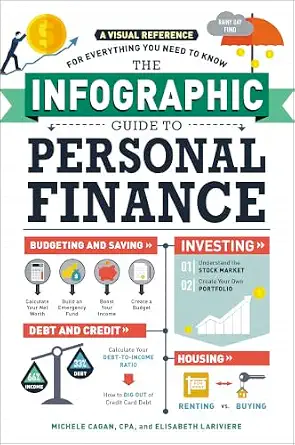
The Infographic Guide to Personal Finance: A Visual Reference for Everything You Need to Know
This book stands out for its highly engaging visual approach, making complex personal finance topics accessible especially for those new to money management. Compared with more hands-on tools like The Financial Planning Workbook, it offers a broad overview rather than practical exercises, which may limit application for some readers. Its infographics simplify concepts but lack depth for advanced financial strategies, making it ideal for complete beginners seeking a solid foundation. The absence of practical activities means learners might need additional resources for actionable steps.
bestFor: Recent grads who prefer visual learning and need a comprehensive overview without technical jargon.
notIdealFor: Those looking for step-by-step planning or technical financial details.
- Visually engaging and easy to understand
- Comprehensive overview of personal finance topics
- Great for beginners and financial novices
- Lacks in-depth detail for advanced readers
- No practical exercises included
Verdict: This book is perfect for visual learners starting their financial literacy journey.
- Format:Hardcover, Paperback, Kindle
- Pages:256
- Audience:Beginners, visual learners
- Topics Covered:Budgeting, Saving, Investing Basics
- Illustrations:Infographics and visuals
- Publication Year:2018
The One-Page Financial Plan: A Simple Way to Be Smart About Your Money
This book excels at distilling complex financial planning into a single, clear page, making it ideal for recent grads overwhelmed by detailed strategies. Unlike The Financial Planning Workbook, which provides in-depth exercises, this guide emphasizes quick decision-making and simplicity. It’s well suited for those who want a straightforward, actionable overview without the clutter of technical details. However, its simplicity can be a drawback for individuals with more complex financial situations or those seeking long-term, detailed planning.
bestFor: Recent grads seeking a quick, easy-to-understand financial plan without technical jargon.
notIdealFor: Those needing detailed, technical financial strategies or planning for complex situations.
- Simple and straightforward financial planning method
- Easy to understand for beginners
- Concise and focused content
- Lacks detailed financial strategies
- Limited scope for complex financial situations
Verdict: This pick makes the most sense for recent grads who want a quick, actionable financial plan.
- Format:Paperback
- Pages:144
- Audience:Beginners, busy recent grads
- Focus:One-page plan
- Publication Year:2012
- Approach:Simplified, visual
The Financial Planning Workbook: A Comprehensive Guide to Building a Successful Financial Plan (2024 Edition)
This workbook offers a detailed, step-by-step guide that goes beyond simple advice, making it ideal for recent grads committed to actively building their financial skills. Compared with The One-Page Financial Plan, which emphasizes speed and simplicity, this option provides practical exercises and deeper strategies, suitable for those willing to invest more time. Its comprehensive approach can be overwhelming for someone looking for quick tips, but it ultimately provides a solid foundation for long-term financial success. The lack of specific technical details might leave advanced investors wanting more.
bestFor: Recent grads who want a guided, practical approach to creating a detailed financial plan.
notIdealFor: Those seeking quick, high-level advice or who prefer a less involved process.
- Comprehensive and practical guidance
- Includes exercises for active learning
- Updated for 2024
- Lacks specific technical features or tools
- Requires time commitment for best results
Verdict: This workbook suits recent grads eager for an interactive, thorough financial planning experience.
- Format:Paperback
- Pages:320
- Audience:Motivated beginners, proactive learners
- Updated:2024
- Approach:Step-by-step, exercises
- Focus:Building a detailed plan
Personal Finance QuickStart Guide: The Simplified Beginner’s Guide to Eliminating Financial Stress, Building Wealth, and Achieving Financial Freedom
This guide focuses on reducing financial stress and providing practical steps toward wealth, making it well suited for recent grads feeling overwhelmed by financial uncertainty. Unlike The Infographic Guide, which emphasizes visual learning, this book prioritizes straightforward advice for eliminating common money worries. While it offers accessible strategies, it doesn’t delve into detailed investment techniques, which could limit those ready to deepen their financial knowledge. Its simplified scope is a strength for beginners but a drawback for those seeking comprehensive investment guidance.
bestFor: Recent grads looking to manage stress and start building wealth without technical complexity.
notIdealFor: Those wanting detailed investment plans or complex financial strategies.
- Easy-to-understand guidance for beginners
- Focuses on reducing financial stress
- Provides practical wealth-building steps
- Lacks detailed investment strategies
- May oversimplify complex topics
Verdict: This guide is best for recent grads seeking practical, stress-reducing financial advice.
- Format:Paperback
- Pages:192
- Audience:Beginners, overwhelmed grads
- Focus:Stress reduction and wealth building
- Publication Year:2020
- Approach:Simplified, practical
Our verdict“Best for Stress-Free Wealth Building — a strong pick in this lineup.”
Financial Literacy for Young Adults: How to Manage, Save, and Invest Money
This book offers essential financial skills tailored for young adults, making it a strong choice for recent grads who want practical guidance on managing and saving money, with some investment basics. Compared with The Financial Planning Workbook, it focuses more on foundational skills rather than detailed planning processes. While it emphasizes independence and practical tips, it doesn’t go deep into advanced investment strategies, which might leave those with some financial background wanting more. Its straightforward language makes it accessible but limits depth for more experienced learners.
bestFor: Recent grads seeking to establish essential financial skills and independence early on.
notIdealFor: Those looking for advanced investment advice or comprehensive financial planning tools.
- Practical tips for managing and saving money
- Focus on building financial independence
- Easy-to-understand guidance
- Lacks detailed investment strategies
- No technical or advanced planning features
Verdict: This book is ideal for recent grads aiming to master foundational financial skills quickly.
- Format:Paperback
- Pages:144
- Audience:Young adults, new earners
- Topics:Managing, saving, basic investing
- Approach:Practical, accessible
- Publication Year:2022
Our verdict“Best for Building Foundational Skills — a strong pick in this lineup.”

How We Picked
These products were selected based on a combination of usability, comprehensiveness, and value for recent grads. We prioritized tools that balance ease of use with a broad feature set, including budgeting, saving, investing, and goal tracking. The evaluation also considered the quality of educational content, customization options, and platform accessibility. Price and free trials were factored in, ensuring options are accessible regardless of budget. The ranking reflects how well each tool meets the typical needs of recent graduates who want a solid foundation in personal finance without feeling overwhelmed.| financial planning tools for recent grad | Target Audience | Format | Audience |
|---|---|---|---|
| Financial Planning for College | Recent college graduates | — | — |
| Get a Financial Life: Personal | Young adults in their twenties and thirties | — | — |
| Money Skills for Young Adults: | Young adults seeking basic financial habits | — | — |
| Retirement Planning QuickStart | Beginners interested in retirement planning | — | — |
| A Young Adult’s Guide to Finan | Young adults aiming for financial independence and income growth | — | — |
| The Infographic Guide to Perso | — | Hardcover, Paperback, Kindle | Beginners, visual learners |
| The One-Page Financial Plan: A | — | Paperback | Beginners, busy recent grads |
| The Financial Planning Workboo | — | Paperback | Motivated beginners, proactive learners |
| Personal Finance QuickStart Gu | — | Paperback | Beginners, overwhelmed grads |
| Financial Literacy for Young A | — | Paperback | Young adults, new earners |
Factors to Consider When Choosing Financial Planning Tools For Recent Grads
Choosing the right financial planning tool as a recent graduate involves balancing simplicity, features, and cost. It’s important to consider your current financial knowledge and goals, as some tools are more educational while others focus on automation. Additionally, think about whether you prefer a free app or are willing to invest in a premium service for more advanced features. Compatibility with your devices and the availability of ongoing support can also influence your decision. This guide highlights key factors to consider to help you find a tool that grows with your financial journey.Ease of Use and User Interface
For recent grads new to personal finance, an intuitive interface can make a significant difference. A simple, clean layout reduces the intimidation factor and encourages regular engagement. Be cautious of overly complex tools that might overwhelm beginners, but also avoid platforms that lack enough guidance or automation. The best options strike a balance, providing step-by-step instructions and visual aids to facilitate understanding and consistent use.Features and Functionality
Look for tools that cover the fundamentals—budgeting, saving, investing, and debt management—plus any specific features aligned with your goals. Some platforms excel at financial goal tracking, while others prioritize investment planning or educational resources. Consider whether you need automation, like automatic transfers or investment rebalancing, which can simplify your financial routine. Avoid tools that are too limited or overly complicated for your current level of financial knowledge.Cost and Value
Many tools offer free versions, but these often come with restrictions or limited features. Paid plans can unlock advanced functionalities such as personalized coaching or comprehensive reports, which may be worth the investment if you want more guidance. Evaluate whether the subscription cost aligns with your budget, especially as a recent graduate. Remember, the most expensive tool isn’t always the best choice—prioritize value and how well it fits your specific needs.Educational Content and Support
Tools that include educational resources, tutorials, or access to financial advisors can accelerate your learning curve. As a recent grad, building financial literacy is key, so platforms that combine planning with learning modules are advantageous. Check if customer support is accessible and responsive, particularly if you’re new to personal finance. Avoid platforms that lack adequate guidance, which can lead to confusion or poor habit formation.Platform Accessibility and Compatibility
Ensure your chosen tool is accessible across your devices, whether desktop, tablet, or smartphone. Many recent grads prefer mobile apps for on-the-go tracking and quick adjustments. Compatibility with other financial accounts or apps can streamline your workflow, saving time and reducing errors. Consider whether the platform offers offline access or integrations with banks, investment accounts, and budgeting tools to create a seamless experience.Frequently Asked Questions
Should I choose a free or paid financial planning tool as a recent grad?
Deciding between free and paid tools depends on your current financial needs and goals. Free options often provide basic budgeting and tracking features suitable for beginners, making them a low-risk way to start. However, paid tools tend to offer more comprehensive features, personalized advice, and educational content that can significantly accelerate your financial literacy and planning. If you’re serious about building good habits and want tailored guidance, investing in a paid service might be worthwhile, especially as your financial situation becomes more complex.How important is it for a tool to include investment planning for recent grads?
Investment planning becomes increasingly relevant as you build savings and seek to grow wealth over time. While not every recent grad needs sophisticated investment features immediately, choosing a tool that offers at least basic investment guidance can set a strong foundation. Many platforms integrate investment tracking and automated contributions, which help instill good habits early. If your primary focus is budgeting and debt repayment, a simpler tool may suffice, but having options for future investment planning adds long-term value.Can I rely on a single financial planning tool for all my needs?
While some platforms aim to be all-in-one solutions, many recent grads find that combining two or more tools provides better coverage. For example, a budgeting app paired with an investment tracker can target specific goals more effectively. Consider your priorities—if you want simplicity, an all-in-one tool might work, but if you prefer specialized guidance, using separate apps could be more beneficial. Be mindful of data synchronization and ease of use when managing multiple platforms.What features should I prioritize if I want to focus on debt repayment?
If paying off student loans or other debts is your main goal, look for tools that emphasize debt management features, such as tracking balances, interest rates, and repayment schedules. Some apps include calculators to project payoff timelines and suggest optimized repayment strategies. Prioritize tools that allow easy input of different debt types and provide alerts or reminders. While budgeting is essential, a platform with dedicated debt features can help you stay motivated and on track.How can I ensure a financial planning tool will grow with me over time?
Choose a platform that offers scalable features and educational resources suited for different life stages. Look for tools that allow upgrades or add-on modules, such as investment planning or retirement saving, as your financial situation evolves. A user-friendly interface and ongoing support can ease transitions to more complex planning. Selecting a flexible tool that adapts to your changing needs helps you develop long-term financial habits without needing to switch platforms later.Conclusion
For recent grads seeking an all-around solid start, Financial Planning for College Graduates offers comprehensive features with ease of use. Those prioritizing value should consider Get a Financial Life for its practical guidance at a lower cost. If you’re ready to invest in premium features, The Financial Planning Workbook provides depth and customization. Beginners aiming for simplicity might prefer The One-Page Financial Plan, while those focused on debt management should explore tools with dedicated repayment features. Ultimately, the best choice aligns with your current goals and future aspirations—whether that’s building wealth, paying down debt, or gaining financial confidence.Halloween Picks
halloween
As an affiliate, we earn on qualifying purchases.