
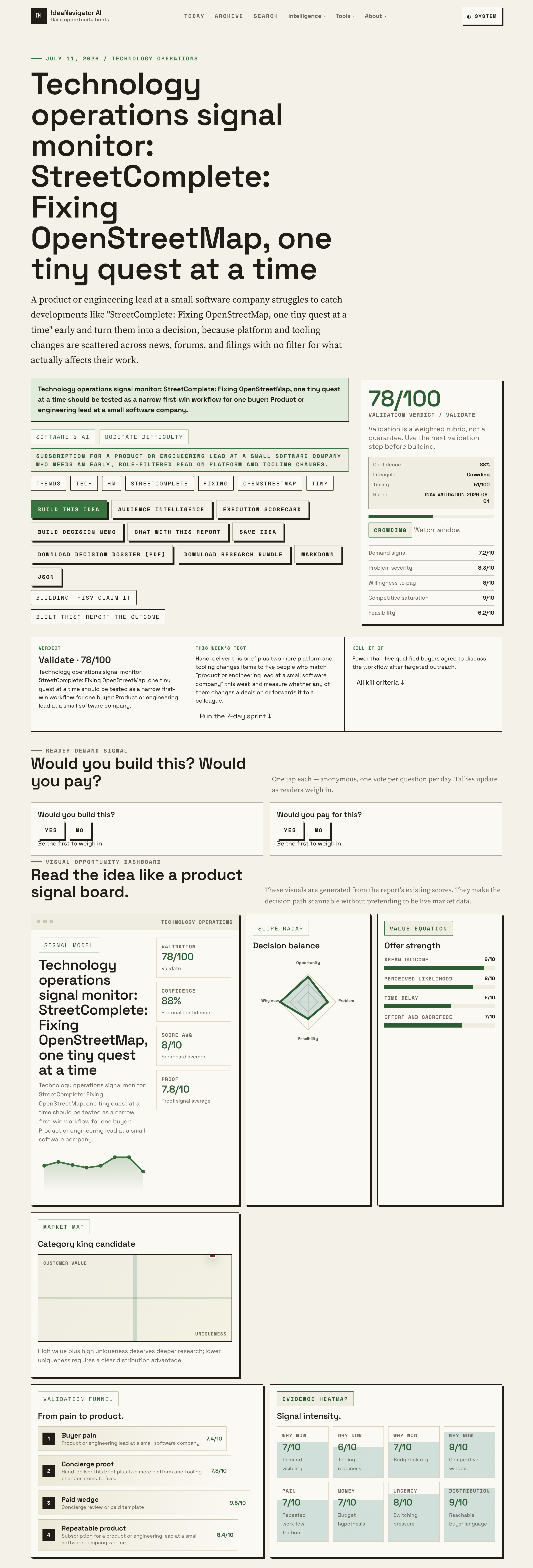
📊 Full opportunity report: StreetComplete Offers A Fresh Way To Contribute To OpenStreetMap on IdeaNavigator AI — validation score, market gap, and execution plan.

Get smart everyday buys delivered free with Prime
- Fast, free delivery on millions of items
- Prime Video, Amazon Music and more included
- Member-only deals all year
TL;DR
StreetComplete, an open-source Android app, lets anyone improve OpenStreetMap by answering simple, location-based questions — such as a shop’s opening hours or a road’s surface — instead of editing raw map data. The app gained renewed attention after surfacing on Hacker News with a high relevance signal, according to IdeaNavigator AI.
StreetComplete, a free and open-source Android app, offers one of the simplest ways to contribute to OpenStreetMap: instead of editing map data directly, users answer small, predefined questions about nearby places — a shop’s opening hours, a road’s surface, whether a bench exists. The project drew renewed attention this week after discussion of it surfaced on Hacker News, where IdeaNavigator AI’s technology-operations signal monitor scored the item at 88 out of 100, flagging it as a development worth a same-day read for technology decision-makers.
The app’s core mechanic is what its community calls “quests”. When a user opens StreetComplete, the map shows markers at locations where OpenStreetMap data is incomplete or outdated. Tapping a marker presents a single, multiple-choice question — for example, “What is the surface of this road?” or “Does this shop have wheelchair access?” Answering takes seconds, and the app submits the change to OpenStreetMap on the user’s behalf.
This approach removes the main obstacle that keeps casual users away from OpenStreetMap: the complexity of traditional editing tools. Full map editors require users to understand tagging schemes, geometry editing, and community editing guidelines. StreetComplete hides all of that behind guided question forms, making a valid contribution possible without any prior mapping knowledge.
According to IdeaNavigator AI, which surfaced the item through its monitoring of platform and tooling developments, the Hacker News discussion earned an 88/100 signal score — a rating the monitor uses to indicate how strongly a development warrants attention from product and engineering leads. The same monitor suggested the project serves as a useful example of a narrow, low-friction contribution workflow, a design pattern relevant to teams building crowdsourced or community-driven data products.
Why Tiny Quests Matter for Crowdsourced Data
StreetComplete matters because it demonstrates how task decomposition can transform participation in a volunteer project. OpenStreetMap, like Wikipedia, depends on continuous contributions from a distributed community, but its traditional editor tooling effectively limits contributions to people willing to learn a specialist interface. By splitting map improvement into thousands of tiny, answerable questions, StreetComplete converts passive map users into active contributors.
For product and engineering teams, the app is a working case study in reducing contribution friction — the difference between asking a user to “edit the map” and asking them “is this café open on Sundays?” is the difference between a steep learning curve and a two-second interaction. That pattern has implications beyond mapping: any platform that relies on user-generated data, from review sites to internal knowledge bases, faces the same challenge of making contribution effortless enough to happen at all.
OpenStreetMap and the Tooling Gap
: “OpenStreetMap is a collaborative, open-data project often described as the Wikipedia of maps. Founded in 2004, it powers map data used by companies and applications worldwide. Contributions traditionally flow through desktop editors such as JOSM or web-based tools like iD, both of which expose users to OpenStreetMap’s detailed tagging system.
Several apps have attempted to lower this barrier over the years, but StreetComplete distinguished itself by restricting its scope to small, verifiable fixes tied to the user’s current location rather than offering general-purpose editing. The app is developed as open source, with its quest types and design decisions documented publicly. Its visibility on Hacker News is not its first wave of attention — the project has periodically resurfaced in developer forums as an example of well-designed contribution tooling.
What the Signal Score Does and Doesn’t Tell You
The 88/100 signal score comes from IdeaNavigator AI’s monitoring methodology and reflects that platform’s own relevance weighting for a specific audience — product and engineering leads at small software companies. It is not a measure of the app’s popularity, download numbers, or recent code changes. It is not yet clear from the surfaced material whether the Hacker News discussion reflected a new release, a milestone, or simply renewed general interest in the project.
Exact current user figures, recent quest-type additions, and the state of the app’s development roadmap are not specified in the available material. Readers seeking those details should consult the project’s official repository and documentation directly.
Where StreetComplete and Similar Tooling Go From Here
For the StreetComplete project itself, the likely path is continued expansion of quest types and refinement of which questions get shown to which users — the app’s long-term challenge is avoiding contributor fatigue while covering the long tail of incomplete map data. For teams watching from a product perspective, IdeaNavigator AI suggested a concrete validation step: test whether a role-filtered, same-day brief on developments like this one actually changes decisions, by delivering such briefs to a small group of matching professionals and measuring whether they act on or share them.
Readers interested in the app can find it through its official open-source channels, and those curious about the monitoring methodology behind the signal score can review IdeaNavigator AI’s published brief on the item.
Source: IdeaNavigator AI
Key Questions
What is StreetComplete?
StreetComplete is a free, open-source Android app that lets users improve OpenStreetMap by answering simple, multiple-choice questions about nearby places, called quests, rather than editing map data manually.
Do I need mapping experience to use it?
No. The app is designed for users with no prior OpenStreetMap knowledge — each quest is a single guided question, and the app handles submitting the change correctly.
What is the 88/100 signal score mentioned in reports?
It is a relevance score assigned by IdeaNavigator AI’s technology-operations signal monitor, indicating how strongly the item warrants attention from its target audience. It is not a measure of the app’s popularity.
Is StreetComplete available on iOS?
The project is developed for Android. The available material does not address an iOS version, so users should check the project’s official channels for current platform support.
Why are product and engineering leads paying attention to a mapping app?
Because StreetComplete exemplifies low-friction contribution design — decomposing a complex task into tiny guided interactions — a pattern applicable to any product relying on user-generated data.
Source: IdeaNavigator AI
Halloween Picks
halloween
As an affiliate, we earn on qualifying purchases.