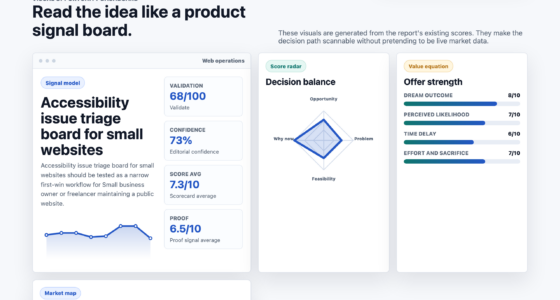

📊 Full opportunity report: The Delegation Ladder: The Four Agentic Loops, And What Each One Lets You Stop Doing on ThorstenMeyerAI.com — validation score, market gap, and execution plan.

Get smart everyday buys delivered free with Prime
- Fast, free delivery on millions of items
- Prime Video, Amazon Music and more included
- Member-only deals all year
TL;DR
The Delegation Ladder outlines four levels of agentic loops in AI, from simple turn-based checks to fully autonomous processes. Each rung defines what tasks can be delegated and what must be retained, impacting AI system design and management.
The Delegation Ladder describes four distinct agentic loops in AI workflows, each representing a different level of task delegation. This framework, recently highlighted by Anthropic’s Claude Code team, clarifies how far AI systems can be trusted to operate autonomously and what human oversight remains necessary.
The four agentic loops are defined by what is handed off to the AI system at each level. The first, Turn-based, involves the user providing prompts and verification steps, with the AI performing cycles of work and checks under human supervision. The second, Goal-based, allows the AI to decide when a task is complete based on predefined success criteria, with a separate evaluator confirming the outcome.
The third, Time-based, introduces scheduled or event-triggered re-execution of tasks, enabling work to continue automatically over time without user input, such as monitoring code reviews or updating reports. The highest, Proactive, involves fully autonomous, event-driven workflows where the AI manages entire processes, including orchestrating multiple agents and decision-making without human prompts.
Anthropic emphasizes that not all tasks require these loops, advocating starting with simple, manageable levels and only climbing when necessary. The effectiveness of each loop depends on the surrounding system’s design, including verification, documentation, and error handling.
The delegation ladder: four agentic loops, and what each lets you stop doing
Strip the hype and a “loop” is simple — an agent repeating work until a stop condition is met. The useful lens isn’t the mechanics, it’s what you hand off. Four loop types = four rungs of delegation, from a tool you operate to a process that runs.
The whole framework reduces to one question about your own work: where am I the bottleneck, and which single piece can I hand off? Can you write the check? Is the goal concrete? Does the work arrive on a schedule? That answer picks your rung — and you climb one step at a time. The real skill isn’t operating a loop; it’s the judgment of what to delegate and how far — enough hands off to gain leverage, enough on the wheel that “runs without you” doesn’t become “runs away from you.”
Implications for AI Workflow Optimization
This framework helps businesses and developers understand how much autonomy to delegate to AI systems, balancing efficiency with control. It highlights that higher loops offer greater leverage but require disciplined system design to prevent errors and ensure quality. Recognizing these levels can guide the development of safer, more effective AI applications, especially in automating repetitive or complex tasks.
As an affiliate, we earn on qualifying purchases.
Evolution of AI Task Delegation Strategies
The concept of the Delegation Ladder builds on ongoing efforts to formalize how AI systems can be integrated into workflows. Previously, AI was primarily used as a tool operated by humans; now, the focus shifts toward creating autonomous processes. Anthropic’s recent publication formalizes these levels, aligning with broader trends in AI automation and self-management, which have gained momentum as models become more capable and reliable.
This development follows earlier discussions on prompt engineering and system design, emphasizing that effective AI deployment depends on structured task delegation and system architecture. The ladder provides a clear map for transitioning from manual prompts to fully autonomous routines, reflecting an industry move toward less human oversight in routine operations.
“The Delegation Ladder offers a practical framework for understanding how and when to trust AI with increasing levels of responsibility.”
— Thorsten Meyer, AI researcher
As an affiliate, we earn on qualifying purchases.
Unanswered Questions About Implementation and Risks
It is not yet clear how widely the framework will be adopted across different industries or how organizations will manage the risks associated with higher-level autonomous loops. Specific best practices for error handling, verification, and system safety at each rung are still evolving, and real-world testing is ongoing.
AI process orchestration platforms
As an affiliate, we earn on qualifying purchases.
As an affiliate, we earn on qualifying purchases.
Next Steps in Developing and Applying the Delegation Ladder
Researchers and practitioners are expected to experiment with implementing these loops in various AI applications, refining guidelines for safety and effectiveness. Industry standards and best practices will likely emerge, and further case studies will illustrate how organizations manage the transition between levels. Monitoring these developments will be key to understanding the practical impact of the framework.
AI monitoring and evaluation tools
As an affiliate, we earn on qualifying purchases.
As an affiliate, we earn on qualifying purchases.
Key Questions
What is the main purpose of the Delegation Ladder?
The ladder provides a structured way to understand and implement different levels of task delegation in AI systems, from simple checks to fully autonomous workflows.
How does each rung change the role of human oversight?
Lower rungs require more direct human involvement, such as verifying outputs, while higher rungs automate decision-making and task management, reducing human oversight.
Is the framework applicable to all AI tasks?
No, the framework is meant to guide task delegation based on complexity, safety considerations, and the specific needs of each application. Not every task should or can be fully automated.
What are the risks of moving to higher levels of automation?
Increased autonomy can lead to errors, unintended consequences, or loss of control if not managed with proper verification, safety checks, and oversight mechanisms.
When can organizations start applying these loops?
Organizations should begin with simple, well-understood tasks and gradually move up the ladder, ensuring systems are robust and safe at each level before increasing autonomy.
Source: ThorstenMeyerAI.com
Fall Picks
fall essentials
As an affiliate, we earn on qualifying purchases.