📊 Full opportunity report: An Empty Tracker For Trust Funding, Retitling, And Probate on IdeaNavigator AI — validation score, market gap, and execution plan.

Get smart everyday buys delivered free with Prime
- Fast, free delivery on millions of items
- Prime Video, Amazon Music and more included
- Member-only deals all year
TL;DR
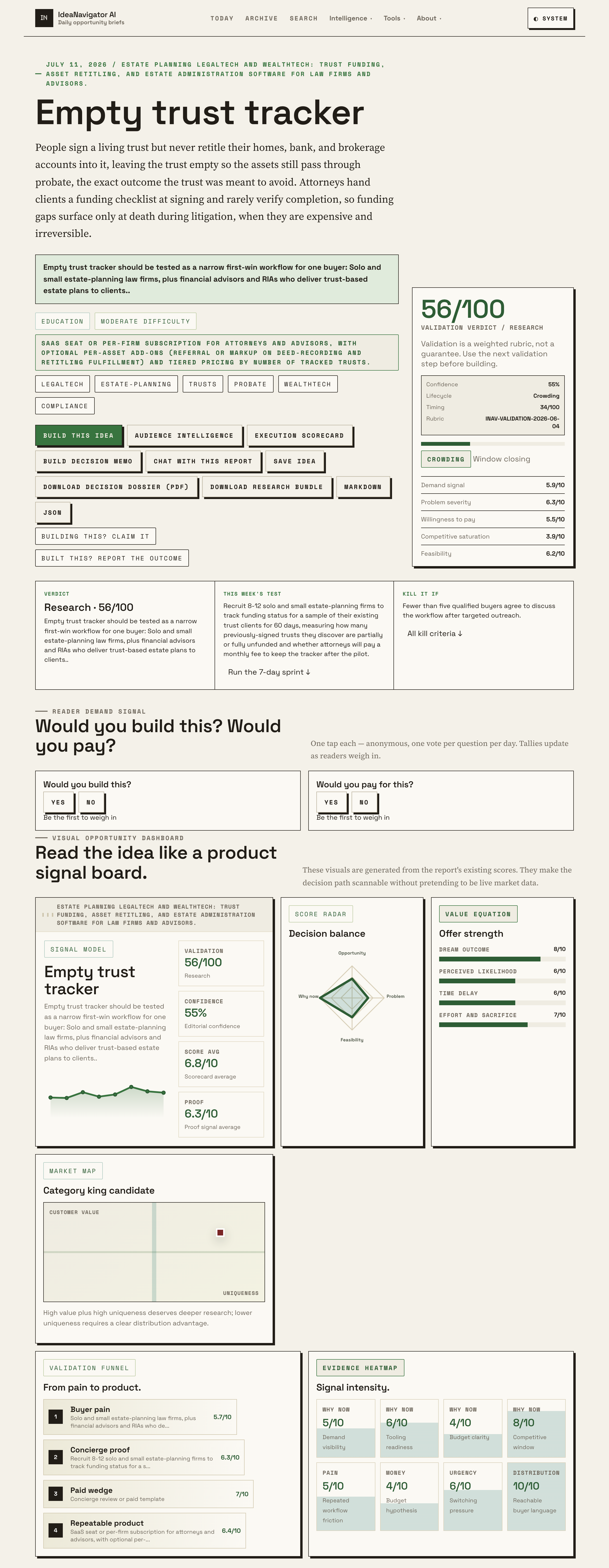
A proposed trust-funding tracker would let small estate-planning firms and financial advisers monitor whether clients move assets into their living trusts. The idea is at the validation stage: a 60-day pilot with 8 to 12 firms is proposed, but no results or customer commitments are reported.
IdeaNavigator AI has proposed a trust-funding tracker for solo and small estate-planning firms and financial advisers, aimed at showing whether clients have transferred assets into living trusts after signing the documents. The proposal addresses a gap that can leave a trust without the assets it was created to hold, but no pilot results, launched product or paying customers are reported.
The proposed tool would let a firm create a checklist for each client trust, covering assets such as real estate, bank and brokerage accounts, business interests and beneficiary designations. Staff or clients could mark each item as pending, in progress or confirmed funded, then attach evidence such as a recorded deed or a statement showing that an account was retitled. Automated reminders would prompt clients to complete outstanding steps.
A firm dashboard would display the funding status of its portfolio of trusts, including the share of listed assets marked as funded. The proposal is intended to help attorneys and advisers spot incomplete funding while clients are alive, when there may still be an opportunity to follow up. It does not establish that uploaded evidence would be independently verified, or that a status label would guarantee an asset will avoid probate.
IdeaNavigator AI suggests subscription pricing by firm or user seat, with tiers based on the number of trusts tracked. It also proposes optional fees or referrals for deed-recording and retitling services. To test demand, the proposal calls for 8 to 12 solo and small firms to track a sample of existing clients’ trusts for 60 days, measuring how many are found to be partly or fully unfunded and whether firms would pay to continue using the tool. No firms are identified as participants.
Funding Gaps Can Outlast Signing
The proposal targets the period after trust documents are signed, when clients may still need to transfer ownership or update account records. A checklist handed over at signing can be difficult for a firm to follow up on across many clients. A shared tracker could make outstanding tasks more visible to both staff and clients, if firms adopt it and clients keep the information current.
The potential consequence is practical: assets that were never transferred into a trust may not be handled as intended by that trust and could be subject to probate procedures. The proposal argues that gaps often surface only after a client dies, when correction may be impossible and disputes can be costly. Those are claims motivating the product concept; no data in the proposal quantifies how often such failures occur or their costs.
For firms, the commercial question is whether monitoring can fit into existing workflows and justify a recurring fee. The suggested pilot would test whether firms find enough incomplete trusts to value a dedicated tool. It would not, by itself, show that the tracker prevents probate or reduces litigation.
The Work After Trust Signing
A living trust is a legal arrangement intended to hold assets and provide instructions for their management and distribution. Creating and signing the trust document does not automatically place every home, account or other asset in it. Depending on the asset and applicable procedures, ownership may need to be retitled or records updated. The proposal focuses on tracking these follow-up actions, rather than drafting the trust itself.
IdeaNavigator AI describes trust funding as a manual and fragmented process that document-drafting software does not resolve. It also says estate-planning adoption and digital tools are rising in 2026, while about 11% of Americans hold a trust. The proposal does not provide a citation, survey date or definition for that estimate, so it should be treated as an attributed figure rather than a verified current measurement.
The concept also points to deed-funding services priced from $250 as evidence of a paid market. That figure is presented without details about providers, geography or the services included. The proposed tracker would sit alongside fulfillment services, with possible referral or markup revenue, rather than necessarily performing retitling itself.
Pilot, Accuracy and Adoption
The proposal remains unvalidated in the information available. There is no named firm, adviser, customer or product launch, and no reported pilot findings, pricing commitments or measured funding outcomes. The suggested 60-day study is a plan, not evidence that firms have agreed to participate.
It is also unclear how the tracker would confirm that a transfer is legally effective, how it would handle assets with different transfer requirements, or who would be responsible for checking documents clients upload. A recorded deed or account statement may provide evidence of a step, but the proposal does not describe a review standard or integrations with financial institutions, courts or recording offices.
The claimed 11% trust ownership estimate and the starting price of $250 for deed-funding services lack supporting methodology or market detail in the proposal. No figures are given for the frequency of unfunded trusts, the share of assets typically left out, or the financial impact on families.
A 60-Day Firm Pilot
The next stated step is to recruit 8 to 12 solo and small estate-planning firms for a 60-day trial using a sample of existing trust clients. The proposed measures are how many signed trusts prove partly or fully unfunded and whether firms will pay a monthly fee to keep the tracker after the trial.
Those results, if the pilot takes place, could indicate whether firms encounter the problem often enough to support a dedicated service. Further details would be needed on participant selection, what counts as confirmed funding, how client documents are reviewed, and whether the tool changes completion rates. Until those details or results are published, the tracker is a product opportunity under consideration rather than an established solution.
Source: IdeaNavigator AI
Key Questions
What is the proposed trust-funding tracker?
It is a proposed tool for firms to list assets associated with each client’s living trust, track funding steps and send reminders. The idea includes a dashboard showing recorded funding status across a firm’s clients.
Why might a signed trust still be unfunded?
Signing the trust document does not necessarily transfer a home, bank account or other asset into the trust. Ownership records or account arrangements may need separate updates, depending on the asset.
Has the tracker launched or been tested?
No launch or test results are reported. The proposal recommends a 60-day pilot with 8 to 12 small firms, but does not name participating firms.
What would the proposed pilot measure?
It would count how many previously signed trusts in the sample are found partly or fully unfunded and ask whether participating firms would pay a monthly fee to continue using the tracker.
Would using the tracker guarantee that assets avoid probate?
No such guarantee is established. The proposal describes status tracking and document uploads, but does not specify how legal effectiveness would be verified or whether the tool would prevent probate.
Source: IdeaNavigator AI
Halloween Picks
halloween
As an affiliate, we earn on qualifying purchases.