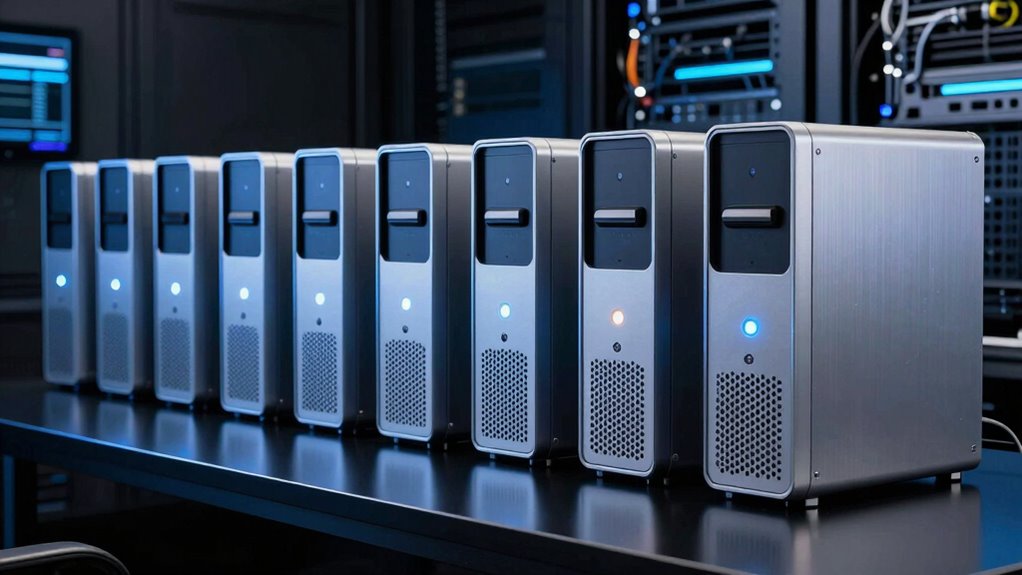

Buyers searching for a Mac Pro for enterprise IT deployments may be weighing a dedicated desktop against Apple’s current high-performance laptops. This lineup includes one older Mac Pro tower and three MacBook Pro configurations, so the best fit depends on whether your priority is workstation expandability, mobile deployment, or sustained high-memory workloads. I rank the 16-inch M5 Max MacBook Pro first for teams needing substantial compute and memory in a deployable system, while the 14-inch M5 Pro is the more manageable choice for general professional fleets. The refurbished Intel Mac Pro is the only desktop here, but its older ports and platform make it a specialized legacy option rather than a default enterprise purchase.

Get smart everyday buys delivered free with Prime
- Fast, free delivery on millions of items
- Prime Video, Amazon Music and more included
- Member-only deals all year
The main tradeoff is straightforward: newer Apple silicon systems offer newer connectivity and portable deployment, while the Intel tower provides a fixed workstation form factor and legacy hardware compatibility. None of these listings is a like-for-like substitute for a new modular Mac Pro desktop. I focus on the listed configuration, service and compatibility implications, memory, storage, ports, and the practical demands of managing devices across an organization.
Key Takeaways
- Best overall fleet workstation: The 16-inch M5 Max MacBook Pro with 128GB unified memory is the strongest fit for teams running demanding local development, media, or AI workloads.
- Best for broad professional deployment: The 14-inch M5 Pro balances modern performance and a smaller footprint, but its 24GB memory may constrain specialist workloads.
- Best for a stationary legacy setup: The refurbished Intel Mac Pro offers ECC memory and Thunderbolt 2, making it relevant only where older workflows or existing peripherals require them.
- Two 16-inch M5 Max listings differ in the evidence provided: The Space Black model specifies an XDR display and newer connectivity; the Silver listing gives fewer display and connectivity details.
- Enterprise buyers should validate support and compatibility: Confirm warranty, management needs, applications, ports, and device lifecycle before standardizing on any configuration.
| Apple MacBook Pro 16.2-inch Laptop with M5 Max Chip, 128GB RAM, 2TB SSD, Space Black |  | Best Overall for High-Performance Enterprise Teams | Processor: M5 Max, 18-core CPU, 40-core GPU | Memory: 128GB unified memory | Storage: 2TB SSD | VIEW ON AMAZON | See Our Full Breakdown |
| Apple 2026 MacBook Pro Laptop with M5 Pro Chip, 14.2-inch Liquid Retina XDR Display, 24GB RAM, 2TB SSD, Space Black |  | Best for General Professional Fleets | Processor: M5 Pro, 18-core CPU, 20-core GPU | Memory: 24GB unified memory | Storage: 2TB SSD | VIEW ON AMAZON | See Our Full Breakdown |
| Apple 16-Inch MacBook Pro Laptop Early 2026 with M5 Max Chip, 18-Core CPU, 40-Core GPU, 128GB RAM, 2TB SSD, Silver |  | Best for M5 Max Capacity with a Less-Documented Listing | Processor: M5 Max, 18-core CPU, 40-core GPU | Memory: 128GB unified memory | Storage: 2TB SSD | VIEW ON AMAZON | See Our Full Breakdown |
| Apple Mac Pro Quad Core 3.7GHz Xeon (ME253LL/A) 64GB RAM, 512GB SSD (Renewed) |  | Best for Legacy Fixed Workstations | Processor: 3.7GHz quad-core Xeon | Memory: 64GB DDR3 ECC SDRAM | Storage: 512GB SSD | VIEW ON AMAZON | See Our Full Breakdown |
| mac pro for enterprise it deployment | Processor | Memory | Storage | Display |
|---|---|---|---|---|
| Apple MacBook Pro 16.2-inch La | M5 Max, 18-core CPU, 40-core GPU | 128GB unified memory | 2TB SSD | 16.2-inch Liquid Retina XDR |
| Apple 2026 MacBook Pro Laptop | M5 Pro, 18-core CPU, 20-core GPU | 24GB unified memory | 2TB SSD | 14.2-inch Liquid Retina XDR |
| Apple 16-Inch MacBook Pro Lapt | M5 Max, 18-core CPU, 40-core GPU | 128GB unified memory | 2TB SSD | 16-inch Retina display; XDR specification not stated in supplied details |
| Apple Mac Pro Quad Core 3.7GHz | 3.7GHz quad-core Xeon | 64GB DDR3 ECC SDRAM | 512GB SSD | — |
More Details on Our Top Picks
Apple MacBook Pro 16.2-inch Laptop with M5 Max Chip, 128GB RAM, 2TB SSD, Space Black
I put this configuration first because it combines the lineup’s most complete stated feature set with a workstation-class memory allocation in a mobile system. The M5 Max with 128GB unified memory is the clearest match here for developers, technical teams, and creative departments that run large local projects or several demanding tools at once. Its 2TB SSD also gives users more room for active files and development environments than a small-system-drive configuration, though centrally stored data and backup policy still matter for managed fleets.
Compared with the Silver 16-inch M5 Max, this listing explicitly names a 16.2-inch Liquid Retina XDR display, three Thunderbolt 5 ports, Wi-Fi 7, and Bluetooth 6. Those details make it easier to assess how it might fit into modern desks and wireless environments. Against the 14-inch M5 Pro, it is a more convincing pick for memory-heavy work, but the 14-inch option is a better match when a smaller footprint and less specialized workloads matter more than peak configuration.
The laptop format can simplify deployment for staff who move between locations, but it is not a substitute for every fixed workstation. Its size and weight reduce the appeal for frequent travel, and a large screen may be unnecessary for employees who work docked at a desk. I would also check software compatibility and device-management requirements rather than assuming that listed performance alone makes it a fleet standard. The high configuration is most sensible when the team can use its headroom; otherwise, the M5 Pro may be the more disciplined choice.
Pros:- M5 Max with 18-core CPU and 40-core GPU for demanding professional workloads
- 128GB unified memory supports large projects and extensive multitasking
- 2TB SSD and three Thunderbolt 5 ports suit data-intensive mobile work
- 16.2-inch XDR display and Wi-Fi 7 provide a well-specified modern workstation setup
Cons:- Large, heavy chassis is less convenient for frequent travel than the 14-inch M5 Pro
- High-end configuration may be unnecessary for standard office and administrative roles
- Apple ecosystem and application compatibility may limit use in mixed-platform environments
Best for: Enterprise developers, media teams, and technical specialists who need 128GB unified memory, a large display, and a high-performance Apple silicon laptop.
Not ideal for: Organizations standardizing on lightweight general-use devices, employees who travel frequently, or teams whose applications do not benefit from the M5 Max and 128GB memory.
- Processor:M5 Max, 18-core CPU, 40-core GPU
- Memory:128GB unified memory
- Storage:2TB SSD
- Display:16.2-inch Liquid Retina XDR
- Ports:Three Thunderbolt 5, MagSafe 3, SDXC, HDMI, headphone jack
- Connectivity:Wi-Fi 7, Bluetooth 6
- Battery:Described as all-day; real-world fleet runtime is not specified
- Color:Space Black
Our verdict“I rank this first for enterprise teams that can put its 128GB memory and M5 Max performance to work, rather than for broad, undifferentiated laptop fleets.”
Apple 2026 MacBook Pro Laptop with M5 Pro Chip, 14.2-inch Liquid Retina XDR Display, 24GB RAM, 2TB SSD, Space Black
This is the lineup’s more balanced mobile deployment option. The 14.2-inch M5 Pro model keeps the current-generation platform, three Thunderbolt 5 ports, and a 2TB SSD, while taking up less space than either 16-inch model. For a company issuing laptops to staff who move between offices or work at mixed desk and travel setups, that smaller footprint can matter more than the additional memory and GPU resources of the M5 Max machines.
The main compromise is its 24GB unified memory. That can be a reasonable fit for many professional applications, but it is far below the 128GB in both M5 Max listings. I would select it for general development, business productivity, and moderate creative tasks only after checking the team’s actual software and workload requirements. Compared with the first-place 16-inch M5 Max, it offers less headroom for unusually large projects; compared with the refurbished Mac Pro, it brings a newer mobile platform and Thunderbolt 5 instead of an older fixed desktop connection set.
The listing describes all-day battery life, but does not provide real-world longevity details, so I would avoid using that phrase as a fleet planning guarantee. The 14-inch chassis is also not a small laptop by every standard, and teams needing a permanently docked workstation may get little benefit from paying for a portable display and battery. Its best role is a standard professional laptop for users who need capability without the 16-inch M5 Max’s scale, subject to memory validation and enterprise software checks.
Pros:- M5 Pro chip with 18-core CPU and 20-core GPU
- 14.2-inch XDR display offers a smaller work surface than the 16-inch options
- 2TB SSD and three Thunderbolt 5 ports provide useful storage and modern connections
- Wi-Fi 7 and Bluetooth 6 are specified for current wireless environments
Cons:- 24GB unified memory offers much less headroom than either M5 Max configuration
- Battery life is described broadly, without a stated real-world runtime
- Still a premium, Apple-only platform that may not suit every mixed-device estate
Best for: Organizations issuing capable, modern laptops to professional users whose workloads fit within 24GB unified memory and who value a smaller display footprint.
Not ideal for: Teams with memory-intensive local workloads, users who need the M5 Max GPU configuration, or buyers seeking a fixed desktop workstation.
- Processor:M5 Pro, 18-core CPU, 20-core GPU
- Memory:24GB unified memory
- Storage:2TB SSD
- Display:14.2-inch Liquid Retina XDR
- Ports:Three Thunderbolt 5, MagSafe 3, SDXC, HDMI, headphone jack
- Connectivity:Wi-Fi 7, Bluetooth 6
- Battery:Described as all-day; no specific runtime supplied
- Color:Space Black
Our verdict“I would choose this for broad professional deployment when 24GB is sufficient and portability matters more than M5 Max-level memory capacity.”
Apple 16-Inch MacBook Pro Laptop Early 2026 with M5 Max Chip, 18-Core CPU, 40-Core GPU, 128GB RAM, 2TB SSD, Silver
This Silver 16-inch MacBook Pro has the same headline performance figures as the first-place pick: M5 Max, 18-core CPU, 40-core GPU, 128GB unified memory, and 2TB SSD. On those listed specifications alone, it belongs in the same high-performance tier. It is a strong candidate for teams that need a large-screen mobile workstation and can make use of abundant memory, especially where a laptop must handle demanding work both at a desk and away from one.
I place it below the Space Black M5 Max because its supplied product information is less detailed. It says “16-inch Retina display” rather than specifying the Liquid Retina XDR display, and it does not list the Thunderbolt, HDMI, wireless, or other port details given for the first-place configuration. That difference does not prove the hardware is inferior; it does mean an IT buyer has fewer listed facts to use when checking dock, monitor, and peripheral compatibility. I would confirm the exact configuration before treating the two listings as interchangeable.
Compared with the 14-inch M5 Pro, this option is aimed at a narrower group that benefits from 128GB memory and the M5 Max GPU, not users who simply want a capable everyday laptop. The included 140W USB-C power adapter is specified, and the listing mentions a one-year warranty, but I would still review the actual seller and warranty terms for a business purchase. The 16-inch size and weight remain drawbacks for roaming staff, and high-end hardware can be wasteful when employees’ applications do not use it.
Pros:- M5 Max processor with 18-core CPU and 40-core GPU
- 128GB unified memory and 2TB SSD match the other 16-inch M5 Max configuration
- Large 16-inch display and included 140W USB-C adapter
- Listing states a one-year warranty
Cons:- Display specification is less detailed than the Space Black model’s XDR listing
- Ports and wireless connectivity are not itemized in the supplied specifications
- Large chassis and high-end configuration may be a poor fit for mobile or general-use fleets
Best for: Technical and creative teams that need M5 Max performance and 128GB memory and are comfortable verifying display, port, and warranty details before ordering.
Not ideal for: Fleet buyers who require fully specified connectivity from the listing, frequent travelers, or standard office users who do not need the M5 Max configuration.
- Processor:M5 Max, 18-core CPU, 40-core GPU
- Memory:128GB unified memory
- Storage:2TB SSD
- Display:16-inch Retina display; XDR specification not stated in supplied details
- Power adapter:140W USB-C
- Warranty:One-year warranty stated in listing; confirm terms
- Color:Silver
- Connectivity:Not itemized in supplied specifications
Our verdict“I see this as a capable M5 Max alternative, but I would place an order only after verifying its display, ports, and business warranty terms.”
Apple Mac Pro Quad Core 3.7GHz Xeon (ME253LL/A) 64GB RAM, 512GB SSD (Renewed)
This is the only actual Mac Pro desktop in the roundup, and that makes it relevant for a very different reason from the MacBook Pros: it is a stationary Intel workstation with ECC memory, not a portable Apple silicon system. A team maintaining software or equipment that depends on an older Mac environment may find the form factor and listed connections useful. Its 64GB of DDR3 ECC memory is also a distinct specification from the unified memory in the newer laptops, so I would assess it against the exact application and support requirements rather than comparing capacity numbers as if they were equivalent.
It ranks fourth because enterprise deployment is about lifecycle and support as much as a desktop chassis. The 3.7GHz quad-core Xeon, 512GB SSD, FirePro D300 graphics, and Thunderbolt 2 connections make this a much older platform than the M5 MacBook Pros. The two M5 Max laptops provide newer listed connectivity and far more current silicon; the 14-inch M5 Pro offers a better fit for many managed users who need a contemporary mobile system. This renewed Mac Pro’s niche is continuity with legacy workflows, not general fleet standardization.
Before choosing it, I would confirm the seller’s refurbishment process, warranty coverage, operating-system and application support, and whether required displays or accessories can connect through its older ports. Four USB 3.0 ports and HDMI 1.4 are listed, but that does not establish compatibility with every current enterprise setup. The 512GB internal drive may also require a separate storage plan. Buyers who do not have a specific legacy dependency should look first at the M5 Pro or M5 Max configurations.
Pros:- Desktop workstation form factor for a fixed installation
- 64GB DDR3 ECC memory is specified
- Dual AMD FirePro D300 graphics and multiple video and data connections
- Six Thunderbolt 2 and four USB 3.0 ports are listed
Cons:- Renewed status makes refurbishment and warranty terms a key procurement check
- Older Xeon platform and Thunderbolt 2 ports lag the M5 MacBook Pro options
- 512GB SSD may require additional storage planning for enterprise workloads
Best for: Organizations maintaining a specific legacy Mac workflow or peripheral setup that requires an Intel Mac Pro desktop and can accept renewed hardware.
Not ideal for: Businesses building a new general-purpose Mac fleet, teams that need current connectivity, or buyers who require a clearly documented new-device support path.
- Processor:3.7GHz quad-core Xeon
- Memory:64GB DDR3 ECC SDRAM
- Storage:512GB SSD
- Graphics:Dual AMD FirePro D300, 2GB GDDR5 each
- Thunderbolt:Six Thunderbolt 2 ports
- USB:Four USB 3.0 ports
- Video:HDMI 1.4 UltraHD port
- Condition:Renewed
Our verdict“I would choose this only when a defined legacy requirement favors an Intel Mac Pro desktop over the newer, more portable Apple silicon options.”

How We Picked
I ranked these options for enterprise IT deployment, not for consumer appeal or raw specifications alone. I looked at the stated processor, memory, storage, display, ports, and connectivity, then asked how each setup could fit into a managed work environment: whether it can support demanding workloads, how easily it can travel between desks, and whether its interfaces suit current or legacy equipment.
The ranking gives priority to newer Apple silicon configurations with substantial memory and modern connectivity. That makes the 16-inch M5 Max the strongest all-around choice in this particular group, with the 14-inch M5 Pro placed next for teams that need a more compact general-purpose device. The two 16-inch M5 Max listings are close on processor, memory, and storage; I separate them based on the detail supplied, not an assumption that the chips differ. The renewed Intel Mac Pro ranks fourth because its desktop form and ECC memory can serve a narrow use case, but its older Thunderbolt 2 connections, modest internal storage, and refurbished status add deployment and support questions.
This is a comparison of the supplied listings, not a compatibility certification. I would verify operating-system support, enterprise management requirements, application and peripheral compatibility, warranty terms, and lifecycle plans with the vendor and internal IT team before a fleet purchase. The product descriptions do not establish long-term battery behavior, repairability, or a specific enterprise support arrangement, so I do not treat those as proven advantages.
| mac pro for enterprise it deployment | Connectivity | Battery | Color |
|---|---|---|---|
| Apple MacBook Pro 16.2-inch La | Wi-Fi 7, Bluetooth 6 | Described as all-day; real-world fleet runtime is not specified | Space Black |
| Apple 2026 MacBook Pro Laptop | Wi-Fi 7, Bluetooth 6 | Described as all-day; no specific runtime supplied | Space Black |
| Apple 16-Inch MacBook Pro Lapt | Not itemized in supplied specifications | — | Silver |
| Apple Mac Pro Quad Core 3.7GHz | — | — | — |
Factors to Consider When Choosing Mac Pro For Enterprise It Deployments
I would select a system for enterprise deployment by matching its workload and lifecycle to a specific employee group. These four listings span two categories—current Apple silicon laptops and a renewed Intel desktop—so I would not treat them as interchangeable Mac Pro builds.Start with the workload, not the chip name
For broad office work and many professional tasks, the 14-inch M5 Pro with 24GB memory is the most measured configuration here. The 16-inch M5 Max models make more sense for teams that can use their 128GB memory and higher GPU configuration, such as users handling demanding local projects. An enterprise buyer should check the memory and application requirements of the actual workload before paying for capacity that will sit unused. The renewed Xeon Mac Pro belongs in a separate category: keep it under consideration only where an older Intel desktop or its particular connections answer a real need.
Choose form factor for the deployment pattern
A laptop can move with its user and serve as both a travel system and a docked workstation. The 14-inch model takes less space than the 16-inch configurations, while the larger M5 Max laptops provide a broad built-in display for users who work directly on the machine. A fixed Mac Pro desktop may suit a dedicated station, but it does not provide the same user mobility. I would map devices to roles: shared desks, mobile staff, specialist workstations, and fixed installations often need different configurations rather than one model for everyone.
Check memory and storage against your operating plan
The M5 Pro listing supplies 24GB unified memory and a 2TB SSD; both M5 Max listings specify 128GB and 2TB. The renewed Intel Mac Pro lists 64GB ECC memory and a 512GB SSD, which creates a different balance between memory type, capacity, and internal storage. I would validate application demands, data retention, backup policy, and whether files live locally or on managed storage. A larger SSD alone does not settle security or recovery needs, and memory figures across different architectures should not be treated as a direct performance ranking.
Treat ports and compatibility as procurement checks
The Space Black M5 Max and M5 Pro listings specify Thunderbolt 5, HDMI, SDXC, and Wi-Fi 7. The Silver M5 Max listing does not itemize those details, so I would confirm its exact configuration before standardizing on it. The renewed Mac Pro lists Thunderbolt 2, USB 3.0, and HDMI 1.4. That older connection set may help with a legacy setup, but current monitors, docks, and accessories need explicit compatibility checks. Include adapters, displays, networking, and any specialized peripherals in a deployment pilot.
Verify lifecycle, warranty, and management fit
Enterprise readiness involves more than a processor and port list. I would confirm the seller and warranty terms, support route, operating-system and application compatibility, enrollment and management requirements, and the organization’s replacement cycle. This deserves extra scrutiny for the renewed Intel Mac Pro, while the Silver M5 Max listing also provides fewer configuration details than the Space Black version. Before purchasing multiple units, test the intended setup with representative software and accessories, and document how devices will be secured, backed up, and serviced.
Frequently Asked Questions
Is the renewed Intel Mac Pro the best choice for a new enterprise fleet?
I would not make it the default fleet choice based on this listing alone. Its desktop format and 64GB ECC memory may suit a specific legacy requirement, but it is a renewed Intel system with Thunderbolt 2 ports and a 512GB SSD. The M5 Pro and M5 Max laptops offer newer listed connectivity and more flexible deployment. I would reserve the Intel model for cases where its particular platform or connections are necessary and where support and warranty terms have been checked.
Which option is best for employees with demanding workloads?
For workloads that benefit from high memory and GPU resources, I would start with either 16-inch M5 Max configuration, both of which list 128GB unified memory, an 18-core CPU, a 40-core GPU, and 2TB storage. The Space Black listing ranks higher because it gives more detail about its XDR display and connectivity. I would still confirm software compatibility and actual workload needs; the 14-inch M5 Pro may be a better fit if the workload does not need that capacity.
Should I choose the 14-inch M5 Pro or the 16-inch M5 Max?
I would choose the 14-inch M5 Pro for professional users who benefit from a smaller laptop and can work within its listed 24GB memory. The 16-inch M5 Max is better suited to specialist teams needing 128GB memory, a 40-core GPU, and a larger screen. The M5 Max is not automatically the right fleet standard: if employees do not use its extra capability, the 14-inch model presents a more practical role fit. Validate software demands and mobility requirements before deciding.
Are the two 16-inch M5 Max listings equivalent?
Their headline processor, memory, and storage specifications match: each lists an M5 Max with an 18-core CPU and 40-core GPU, 128GB unified memory, and a 2TB SSD. Their supplied descriptions are not equally specific, though. The Space Black version names a 16.2-inch Liquid Retina XDR display and lists ports and wireless connectivity; the Silver listing gives a 16-inch Retina display and does not itemize those connections. I would verify the precise hardware and warranty before treating them as equivalent for procurement.
What should IT verify before buying any of these systems?
I would check application and operating-system compatibility, device enrollment and management, required docks and displays, storage and backup policy, security requirements, warranty and seller support, and expected service life. For the renewed Mac Pro, I would give added attention to refurbishment details and Thunderbolt 2 peripheral needs. For the Silver M5 Max, I would confirm the unspecified display and connection details. A small deployment pilot can expose compatibility issues before a larger rollout.
Conclusion
For enterprise developers and specialist teams who can use 128GB memory and M5 Max performance, I recommend the Space Black 16-inch MacBook Pro as the clearest all-around choice in this group. For a broader professional fleet where a smaller system and capable general performance matter more, I would choose the 14-inch M5 Pro, provided 24GB memory fits the workload. Teams seeking the same M5 Max figures in Silver should verify the less-detailed listing’s display, ports, and warranty before ordering.
I would select the renewed Intel Mac Pro only for a documented legacy desktop requirement, after checking refurbishment coverage and peripheral support. These listings do not include a new modular Mac Pro tower, so buyers specifically seeking that class of desktop should broaden the comparison rather than assume a MacBook Pro is a direct replacement. Match each configuration to its users, check the deployment environment, and standardize only where the workload and support plan justify it.
Fall Picks
fall essentials
As an affiliate, we earn on qualifying purchases.