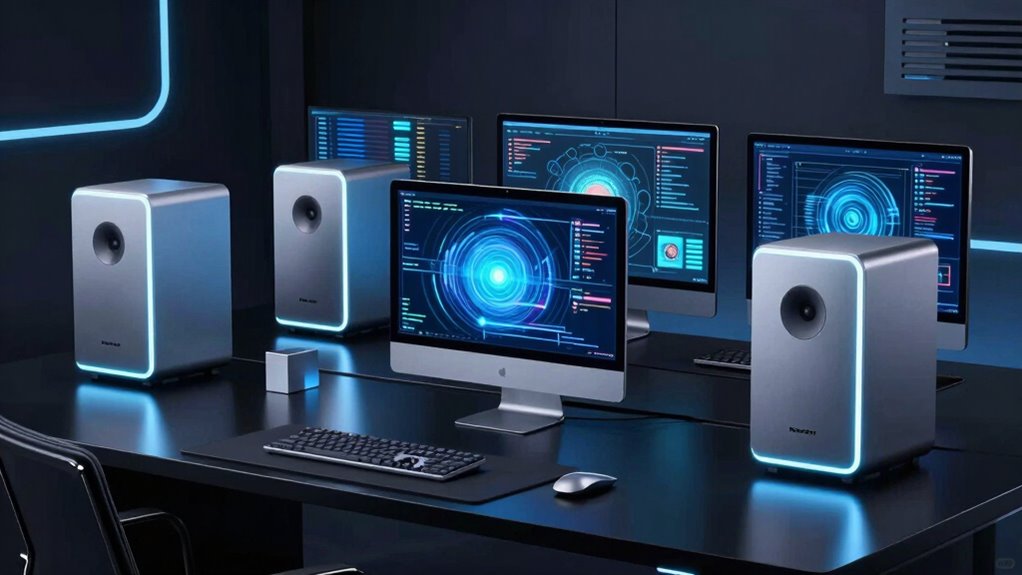

Choosing the right Mac Studio for machine learning in 2026 means balancing raw performance, memory capacity, and budget. The Apple 2024 iMac with M4 stands out for its ease of use and vibrant display, making it a solid entry point. In contrast, the Mac Studio with M4 Max offers unmatched computational power and memory, suited for demanding AI workflows. While the iMac is more accessible for less intensive tasks, the Mac Studio truly shines in high-performance machine learning environments. Here’s how these two top picks stack up, along with their main tradeoffs.

Get smart everyday buys delivered free with Prime
- Fast, free delivery on millions of items
- Prime Video, Amazon Music and more included
- Member-only deals all year
Key Takeaways
- The Mac Studio with M4 Max delivers exceptional performance with high core counts and large memory, ideal for intensive machine learning tasks.
- The 2024 iMac with M4 provides a more affordable, all-in-one experience with a stunning display, best for lighter AI workflows.
- Memory capacity is a key differentiator—128GB on the Mac Studio versus 16GB on the iMac—impacting workload scalability.
- Connectivity options favor the Mac Studio with Thunderbolt 5, while the iMac is limited to Thunderbolt 4 and Wi-Fi 6E.
- Pricing reflects performance—expect to pay a premium for the Mac Studio’s cutting-edge hardware for machine learning.
| Apple 2024 iMac All-in-One Desktop Computer with M4 Chip, 24-inch Retina Display, 16GB RAM, 256GB SSD, Blue |  | Best for Entry-Level and Creative ML Work | Processor: M4 chip with 8-core CPU and 8-core GPU | Display: 24-inch Retina, 4.5K resolution | Memory: 16GB Unified Memory | VIEW ON AMAZON | See Our Full Breakdown |
| Apple Mac Studio with M4 Max 16-Core CPU / 40-Core GPU, 128GB Unified Memory, 1TB SSD |  | Best for High-Performance Machine Learning | Processor: M4 Max 16-Core CPU / 40-Core GPU | Memory: 128GB Unified Memory | Storage: 1TB SSD | VIEW ON AMAZON | See Our Full Breakdown |
| mac studio for machine learning | Processor | Memory | Storage | Connectivity |
|---|---|---|---|---|
| Apple 2024 iMac All-in-One Des | M4 chip with 8-core CPU and 8-core GPU | 16GB Unified Memory | 256GB SSD | Wi-Fi 6E, Bluetooth 5.3, Thunderbolt 4 |
| Apple Mac Studio with M4 Max 1 | M4 Max 16-Core CPU / 40-Core GPU | 128GB Unified Memory | 1TB SSD | Thunderbolt 5 |
More Details on Our Top Picks
Apple 2024 iMac All-in-One Desktop Computer with M4 Chip, 24-inch Retina Display, 16GB RAM, 256GB SSD, Blue
The 2024 iMac with M4 chip offers a compelling mix of performance and visual quality, thanks to its 8-core CPU and GPU on the M4 chip. Its 24-inch Retina display provides high color accuracy, which is beneficial for AI projects involving visual data or UI work. Compared with the Mac Studio, the iMac’s integrated design simplifies setup and reduces clutter. However, its limited 256GB storage can be a bottleneck for large datasets, and the system’s performance might fall short for very demanding machine learning tasks. It’s an excellent choice for users beginning with AI or those working on smaller models, but professionals handling extensive data or complex models should look elsewhere.
Pros:- Powerful M4 chip ensures smooth performance for daily AI tasks
- Vibrant 24-inch Retina display with high color fidelity
- Seamless integration with Apple ecosystem
- Multiple connectivity options including Thunderbolt 4
Cons:- Limited storage capacity with only 256GB SSD
- Premium price for relatively modest hardware
- Only available in blue, limiting customization
Best for: Beginners or creative professionals who need a capable machine for light AI development and multimedia tasks
Not ideal for: Deep learning, large dataset processing, or high-end AI research
- Processor:M4 chip with 8-core CPU and 8-core GPU
- Display:24-inch Retina, 4.5K resolution
- Memory:16GB Unified Memory
- Storage:256GB SSD
- Connectivity:Wi-Fi 6E, Bluetooth 5.3, Thunderbolt 4
- Camera:12MP Center Stage
Our verdict“A solid, visually stunning machine suited for entry-level AI work and creative tasks, but not for heavy-duty machine learning.”
Apple Mac Studio with M4 Max 16-Core CPU / 40-Core GPU, 128GB Unified Memory, 1TB SSD
The Mac Studio with M4 Max sets a new bar for demanding AI workflows, featuring a 16-core CPU and 40-core GPU that deliver unmatched processing power. Its 128GB of unified memory enables handling of massive datasets and complex models without bottlenecks. Compact yet powerful, it is designed for professionals who need serious compute capacity in a desktop form factor. The inclusion of Thunderbolt 5 ensures lightning-fast data transfer, making it perfect for high-speed data pipelines. The main tradeoff is the high price and limited upgrade options after purchase—if your AI needs grow, you’re likely to need a new system. Nonetheless, for intensive machine learning, this is hard to beat.
Pros:- Exceptional performance with M4 Max CPU and GPU
- Large 128GB RAM supports multitasking and large datasets
- Fast Thunderbolt 5 connectivity accelerates data handling
- Compact design fits well in professional environments
Cons:- High price point limits accessibility
- Limited upgrade options after purchase
- Overkill for small or simple AI projects
Best for: AI researchers, data scientists, and developers working on large-scale models and complex datasets
Not ideal for: Budget-conscious users or those with less demanding workflows
- Processor:M4 Max 16-Core CPU / 40-Core GPU
- Memory:128GB Unified Memory
- Storage:1TB SSD
- Connectivity:Thunderbolt 5
- Thermal System:Advanced thermal design
- Size:Compact desktop
Our verdict“The Mac Studio with M4 Max is a powerhouse ideal for high-end machine learning tasks that demand serious hardware, though it comes at a premium price.”

How We Picked
Our selections focus on hardware configurations that best support machine learning workflows, emphasizing CPU and GPU power, memory capacity, and connectivity. We prioritize Apple products that feature Apple Silicon chips optimized for AI tasks, and we consider user needs—from developers running complex models to hobbyists experimenting with AI. We also evaluate value, considering whether the performance gains justify the price, and we compare each product’s suitability for different levels of machine learning complexity.
| mac studio for machine learning | Processor | Connectivity |
|---|---|---|
| Apple 2024 iMac All-in-One Des | M4 chip with 8-core CPU and 8-core GPU | Wi-Fi 6E, Bluetooth 5.3, Thunderbolt 4 |
| Apple Mac Studio with M4 Max 1 | M4 Max 16-Core CPU / 40-Core GPU | Thunderbolt 5 |
Factors to Consider When Choosing Mac Studio For Machine Learning
When selecting a Mac Studio for machine learning, the main considerations revolve around processing power, memory capacity, and future-proofing. Your choice depends on the scale of your projects—lighter AI tasks can get by with the iMac’s capable hardware, while large-scale model training requires the raw power of the Mac Studio with M4 Max. Budget and workspace constraints also influence the decision—an all-in-one versus a dedicated desktop. This guide breaks down these factors to help you identify the best fit for your needs.
Performance Needs
If your work involves training large neural networks or processing big datasets, prioritize systems with higher CPU and GPU core counts, like the Mac Studio with M4 Max. For lighter tasks such as data preprocessing, model testing, or AI-driven creative work, the iMac with M4 provides sufficient power at a lower cost.
Memory and Storage
Memory capacity is critical for handling large models and multitasking. The Mac Studio’s 128GB RAM dwarfs the iMac’s 16GB, making it more suitable for intensive workflows. Storage is another factor—if your datasets are large, opt for models with larger SSDs, or plan for external storage solutions.
Connectivity and Expandability
Thunderbolt 5 offers faster data transfer—crucial for working with high-resolution datasets or multiple peripherals—making the Mac Studio with M4 Max a better choice if connectivity speed matters. The iMac’s Thunderbolt 4 and Wi-Fi 6E are sufficient for most light to moderate AI tasks but limit future expandability.
Budget and Space
The iMac offers an all-in-one design that saves space and simplifies setup, making it appealing for home offices or creative studios. Conversely, the Mac Studio, while compact, commands a higher price but offers greater raw power for machine learning at scale. Budget constraints and workspace size should guide your investment decision.
Frequently Asked Questions
Is the M4 chip significantly better for machine learning than previous Apple Silicon chips?
Yes, the M4 chip introduces improvements in CPU and GPU performance over previous generations, with more cores and efficiency gains that translate into faster training and inference times for AI models. Its enhanced neural engine capabilities also boost ML-specific tasks, making it a more capable choice for machine learning workflows.
How much memory do I need for serious machine learning projects?
For large-scale AI models, 64GB or more is often considered a baseline, with 128GB or higher offering significant advantages in handling massive datasets and complex models. The Mac Studio with 128GB is well-suited for these demands, while the 16GB on the iMac restricts its use to smaller or less complex tasks.
Can the Mac Studio support multiple external GPUs or expand its hardware?
Unlike traditional desktops, the Mac Studio has limited upgrade options after purchase. It does not support external GPUs, so your hardware capacity is fixed at purchase time. This makes it crucial to select a configuration that will meet your needs for several years, especially if working with demanding AI workloads.
Is the 24-inch Retina display important for machine learning workflows?
While the display itself doesn’t directly impact ML performance, a high-quality Retina display improves visual clarity when working with data visualizations, code, and AI-generated outputs. For tasks involving visual data, color accuracy and resolution can make a noticeable difference, which favors the iMac.
What is the main tradeoff of choosing the Mac Studio with M4 Max over the iMac?
The main tradeoff is cost—while the Mac Studio offers unmatched performance and expandability for machine learning, it comes with a significantly higher price tag. The iMac provides a more integrated, space-saving solution at the expense of raw power and scalability, making it more suitable for lighter workloads or users with tighter budgets.
Conclusion
For users just starting out or working on lighter AI projects, the Apple 2024 iMac with M4 offers a balanced mix of performance, display quality, and ease of use. Meanwhile, professionals and researchers engaged in large-scale machine learning or complex data processing should lean toward the Mac Studio with M4 Max for its superior processing power and memory capacity. Your specific workload, budget, and workspace will ultimately determine the best choice.
Fall Picks
fall essentials
As an affiliate, we earn on qualifying purchases.