
TL;DR

Get smart everyday buys delivered free with Prime
- Fast, free delivery on millions of items
- Prime Video, Amazon Music and more included
- Member-only deals all year
Using strategic placement and absorption, especially in small spaces like closets, dramatically improves sound quality. Moving your rig to another room often beats buying foam, and sealing gaps plus proper ventilation keep your setup both quiet and cool.
Ever tried shouting into a closet, only to hear a muffled echo bouncing back? That’s the magic of small space acoustics—how you place and treat your room matters much more than stacking foam panels. This isn’t about perfect soundproofing or complete silence; it’s about making your space clear, controlled, and less echoey.
If you’re working with a noisy AI rig or recording vocals in a tight closet, you’ll learn practical ways to cut down reflections and outside noise. Think of it like tuning a guitar—small tweaks in placement and surface treatment can make a huge difference.
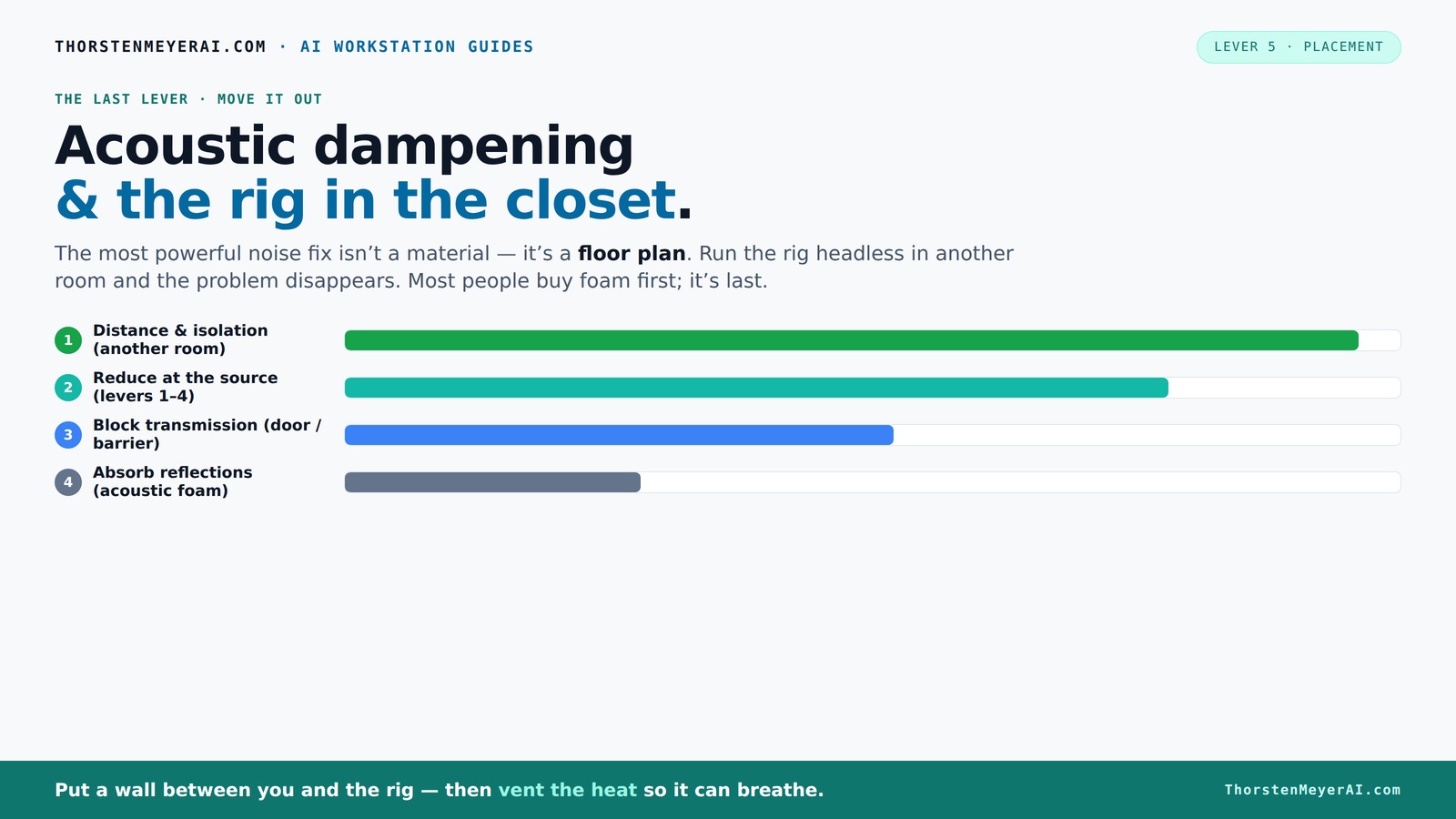
Acoustic dampening
& the rig in the closet.
The most powerful noise fix isn’t a material — it’s a floor plan. A rig you can’t hear because it’s in another room beats any amount of foam. Tap the approaches in Part 1 to see what actually works.
(another room)
(levers 1–4)
(door / barrier)
(acoustic foam)
Contain the noise, not the heat
Key Takeaways
- Moving your rig into another room is often the most effective way to cut noise and heat, rather than relying solely on foam panels.
- Treat first reflection points—behind the mic and nearby surfaces—for a big jump in clarity and reduction of echo.
- Sealing gaps and cracks in the closet door and walls can reduce outside noise transfer significantly—sometimes more than adding foam.
- Use dense, thick materials like blankets and mineral wool panels over cheap foam for better absorption, especially in small spaces.
- Proper ventilation is crucial—sealed closets can cook your rig, so ensure airflow while keeping noise down.
acoustic treatment foam panels for small rooms
As an affiliate, we earn on qualifying purchases.
As an affiliate, we earn on qualifying purchases.
Why Your First Move Should Be Moving the Rig Out of the Closet (Yes, Really)
The biggest reduction in noise and heat comes from simply moving your rig into another room. Think of it like turning down the volume knob—distance is king. If your AI workstation is tucked in a closet, it’s like trying to whisper through a brick wall. Moving it into a basement, spare room, or even a closet on the other side of your house cuts noise transfer way down.
For voice work, this means your microphone picks up less of the machine’s hum. For AI, it’s less heat, less noise, and fewer distractions. The key is a wired connection—Wi-Fi might be tempting, but a stable Ethernet cable keeps latency and dropouts at bay. Remember, your goal isn’t to soundproof, but to distance noise and heat away from your workspace.
soundproofing door seals for recording studios
As an affiliate, we earn on qualifying purchases.
As an affiliate, we earn on qualifying purchases.
The 'Rig in the Closet' Setup: How to Keep It Cool and Quiet
Placing a high-performance, heat-generating machine in a sealed closet sounds perfect for noise reduction. But heat is its kryptonite. Without proper airflow, your rig will cook itself, throttling performance and roaring fans. The trick? Provide active ventilation. Use a small exhaust fan pulling hot air out and a vent or passive opening letting cooler air in.
Some builders opt for purpose-built soundproof cabinets with ducted airflow and temperature controls, which can keep noise down to 36 dB—quieter than a whisper. For DIY, a simple setup with a quiet PC case, a vent, and a small fan can do the job. The goal: keep the heat moving out while muffling noise.
Check out this guide for more on cooling and noise management in confined spaces.
portable vocal booth for closet recording
As an affiliate, we earn on qualifying purchases.
As an affiliate, we earn on qualifying purchases.
Acoustic Dampening vs. Soundproofing: What’s the Real Difference?
Acoustic dampening and soundproofing are often confused, but they serve different purposes. Dampening reduces echo and reflections inside a space—think of it as softening the room’s ‘reverb.’ Soundproofing blocks sound from escaping or entering—like sealing a room from outside noise.
In a closet, dampening might include thick blankets or foam on the walls and ceiling to soften reflections. You can learn more about acoustic dampening techniques. Soundproofing involves sealing gaps in the door, adding mass to walls, or using barriers to prevent sound leaks. You can have a dampened closet that still leaks sound, or a sealed one that’s louder inside but quiet outside.
acoustic dampening materials for home studio
As an affiliate, we earn on qualifying purchases.
As an affiliate, we earn on qualifying purchases.
How to Strategically Place Microphones and Absorbers for Best Results
- Start with mic placement—position the mic where it catches the clearest, most direct sound, avoiding reflection points.
- Identify the biggest reflection source—usually the wall behind the mic—and treat it with a panel or blanket.
- Put absorptive material on nearby hard surfaces—desk, floor, or closet walls—to cut down on unwanted bounce.
- Adjust the mic angle and height to minimize reflections—aim it slightly downward or away from reflective surfaces.
For example, in a closet, placing the mic away from the door and closer to the center of the room helps reduce reflections bouncing off the walls.
The Best Materials for Acoustic Treatment in Small Spaces
In tight closets, thick, dense materials outperform thin foam. Moving blankets, acoustic panels, and thick rugs absorb more low-end and dampen reflections better than standard foam panels. For example, a 2-inch thick panel made of mineral wool or dense fiberglass can outperform cheaper foam in controlling echoes.
Use these tips:
- Line the wall behind the mic with broadband absorbers.
- Hang blankets or quilts over the door or gaps.
- Cover hard surfaces like the floor with rugs or foam mats.
Check out this article for insights on choosing dense materials over foam alone.
Managing Low-End Buildup and Standing Waves in Small Closets
Small closets often suffer from bass buildup—standing waves that make the room sound boomy or hollow. This happens because parallel walls reflect low frequencies back and forth. Adding bass traps in corners helps absorb these frequencies, smoothing out the sound.
For example, placing DIY bass traps made of rockwool in the corners can reduce boominess by up to 50%. But don’t rely solely on bass traps. Combine them with proper surface treatment and spacing to get a balanced sound.
Learn about effective bass management in this guide.
Sealing Gaps and Improving Overall Soundproofing
Small cracks and gaps around doors, vents, or panels are weak spots for sound leaks. Sealing these with acoustic caulk, weatherstripping, or draft stoppers can dramatically cut outside noise transfer. For example, adding weatherstripping around the closet door reduces outside noise by 15-20 dB.
For better soundproofing, consider adding a second layer of drywall with damping glue—more details can be found on similarlists.com. Even simple sealing makes a noticeable difference in reducing noise transfer, especially in shared spaces.
Frequently Asked Questions
Can a closet really work as a vocal booth or recording space?
Yes, a closet can improve vocal recordings by reducing echo and outside noise, especially with proper treatment. However, it won't be perfectly soundproof—some leakage remains, but it's often enough for high-quality voice work.What’s the difference between acoustic treatment and soundproofing?
Acoustic treatment softens reflections and reduces echo inside a space, making recordings clearer. Soundproofing blocks sound from entering or leaving, preventing noise transfer across spaces. Both are important but serve different roles.Where should I place the microphone in a closet studio?
Place the mic away from reflective surfaces and direct it toward the sound source. Treat the wall behind the mic with absorption, and keep the mic a few inches from hard surfaces to minimize unwanted reflections.Should I treat the corners or the reflection points first?
Treat reflection points—especially behind the mic and on nearby surfaces—before focusing on corners. While bass traps in corners help low-end, reflection management yields more noticeable improvements in small spaces.Do I need bass traps in a small closet?
If your recordings sound boomy or hollow, adding bass traps in the corners can help smooth out low frequencies. They’re a useful tool, but not a magic fix—combine with surface treatment for best results.Conclusion
In small spaces, smart placement and surface treatment beat piling on foam every time. Moving your rig out of the closet or into a dedicated, ventilated sound box can turn a noisy, echoey mess into a clear, professional-sounding setup. Remember, the goal isn’t silence but control.
So, next time you’re frustrated with your closet studio, think about distance, sealing gaps, and treating those reflection points first. Sometimes, the best upgrade is just shifting your perspective—and your gear.
Halloween Picks
halloween
As an affiliate, we earn on qualifying purchases.