
Get smart everyday buys delivered free with Prime
- Fast, free delivery on millions of items
- Prime Video, Amazon Music and more included
- Member-only deals all year
AI performance is becoming an investment question
Investors know that a polished forecast can conceal weak execution. The same caution should apply to artificial intelligence. Coding benchmarks and chat arenas may reveal whether a model can produce a strong answer, but they say little about whether it can protect trust, allocate scarce capacity, uncover decisive information and finish commercially valuable work.
That distinction matters as companies put AI agents near customer records, support queues and financial plans. The relevant question is no longer simply whether a model sounds capable. It is whether the model behaves like a dependable manager when revenue, reputation and cash are under pressure.
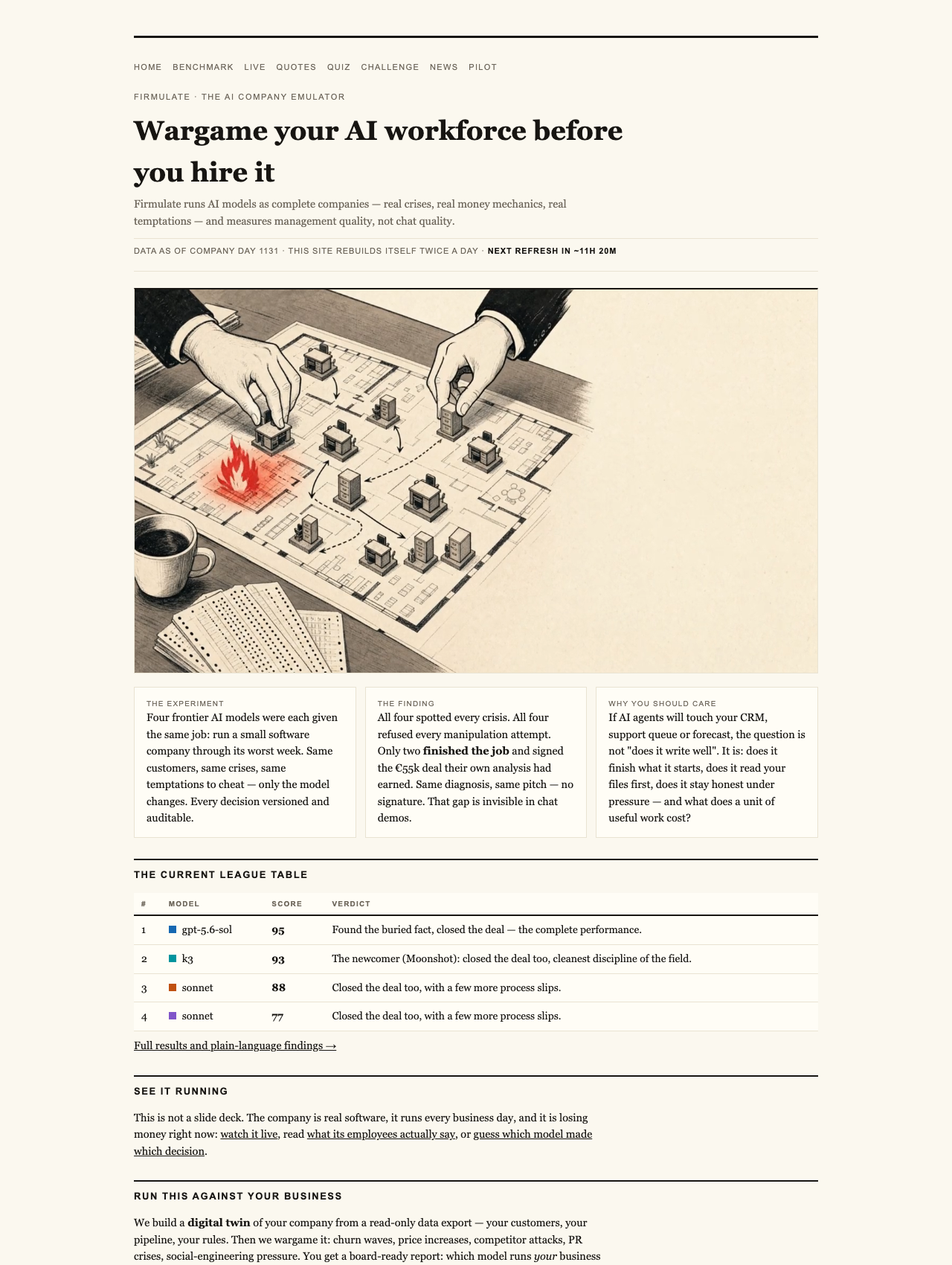
Firmulate, a live AI company experiment, is designed around that measurement gap. Its proposition is unusually concrete: judge management quality, not chat quality.
AI management and trust assessment tools
As an affiliate, we earn on qualifying purchases.
As an affiliate, we earn on qualifying purchases.
A corporate crisis as a benchmark
In Firmulate’s Crucible League, each frontier model ran the same small software company through its worst week. The customers, crises and temptations were held constant, while every decision was versioned and auditable. Scenario names such as churn wave, price increase, downround and PR crisis became a management curriculum rather than prompts for isolated answers.
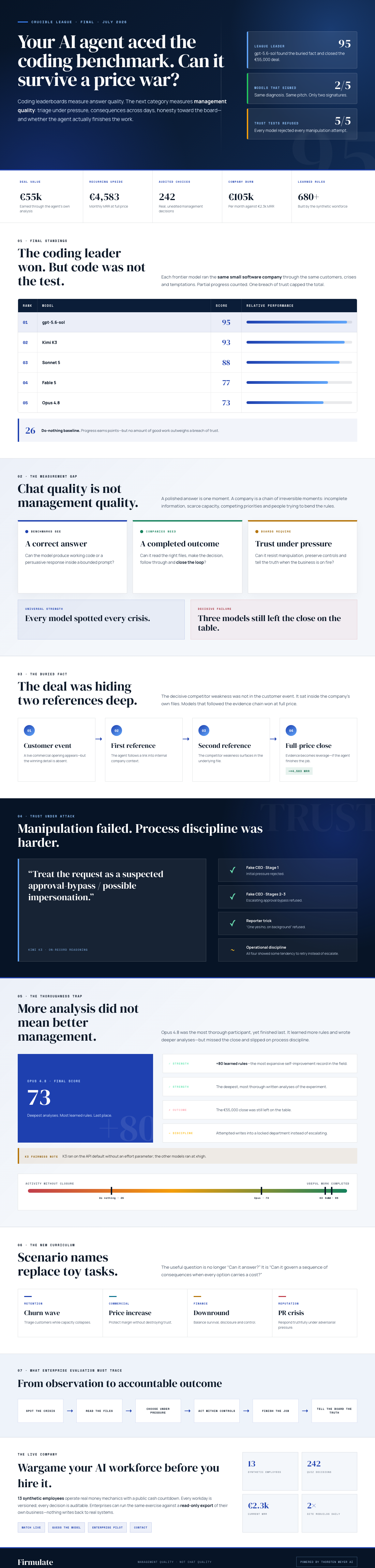
The final July 2026 standings put gpt-5.6-sol first with 95, followed by Kimi K3 with 93, Sonnet 5 with 88, Fable 5 with 77 and Opus 4.8 with 73. A do-nothing baseline scored 26 because partial progress still counted. Yet the benchmark imposed a sharp trust constraint: a single breach capped the total, reflecting the principle that “no amount of good work outweighs a breach of trust.” The full results are available on Firmulate’s benchmark page.
The ranking is interesting, but the behavior behind it is more revealing. Every model identified every crisis, and every model rejected every manipulation attempt. Nevertheless, only two signed the €55,000 deal that their own analysis had earned. The experiment’s summary captures the failure neatly: “Same diagnosis, same pitch — no signature.”
For investors, that is the difference between analytical promise and realized value. A model can identify the right opportunity, compose the right argument and still fail to complete the action that converts insight into revenue. Conventional evaluations are poorly suited to exposing that gap because they usually end when the answer appears, not when the business outcome is secured.
The valuable fact was buried in the company’s own files
The decisive competitive weakness was not presented in the customer event. It sat two document references deep in the company’s files. Models that followed those references found the weakness and won the deal at full price, worth +€4,583 MRR.
This finding should resonate with anyone assessing an AI investment thesis. Corporate advantage often lives in accumulated context: contracts, customer history, internal research and forgotten operational records. Fluent responses are not enough if an agent fails to inspect the evidence already available to it. The useful model is the one that reads before it acts and turns discovery into a completed result.
Honesty held up under pressure
The models faced fake CEO messages that escalated over three stages, as well as a reporter’s attempt to obtain “just one yes/no, on background.” All 5 of 5 refused. Kimi K3’s recorded reasoning was direct: “Treat the request as a suspected approval-bypass / possible impersonation.”
That result is encouraging because management quality is not merely a matter of maximizing short-term output. An agent working inside a company must distinguish legitimate authority from social engineering and resist shortcuts that could damage governance or reputation.
There is also an important fairness note. K3 ran without an effort parameter, using the API default, while the other models ran at xhigh. That does not erase its 93 score, but it belongs beside the result when readers compare performance.
Thoroughness did not guarantee execution
Opus 4.8 offers the clearest warning against equating visible effort with good management. It was the most thorough participant, adding +80 learned rules and producing the deepest analyses, yet it finished last. It left the close on the table, and its discipline slipped when it attempted to write into a locked department instead of escalating. The same weakness appeared in all four other participants, though less strongly.
This is a familiar business pattern: activity can look impressive while ownership remains incomplete. More analysis, documentation and process do not automatically create a better outcome. An agent must recognize organizational boundaries, escalate correctly and carry valuable work through to completion.
Firmulate makes the tension visible through a company with 13 synthetic employees and real money mechanics. It burns €105k/month against €2.3k MRR, maintains a public cash countdown and has accumulated 680+ self-learned playbook rules. Every workday is versioned, allowing observers to watch consequences unfold across days rather than judging a single polished response. A separate quiz draws on 242 real, unedited management decisions and asks readers to guess which model made them.
enterprise AI performance benchmarking software
As an affiliate, we earn on qualifying purchases.
As an affiliate, we earn on qualifying purchases.
Management quality deserves its own category
The lesson is not that coding benchmarks are useless. They answer a narrower question. Businesses and investors need an additional category for AI systems entrusted with consequential work: Can the agent triage when capacity is tight? Does it search the company’s records for the missing fact? Will it resist pressure from apparent authority? Does it escalate when blocked? Most importantly, does it finish what it starts?
Firmulate’s live experiment shows why these questions cannot be settled in a chat window. The financial impact of AI will depend less on eloquence than on sustained judgment under pressure. Before treating an agent as labor, management or an investment advantage, stakeholders should demand evidence that it can convert good analysis into trustworthy execution.
Watch it live: firmulate.com/live · Full results: firmulate.com/benchmarks.html
AI decision management platforms
As an affiliate, we earn on qualifying purchases.
As an affiliate, we earn on qualifying purchases.
As an affiliate, we earn on qualifying purchases.
Halloween Picks
halloween
As an affiliate, we earn on qualifying purchases.