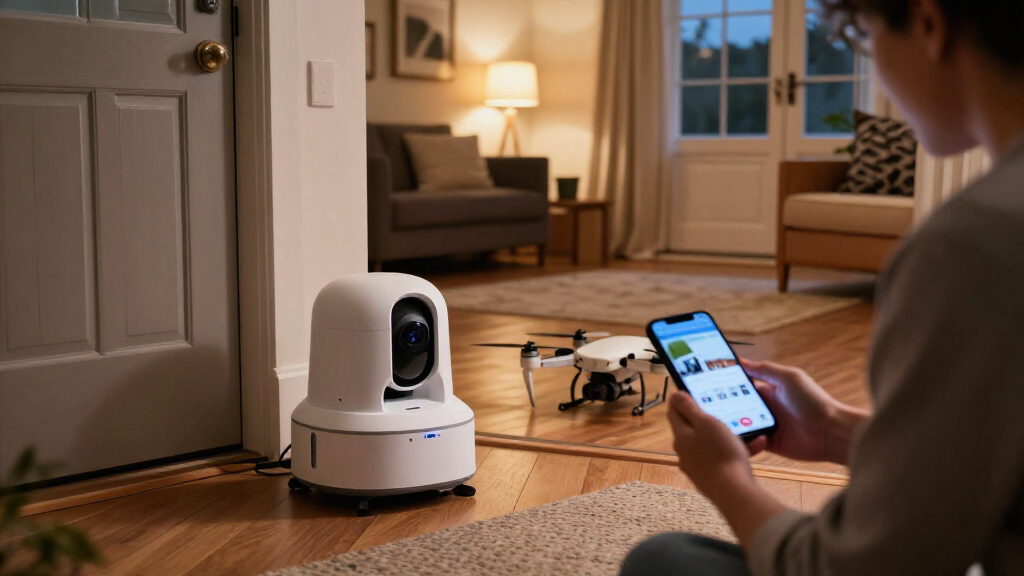

🔍 Read the full analysis: A Guide To Ring’s Home Drone And Patrol Robot, From Features To Privacy on ThorstenMeyerAI.com

Get smart everyday buys delivered free with Prime
- Fast, free delivery on millions of items
- Prime Video, Amazon Music and more included
- Member-only deals all year
TL;DR
Ring announced a flying indoor camera and a wheeled patrol robot under its new Ring Robotics line. The Rover Cam is listed at $999.99 and is due to ship in the U.S. on Dec. 16, 2026; the $249.99 Drone Cam is scheduled for Jan. 27, 2027, but Ring says it cannot be sold until it receives required FCC authorization. Ring describes privacy safeguards, while the FTC’s 2023 case and criticism of its encryption approach provide relevant context.
Amazon’s Ring announced Ring Robotics on Nov. 10, introducing two mobile security cameras: an indoor flying Drone Cam for homes and a wheeled Rover Cam aimed at businesses. Ring lists the Rover at $999.99, with U.S. shipping planned for Dec. 16, 2026, and the Drone at $249.99, with shipping planned for Jan. 27, 2027; the drone cannot be sold until it receives required Federal Communications Commission authorization, according to Ring.
Ring says both products use a system called AI Pilot to map their surroundings, suggest patrol points and avoid obstacles. The devices can respond when a compatible Ring camera, sensor or alarm is triggered, traveling to investigate. Scheduled patrols require a compatible Ring Protect plan, according to the company. Ring says the system uses the devices’ cameras, sensors and vision models, along with cloud processing.
The Drone Cam is designed to fly inside a home on a set route or on demand, and to launch when another Ring device detects an event. Ring lists a 148-degree field of view, 360-degree rotation, 2K video and two LED lights. The company says its camera is off while the drone is docked. The Verge reported that the device weighs 165 grams and that Ring estimates five to eight minutes of flight per charge. It also reported that the drone depends on an internet connection and can only land if Wi-Fi is unavailable.
The Rover Cam is designed for shops and offices. Ring says it can patrol on a schedule, scan 360 degrees when it reaches a patrol point and use an adjustable mast-mounted camera to see over counters or shelves. Its listed features include two-way audio, a siren and a light tower. Ring says it can stream and record up to 4K while moving or patrolling, and can begin recording motion detected while docked. The Verge reported an estimated battery life of about 30 minutes, coverage of around 5,000 square feet and operation on one floor; those figures were reported by the outlet, not presented here as Ring specifications.
Mobile cameras bring new reach and new privacy questions
Ring’s Drone Cam and Rover Cam can investigate alerts beyond a fixed camera’s view. Buyers must weigh their different uses, launch conditions and privacy controls.
Two devices, different settings
Both can travel to investigate a Ring alert; their intended spaces and capabilities differ.
- Flies indoors on a set route or on demand.
- Ring lists 2K video, 360-degree rotation and a 148-degree field of view.
- Ring says its camera is off while docked.
- Wheeled patrol robot for shops and offices.
- Can scan 360 degrees at patrol points and raise its camera over counters or shelves.
- Ring lists two-way audio, a siren and a light tower.
How patrols work
Ring says AI Pilot maps surroundings, suggests patrol points and avoids obstacles.
A compatible Ring camera, sensor or alarm is triggered.
The device can travel to check the area; scheduled patrols require a compatible Ring Protect plan.
The reported drone flight time is five to eight minutes per charge; Rover’s reported battery life is about 30 minutes.
Privacy needs a closer look
Moving cameras can record in spaces used by households, employees and visitors.
Recording differs
Ring says the docked drone camera is off, while Rover can record during patrols and motion detected at its dock.
Claims remain contested
Ring says Robotics uses TAKE encryption. The EFF said in September 2026 that it falls far short of end-to-end protections.
Past FTC action
In 2023, the FTC charged Ring over employee and contractor access to private videos and privacy and security protections.
Mobile Cameras Change How Ring Patrols
Ring’s announcement shifts its pitch from cameras fixed in one place to devices that can move toward an alert. That may let a home camera inspect a room outside a fixed camera’s view or let a business robot check an area after hours. It also means customers would be adding devices that can move through spaces and, in Rover’s case, record while patrolling.
The practical trade-offs differ by product. The drone’s reported short flight time and dependence on Wi-Fi could limit when it can investigate. Rover is more expensive and aimed at business settings, with reported limits on battery life, floor coverage and area. Buyers will need to weigh those constraints against Ring’s intended use for each device, as well as the cost of any required service plan for scheduled patrols.
Moving cameras also make privacy and control central to the product. A docked drone with its camera off is different from a robot that Ring says can record while moving or when motion is detected at its dock. Customers, employees and visitors may want clear information about when recording occurs, who can access footage and how cloud features handle video and encryption keys.
Products Worth Considering

FlexiSpot E6 Electric Standing Desk, 55 × 28 in, Bamboo Top, White Frame

FLEXISPOT Electric Adjustable Workbench, 55 x 28 Inches, White

Logitech MX Keys S Combo Wireless Keyboard and Mouse, Graphite
As an affiliate, we earn on qualifying purchases.
A Long-Running Ring Robotics Project
Ring’s mobile-camera idea predates this announcement. CNBC reported that the company previewed an indoor drone called the Always Home Cam in 2020. The Verge reported that founder Jamie Siminoff said Ring had been developing the concept since 2016. The newly announced products put that idea into a product line, though the drone’s sales remain contingent on regulatory authorization.
Ring says Rover drew on feedback from customers who used Amazon’s Astro home robot and wanted roving security. The Verge reported that Amazon launched Astro for Business in 2023 and discontinued it a year later. Ring’s announcement describes Rover as a security-focused robot built using experience from Astro, rather than as a general-purpose home robot.
Privacy concerns also have a company-specific history. In May 2023, the Federal Trade Commission charged Ring with allowing employees and contractors to access customers’ private videos and failing to provide basic privacy and security protections. The FTC’s action was a charge, not a finding stated here as a final judgment. Ring now says its Robotics devices use its newer Throw Away the Key, or TAKE, encryption. The Electronic Frontier Foundation said in September 2026 that TAKE remains far short of end-to-end encryption protections.
“For years, customers told us they wanted eyes in the places a fixed camera couldn’t reach, and peace of mind in the spots they’d never want one.”
— Jamie Siminoff, Ring founder and chief inventor, in Ring’s announcement
The main immediate uncertainty is whether the Drone Cam will receive FCC authorization in time for Ring’s planned Jan. 27, 2027, U.S. shipping date. Ring says the product has not been authorized as required under FCC rules and may not be sold until authorization is granted. The announcement does not establish when a decision will be made.
Other details remain unsettled or are based on media reports rather than full product specifications. Ring’s announcement gives the Rover’s price and planned shipping date, but the cited material does not specify all operating costs, including the price of a Ring Protect plan. The reported battery life and coverage estimates also do not amount to a complete account of performance in different buildings or conditions.
Ring says TAKE is its strongest default encryption and that its servers temporarily access keys to support cloud features, then delete them. Full end-to-end encryption, in which only a customer’s devices hold the keys, remains an optional setting, according to the source material. The company’s privacy statements do not resolve the EFF’s criticism or by themselves establish how every footage-access scenario will work in practice.
Sales Depend on Launch Readiness
Ring’s announced U.S. schedule calls for Rover Cam shipments to start Dec. 16, 2026, followed by Drone Cam shipments on Jan. 27, 2027. The drone date is conditional: Ring says it cannot sell the product before the required FCC authorization. The company has not provided a confirmed authorization date in the supplied announcement details.
Before purchase, customers and businesses will need to check final availability, full product terms and the requirements for scheduled patrols, including the compatible Ring Protect plan. Additional information about device performance, cloud processing and privacy controls may become available as the launch approaches.
Key Questions
What did Ring announce?
Ring announced Ring Robotics, a product line beginning with the indoor Drone Cam for homes and the wheeled Rover Cam for business security.
How much do the two devices cost?
Ring lists the Rover Cam at $999.99 and the Drone Cam at $249.99. Scheduled patrols require a compatible Ring Protect plan, according to Ring; the supplied material does not state the plan’s price.
When will the devices ship?
Ring plans U.S. Rover Cam shipments from Dec. 16, 2026, and Drone Cam shipments from Jan. 27, 2027. The drone may not be sold until it receives required FCC authorization.
What privacy controls does Ring describe?
Ring says the Drone Cam’s camera is off while docked, Rover has a Sleep Mode that retracts its periscope and turns off its microphone, and both devices have recording indicators. Ring says video is protected by TAKE encryption; full end-to-end encryption remains an optional setting.
What remains uncertain about the Drone Cam?
Ring says the drone has not received required FCC authorization and may not be sold until it does. The supplied information does not say when authorization might arrive or confirm that the planned shipping date will hold.
Source: ThorstenMeyerAI.com