📊 Full opportunity report: Best Quiet Case Fans + the Airflow Setup That Actually Works on ThorstenMeyerAI.com — validation score, market gap, and execution plan.

Get smart everyday buys delivered free with Prime
- Fast, free delivery on millions of items
- Prime Video, Amazon Music and more included
- Member-only deals all year
TL;DR
This article identifies the best quiet case fans for 2026, emphasizing larger, slower-moving fans for optimal airflow and minimal noise. It also details effective airflow setups that balance cooling and silence for high-power AI workstations.
In 2026, the leading recommendation for quiet, effective airflow in high-performance AI workstations is to use larger, slower fans—specifically 140mm models—mounted with proper airflow configurations that prioritize moving air gently through the case. This approach significantly reduces noise while maintaining optimal cooling, according to expert analysis and recent testing.
Recent testing and expert consensus highlight that larger fans, such as 140mm models, running at lower RPMs, deliver the same or better airflow as smaller fans but with substantially less noise. The Noctua NF-A14 and Arctic P14 are among the top-rated options for case intake and exhaust, offering high airflow and durability at different price points. For radiators, static-pressure fans like the Arctic P12 Pro and Noctua NF-F12 are recommended to push air through dense heatsinks and filters effectively.
Proper airflow setup involves positioning large intake fans at the front and exhaust fans at the rear or top, with a focus on creating a gentle, continuous flow of air. Using a flat, low fan curve minimizes noise further, ensuring the system remains both cool and quiet during sustained workloads. This configuration aligns with the principle that moving a lot of air slowly is more effective and quieter than small, fast-moving fans.
Best quiet case fans
+ the airflow that works.
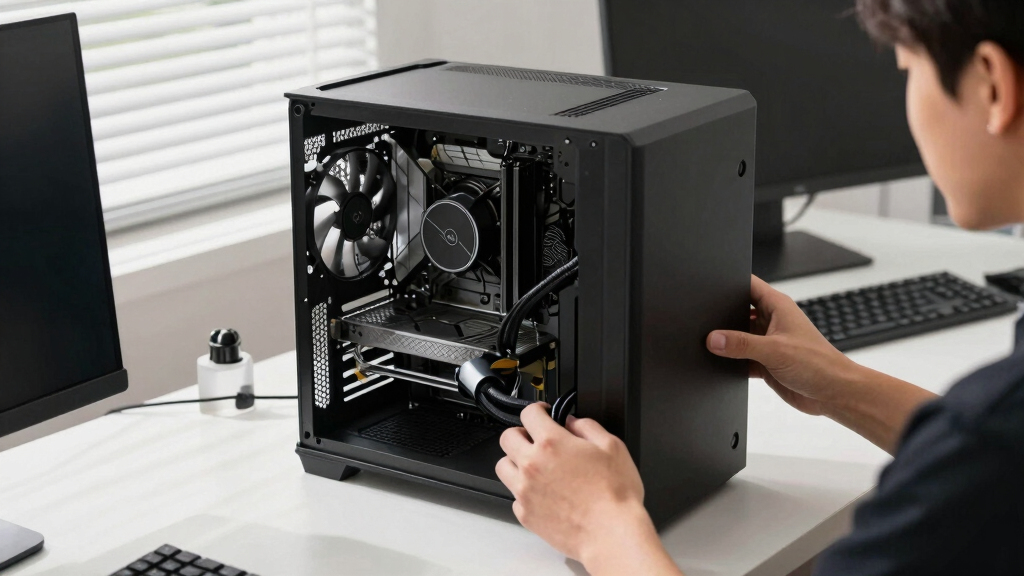
The best fan won’t help if it’s pointed the wrong way. The whole recipe: big fans, running slowly, in a clean front-to-back path, with slightly more intake than exhaust. Build a config in Part 2 and watch the pressure balance respond.
Why Quiet Fans and Proper Airflow Matter in 2026
Choosing the right fans and airflow setup is essential for maintaining high-performance AI workstations that are both cool and silent. Excessive noise can be disruptive, especially in office or shared environments, while inadequate cooling risks hardware stability. The recommended larger, slow-moving fans enable prolonged operation without noise fatigue, supporting productivity and hardware longevity.
Additionally, this approach reduces energy consumption and wear on components, making high-power setups more sustainable and cost-effective over time. For builders and professionals, implementing these proven airflow strategies ensures a balanced, reliable system that meets demanding computational needs without sacrificing quiet operation.
As an affiliate, we earn on qualifying purchases.
Advances in Quiet Fan Design and Airflow Principles in 2026
Over recent years, fan technology has improved with larger blades and refined bearings, allowing fans like the Noctua NF-A14 and Arctic P14 to operate efficiently at lower RPMs. The core principle remains that moving larger volumes of air at slower speeds results in less noise and better cooling. Industry trends favor open-blade airflow fans for case intake and static-pressure fans for radiators and filters, which has been validated through recent testing and user feedback.
Previous guides emphasized small, high-RPM fans, but new research and product development in 2026 reinforce that bigger, slower fans provide a superior balance of quietness and cooling, especially for high-performance, always-on systems like AI workstations.
"Moving large fans at low RPMs is the most effective way to keep a high-power workstation both cool and silent."
— Thorsten Meyer, AI hardware expert
As an affiliate, we earn on qualifying purchases.
Remaining Questions About Long-Term Fan Performance
While current testing supports larger, slower fans for quiet operation, long-term durability and performance consistency over years of continuous use remain areas for ongoing observation. Additionally, specific airflow configurations may vary depending on case design and hardware layout, which can influence effectiveness.
low noise cooling fans for high-performance PC
As an affiliate, we earn on qualifying purchases.
As an affiliate, we earn on qualifying purchases.
Next Steps for Building a Quiet, Efficient AI Workstation
Manufacturers are expected to release new fan models optimized for even lower noise and higher airflow efficiency. Future guides will likely incorporate user feedback and real-world testing over extended periods. Builders should monitor updates from leading fan makers and experiment with airflow configurations tailored to their specific cases and components.
static pressure case fans for radiators
As an affiliate, we earn on qualifying purchases.
As an affiliate, we earn on qualifying purchases.
Key Questions
Why are larger fans better for quiet operation?
Larger fans move the same amount of air at lower RPMs, producing less noise and vibration, which results in a quieter system overall.
Should I use static-pressure fans for radiators?
Yes, static-pressure fans are designed to push air through dense heatsinks or filters effectively, making them ideal for radiators and restrictive airflow paths.
Can I achieve both high airflow and silence with smaller fans?
While possible, smaller fans typically need to run at higher RPMs to match the airflow of larger fans, which increases noise. Larger fans at lower speeds generally provide a better balance.
What is the most important principle for quiet airflow?
Using large, slow-moving fans to move a significant volume of air gently through the case is the key to achieving both quietness and effective cooling.
Source: ThorstenMeyerAI.com
Fall Picks
fall essentials
As an affiliate, we earn on qualifying purchases.