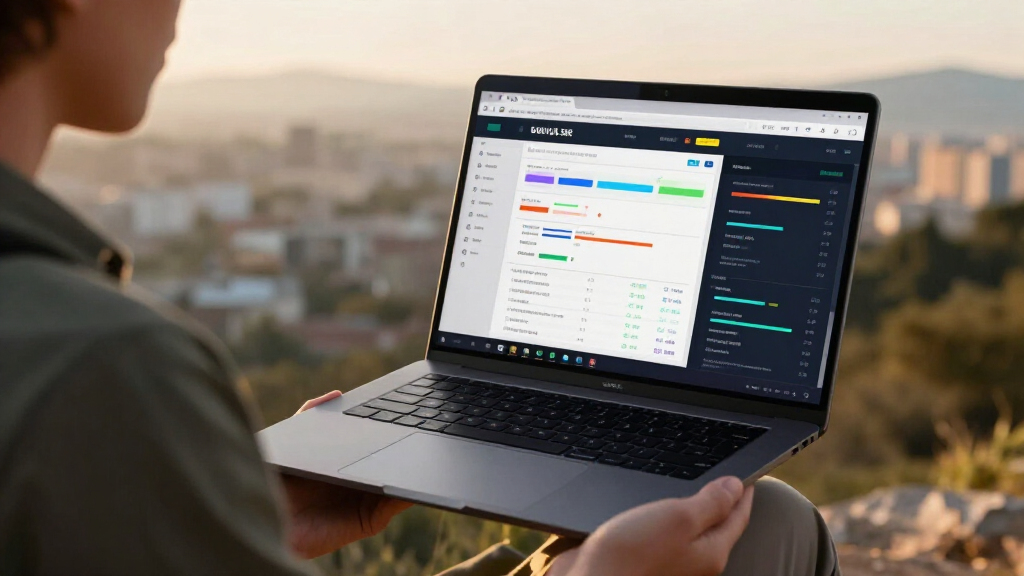

📊 Full opportunity report: Building Corvus ISR in Public, Day 1: A WAMI Exploitation Stack, Starting from Synthetic Data on ThorstenMeyerAI.com — validation score, market gap, and execution plan.

Get smart everyday buys delivered free with Prime
- Fast, free delivery on millions of items
- Prime Video, Amazon Music and more included
- Member-only deals all year
TL;DR
Corvus ISR launches publicly with a synthetic WAMI scene featuring live detection and tracking. This initial build demonstrates a browser-based exploitation pipeline, emphasizing transparency and foundational architecture.
Thorsten Meyer has publicly initiated development of Corvus ISR, a new wide-area motion imagery (WAMI) exploitation stack, with a live demonstration of a synthetic scene featuring detection and tracking. This marks the first day of a transparent build process aimed at addressing the exploitation gap in WAMI sensors, which produce vast data volumes that current systems struggle to analyze efficiently.
The project begins with a fully synthetic WAMI scene, generated procedurally to avoid legal and privacy issues associated with real surveillance data. The scene includes a simulated road network with hundreds of moving vehicles, and the system performs live detection, tracking, and indexing of moving objects directly in the browser.
This initial artifact is deliberately minimal, focusing on geometric detection without deep learning, to demonstrate the core pipeline: scene, sensor, detector, tracker, and ground truth all interact in real time. The approach emphasizes building a robust exploitation architecture before integrating advanced models or real data.
Thorsten Meyer emphasizes that this is a foundational step, with plans to extend the pipeline, improve detection accuracy, and eventually incorporate real-world data, but the current focus is on transparency, architecture validation, and early proof of concept.
CORVUS ISR · synthetic WAMI scene — live detect & track
BUILD IN PUBLIC · DAY 1 ARTIFACTImplications for WAMI Data Exploitation
This development is significant because it demonstrates the feasibility of public, browser-based exploitation tools for WAMI imagery, a sensor class traditionally controlled by government agencies with limited software transparency. By starting with synthetic data, the project sidesteps legal and privacy constraints, enabling open innovation and benchmarking.
It highlights a potential shift towards more democratized and customizable exploitation software, especially for European buyers concerned about dependency on US-controlled systems. The approach could lower the cost and complexity of deploying effective WAMI analysis, broadening access for smaller operators and agencies.
Furthermore, this build-in-public strategy aims to accelerate development, foster community feedback, and establish a clear architecture foundation before tackling real-world data challenges.
Products Worth Considering

Dell UltraSharp 32 U3226QER 4K Thunderbolt Hub Monitor

Apple Mac mini Desktop Computer with M5 Pro Chip (2026)

Dell XPS 13 9350 AI Professional Laptop 13.4 120Hz FHD+ Display
As an affiliate, we earn on qualifying purchases.
Background on WAMI and Exploitation Challenges
Wide-area motion imagery (WAMI) sensors produce gigapixel-scale video streams covering entire urban areas, capturing every vehicle and moving object over tens of square kilometers. The data volumes generated are immense, and current exploitation methods rely heavily on post-mission analysis by human analysts, creating a significant bottleneck.
Despite proliferation of WAMI platforms on drones, aerostats, and manned aircraft, software for real-time detection and tracking remains largely proprietary and closed, especially in the US. European markets are increasingly seeking independent, transparent solutions due to concerns over data sovereignty and reliance on US-based analysis systems.
Prior efforts have focused on developing ML-based detectors, but access to real data for training and benchmarking remains limited, especially under legal restrictions. Synthetic data offers a promising pathway to develop and test exploitation pipelines without these constraints, as demonstrated by Meyer’s project.
This first public build aims to validate the core architecture and establish a baseline for future enhancements, including integration with real data.
“This is the first step in building a transparent, flexible exploitation stack that can operate independently of proprietary, closed systems.”
— Thorsten Meyer
Unconfirmed Aspects of Real-World Deployment
It remains unclear how well the synthetic-based pipeline will transfer to real WAMI data, which involves complex noise, occlusion, and sensor artifacts not yet modeled. The effectiveness of the system in operational environments and its ability to scale with higher scene complexity are still to be demonstrated in future phases.
Additionally, the timeline for transitioning from synthetic prototypes to real data testing and the integration of advanced ML models remains uncertain, as does the response from potential users regarding deployment in sensitive jurisdictions.
Upcoming Development Milestones for Corvus ISR
Following this initial build, the developer plans to enhance the detection and tracking algorithms, incorporate more complex scene scenarios, and begin testing with real WAMI datasets. The next steps include expanding the synthetic environment’s realism, optimizing performance, and soliciting feedback from early users.
Further milestones involve deploying the system in controlled operational simulations, integrating with existing analysis workflows, and exploring deployment options for both sovereign and governed editions, tailored to different jurisdictional requirements.
Key Questions
What is Corvus ISR?
Corvus ISR is a wide-area motion imagery exploitation stack designed to detect, track, and index moving objects in large-scale scenes, with a focus on transparency and control for European and other non-US users.
Why start with synthetic data?
Synthetic data allows safe, legal, and cost-effective development without privacy or export restrictions, providing perfect ground truth for benchmarking detection and tracking algorithms.
Will this system work on real WAMI data?
That remains to be proven. The current focus is on validating architecture and detection pipelines with synthetic scenes before transitioning to real-world data, which involves additional noise and complexity.
What are the benefits for European buyers?
This approach offers a potentially independent, customizable, and compliant exploitation solution that reduces reliance on US-controlled software, aligning with data sovereignty concerns.
When can we expect real data testing?
There is no fixed timeline yet, but future development milestones aim to include real WAMI data integration after initial synthetic validation and system optimization.
Source: ThorstenMeyerAI.com