

🔍 Read the full analysis: 10 Best Mesh Wi-Fi Systems For Whole-Home Internet Coverage In 2027 on ThorstenMeyerAI.com

Get smart everyday buys delivered free with Prime
- Fast, free delivery on millions of items
- Prime Video, Amazon Music and more included
- Member-only deals all year
TL;DR
The source ranks 10 mesh Wi-Fi systems by their fit for different homes, with the TP-Link Deco X55 as its practical general-purpose pick. The recommendations are buyer guidance, not a new product test or a guarantee of coverage; prices, measured performance and 2027 availability are not provided.
A buyer’s guide to 10 mesh Wi-Fi systems, as detailed in the original analysis, names the TP-Link Deco X55 its most balanced starting point, citing its Wi-Fi 6 platform and three-node kit. The recommendations span older dual-band models to Wi-Fi 7 systems, but the guide says coverage depends on home layout, node placement and backhaul—not just the advertised wireless standard.
The guide places the Deco X55 ahead of the other options for broad, practical use, a consideration shared by other recommended mesh Wi-Fi systems. It describes the Deco XE75 as a stronger match for buyers seeking a dedicated 6 GHz band, and the Orbi 770 as a more capable Wi-Fi 7 option. The source gives no benchmark results, prices or controlled testing data, so these are editorial rankings rather than independently demonstrated performance findings.
The other systems named are the Deco 7 Pro, Deco 7 BE5000, Deco S4 and Eero 6+. The guide also refers to 10 options but does not identify all 10 products in the supplied material. It characterizes the Deco 7 Pro and Orbi 770 as performance-focused, the Deco 7 BE5000 as a simpler dual-band Wi-Fi 7 entry point, the older Wi-Fi 5 Deco S4 as a modest-needs option, and Eero 6+ as geared toward guided setup.
Its comparison criteria include Wi-Fi generation, band configuration, backhaul, kit size and management. The guide cautions that extra wireless capacity may help when mesh nodes communicate without Ethernet, while wired backhaul can change that calculation, especially in large homes using tri-band mesh Wi-Fi. A larger kit is not automatically better: two nodes may suit a compact home, while walls, floors and awkward layouts can call for different placement or additional nodes.
The 10 picks
- 1
 NETGEAR Orbi 770 Series WiFi 7 Mesh System, 3-PackView on Amazon →
- 2
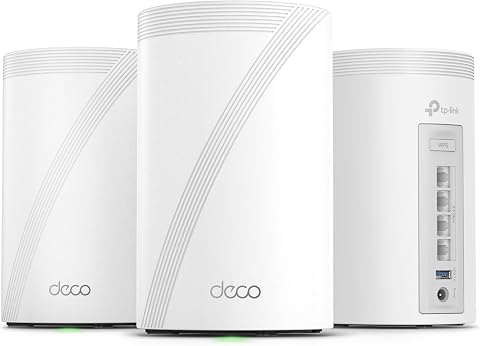 TP-Link Deco 7 Pro BE10000 Tri-Band Wi-Fi 7 Whole-Home Mesh System, 3-PackView on Amazon →
- 3
 Amazon eero 6+ Wi-Fi 6 Mesh System, 3-PackView on Amazon →
- 4
 NETGEAR Orbi 370 Series WiFi 7 Mesh System for Home (RBE373) – Wireless Route…View on Amazon →
- 5
 TP-Link Deco 7 BE5000 Dual-Band Wi-Fi 7 Mesh SystemView on Amazon →
- 6
 TP-Link Deco XE75 AXE5400 Tri-Band Wi-Fi 6E Mesh System, 3-PackView on Amazon →
- 7
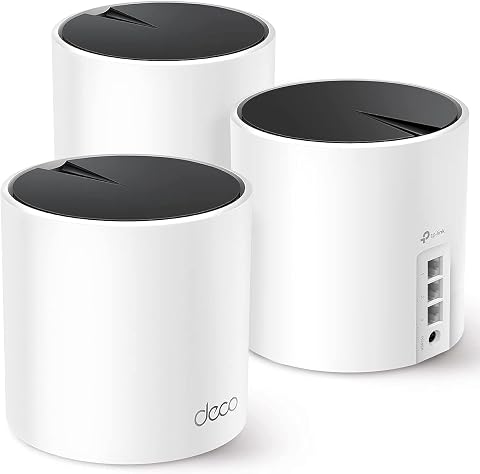 TP-Link Deco X55 AX3000 Wi-Fi 6 Mesh System, 3-PackView on Amazon →
- 8
 TP-Link Deco S4 AC1900 Mesh Wi-Fi System, 3-PackView on Amazon →
- 9
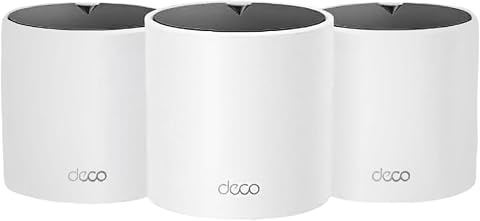 TP-Link Deco X15 AX1500 Dual-Band Wi-Fi 6 Mesh System, 3-PackView on Amazon →
- 10
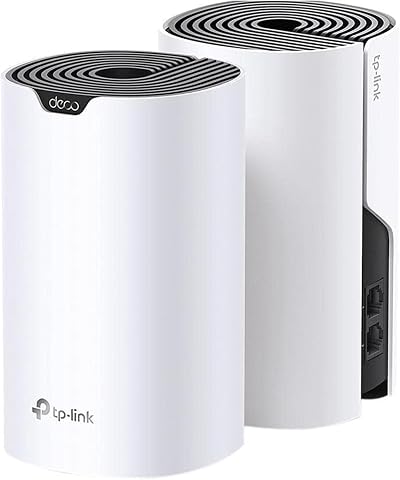 TP-Link Deco S4 Whole Home Mesh WiFi System (2-Pack)View on Amazon →
Choosing Capacity That Fits the Home
The recommendations matter because a mesh upgrade can address dead zones, but buying the newest or most expensive system does not guarantee a stronger connection. The source’s central point is that households should match system capacity to their devices, broadband plan and layout. A Wi-Fi 7 kit may be unnecessary if most devices use older standards or the internet plan is the limiting factor.
Backhaul is another practical consideration. Mesh satellites relay traffic to the main unit, and a weak wireless link between nodes can constrain the network even when the router has a high headline capacity. Node placement and Ethernet availability may have more effect on a particular home than choosing a newer generation. The guide frames its picks as starting points for comparing tradeoffs, not universal solutions.
Products Worth Considering

Samsung Odyssey G4 25-inch FHD Gaming Monitor

Apple MacBook Air 13-inch with M5 chip, 16GB memory, 1TB SSD, and 12MP Center Stage camera (Midnight)

Apple Mac mini Desktop Computer with M4 chip, 10‑core CPU and GPU, 24GB Unified Memory, 512GB SSD, Gigabit Ethernet
As an affiliate, we earn on qualifying purchases.
How the Guide Compares Mesh Kits
The source says it prioritizes everyday considerations over the newest standard alone: generation, bands, wireless backhaul potential, kit size and setup. It treats coverage figures as planning estimates because walls, floors, interference and placement can change results. That method helps explain why the guide ranks a Wi-Fi 6 three-pack above some newer systems for general use while reserving tri-band and Wi-Fi 7 recommendations for households that can benefit from them.
It also distinguishes a two-pack from a three-pack by likely use, rather than presenting node count as a direct measure of quality. The Deco S4 two-pack is presented as a possible fit for smaller homes, while three-node kits can provide more placement flexibility. The supplied source does not include product specifications for every ranked system or identify the remaining options, limiting how fully readers can reproduce the comparison.
“The Deco X55 is the most balanced starting point.”
— ThorstenMeyerAI.com guide
Missing Models and Test Details
The supplied material promises 10 distinct picks but names only seven: Deco X55, Deco XE75, Orbi 770, Deco 7 Pro, Deco 7 BE5000, Deco S4 and Eero 6+. It does not identify the other three systems, provide a complete ordered list, or explain their individual strengths and drawbacks. Those gaps mean the full ten-product comparison cannot be verified from the source text provided.
The source also gives no publication date, prices, hands-on test methodology, measured speeds, coverage results or information about product availability in 2027. Its descriptions should be read as editorial claims and buying guidance, not as proof that one system will outperform another in a specific home. The exact benefits of a band or feature depend on supported devices and network conditions.
Check Availability Before Buying
Readers comparing these systems should confirm current pricing, included node count, supported features and availability with the manufacturer or retailer before purchasing. They should also check which devices support the standard in question, map likely node locations and determine whether Ethernet backhaul is feasible. The source does not announce a follow-up test or provide a date for additional product details.
For a decision grounded in the home’s actual needs, compare the full product specifications and independent testing once available, then match the kit to the layout and broadband service. A mesh system can improve local wireless coverage, but it cannot raise the speed of a slow internet connection.
Key Questions
Which mesh system does the guide rank highest?
The guide names the TP-Link Deco X55 its most balanced starting point, citing Wi-Fi 6 and a three-node kit. That is the source’s editorial judgment, not a guarantee of best performance in every home.
Does buying Wi-Fi 7 guarantee better coverage?
No. The source says a newer standard does not automatically fix weak placement or a slow broadband plan. Results also depend on device support, walls, interference and the link between mesh nodes.
When might a tri-band system be useful?
The guide says an extra band may help with wireless backhaul traffic, particularly when nodes connect wirelessly. The benefit depends on system design and conditions; Ethernet backhaul may change whether the extra band is valuable.
Does the source identify all 10 recommended systems?
No. The supplied material names seven distinct systems while referring to a 10-option list. The other three models and the complete ranking are not included in the source text provided.
Source: ThorstenMeyerAI.com