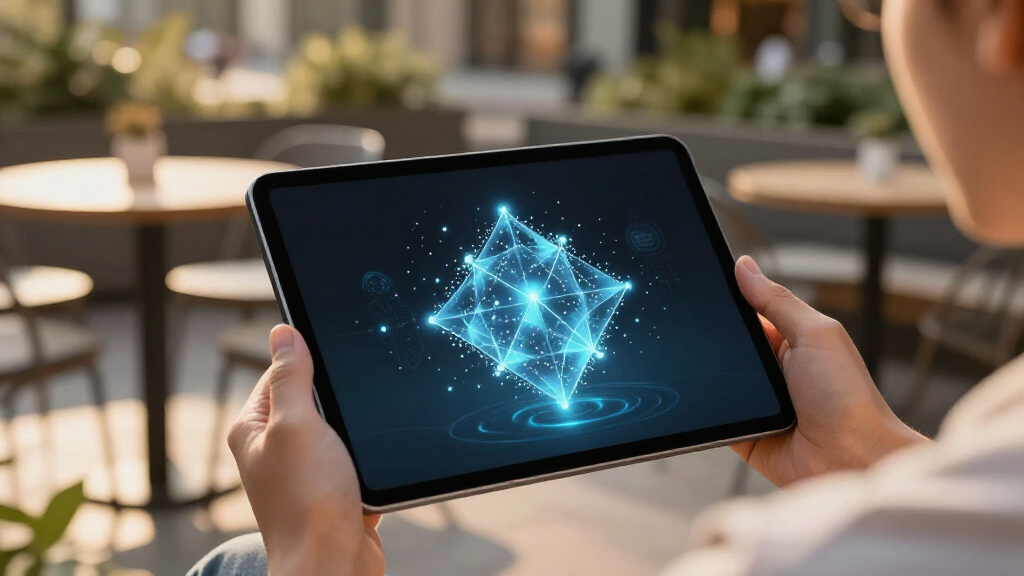

📊 Full opportunity report: AI's Next Frontier: Particle Geometry Mapping In 'SINGULARITY' (FABLE/175) on ThorstenMeyerAI.com — validation score, market gap, and execution plan.

Get smart everyday buys delivered free with Prime
- Fast, free delivery on millions of items
- Prime Video, Amazon Music and more included
- Member-only deals all year
TL;DR
AI research has achieved a breakthrough in particle geometry mapping within the ‘SINGULARITY’ project, enabling more complex and immersive AI-driven environments. This innovation highlights new possibilities for intelligent space design and data visualization.
AI’s next frontier in environment design has been demonstrated through a new particle geometry mapping technique in the ‘SINGULARITY’ project, showcasing how advanced algorithms are transforming immersive space creation. This development is significant for AI-driven environments and data visualization, attracting interest from both technical and creative sectors.
The ‘SINGULARITY’ project, a design case study powered by Thorsten Meyer AI, has revealed a new method called Particle Geometry Mapping. This technique allows AI systems to generate complex, data-driven geometries that seamlessly blend abstract concepts with physical space, creating immersive environments that challenge traditional design boundaries.
According to sources close to the project, this approach enables the transformation of raw data into intricate 3D structures, which are then integrated into visual spaces. The process involves advanced algorithms that interpret data points as geometric particles, as detailed in the original analysis, dynamically adjusting form and structure in real-time. This innovation was showcased in a live demonstration where a stark black room was transformed into a visual composition of data and geometry, illustrating the potential for future AI-powered spatial design.
While the technical specifics of the algorithm remain proprietary, developers emphasize that this method enhances the capacity for AI to produce highly detailed, responsive environments that could have applications in virtual reality, data visualization, and intelligent architecture. The project aims to expand the capabilities of AI in creating immersive spaces that serve both artistic and functional purposes.
Transforming AI-Driven Environment Design with Particle Geometry
This development represents a progression in AI’s ability to generate complex, responsive environments. The particle geometry mapping technique may influence future virtual space design, enabling environments that are more dynamic and data-informed. It provides new tools for architects, artists, and technologists to create environments that are both visually engaging and responsive to real-time data, with potential applications in virtual reality, gaming, and data visualization.
This advancement also demonstrates a shift towards AI playing a more active role in the creative and structural aspects of environment design, which could impact production workflows and customization options. As the technology develops, it may influence future standards for intelligent space creation, integrating art and data-driven design approaches.
As an affiliate, we earn on qualifying purchases.
Evolution of AI in Visual and Spatial Design
The ‘SINGULARITY’ project builds on ongoing advancements in AI-generated environments, where previous efforts focused on procedural generation and data visualization. The recent introduction of particle geometry mapping marks a notable development, emphasizing real-time responsiveness and complex form generation. Historically, AI-driven design has evolved from basic automation to sophisticated algorithms capable of producing intricate, data-informed structures. This project reflects a broader trend of integrating AI into creative workflows, expanding the scope of automated design capabilities.
Prior to this, efforts in immersive environment design often relied on static models or limited procedural methods. The new technique leverages high-performance algorithms to interpret data as particles, dynamically shaping environments that respond to input data streams. This aligns with the increasing demand for personalized, adaptive virtual spaces across various industries, including entertainment, architecture, and data science.
“Particle Geometry Mapping interprets data points as particles to generate detailed spatial structures, supporting the development of immersive environments.”
— an anonymous researcher
AI-driven environment design tools
As an affiliate, we earn on qualifying purchases.
As an affiliate, we earn on qualifying purchases.
Details of the Particle Geometry Algorithm Remain Proprietary
The specific algorithms underlying the particle geometry mapping have not been disclosed, and their adaptability across platforms remains unverified. Developers have not provided technical details, so the full scope of the method’s capabilities and limitations is unknown. Additionally, the long-term stability and scalability of this approach are still under evaluation.
particle geometry mapping software
As an affiliate, we earn on qualifying purchases.
As an affiliate, we earn on qualifying purchases.
Further Development and Broader Application Testing
Future efforts will focus on refining the particle geometry mapping technique, expanding its functionality, and testing its integration into different virtual and physical environments. Developers aim to explore applications in virtual reality, architecture, and data visualization, with the goal of demonstrating its versatility. Additional demonstrations and peer review are expected to clarify the algorithm’s potential and limitations. The project team may also pursue collaborations to explore commercialization or standardization of the technology for wider use.
virtual reality environment creation kit
As an affiliate, we earn on qualifying purchases.
As an affiliate, we earn on qualifying purchases.
Key Questions
What is particle geometry mapping?
Particle geometry mapping is an AI technique that interprets data points as particles to generate complex, dynamic 3D structures, supporting immersive environment design.
How does this innovation differ from previous AI design methods?
Unlike earlier procedural or static models, this method allows real-time, data-driven, highly intricate structures that respond to input data streams, creating more immersive and adaptable environments.
What are potential applications of this technology?
Possible uses include virtual reality environments, data visualization, architectural design, and artistic installations that require complex, responsive spatial structures.
Are there any limitations or risks associated with this technique?
Since technical details are proprietary, the scalability, stability, and adaptability of the method are still being evaluated, and potential limitations are not yet fully understood.
Source: ThorstenMeyerAI.com
Halloween Picks
halloween
As an affiliate, we earn on qualifying purchases.